Brain Injury – special reader contribution

A reader “J.S.” asked to do a guest post — something that I am very fine with. CFS/ME often can be accurately described as  infection caused brain injury for many patients. I usually avoid the term trauma — because it implies someone being hit over the head with a physical bat.

Coping With Brain Trauma: Understanding The Long-Term Effects

Nearly 1.7milion traumatic brain injuries occur in the United States every year, according to CDC. TBI is the leading cause of death and disability, resulting in 1.5 times more deaths than AIDS. Yet, no head injury case is alike. Traumatic brain injury is the leading cause of disability in adults under forty.

Head injuries are worrisome for a number of reasons as they can lead to brain damage but also learn to devastating long-term effects. However, it is important to highlight that there are no “typical” effects of TBI but rather require an understanding of how to cope.

Long-term effects of brain injury

Depending on the severity and location of the brain affected, the consequences will vary. Survivors can be affected in a variety of issues, including:

  • Cognitive Impact – This may include short-term memory loss, poor motivation, impaired reasoning, slowed responses, and difficulty in problem-solving abilities.
  • Physical Changes – Excessive tiredness and fatigue as a common effect for most individuals who sustain brain trauma, including minor accidents. This can lead to reduced balance, coordination, sensory and mobility perceptions. Thus, the individual may need to rely on aids for mobility to walk.
  • Behavioral Effects – The individual’s personality can change after sustaining a head trauma. They will experience sudden emotional outburst and mood swings. In fact, depression, frustration, and anxiety are also quite common and might become difficult to control.

Managing fatigue after brain trauma

In the general population, fatigue is involved with 10% of incidences. But for people with TBI, it is one of the most common complains post-trauma. Consider how a car needs gas to run properly. If your tank is low, your car will start running down, reaching the end of your fuel reserve. This works the same way with fatigue after a traumatic brain injury. Chronic fatigue is caused by a decrease in physiological reserve. When the brain is low on energy, your body becomes exhausted.

Understanding sensory impairment

After a head injury, individuals may feel a loss, reduction, or exaggerated sense of touch. This can also be difficult for those with odd postures in addition to poor eyesight and the sense of smell. If the person has lost the sensation of smell or taste, they might find food unappetizing. Instead, try to present meals that look appealing.

Difficulty with speech

Rapid, slow, or indistinct speech is highly common after a brain injury. It can be hard to understand their initial speech, but listeners will slowly learn to “tune in” instinctively. While some may lose the ability to speak, it is important to remember that their disability does not mean that they have lost their intelligence. If you cannot understand their gestures, ask to repeat the statement or rephrase in another way.

Coping in the longer term is a journey – for the survivor and their loved ones. Constant monitoring is vital as you may end up missing the small, yet vital feats which are the true marks of progress.

Ken’s Notes on Microbiome Changes

There have been a few more studies since my last post in this area.

  • “Experimental stroke altered the composition of caecal microbiota, with specific changes in Peptococcaceae and Prevotellaceae  correlating with the extent of injury” [2016]
  • ” Here we show that antibiotic-induced alterations in the intestinal flora reduce ischemic brain injury in mice, an effect transmissible by fecal transplants.” [2016]
  • Microbiota Dysbiosis Controls the Neuroinflammatory Response after Stroke.[2016]
    • “Reduced species diversity and bacterial overgrowth of bacteroidetes were identified as hallmarks of poststroke dysbiosis, which was associated with intestinal barrier dysfunction and reduced intestinal motility as determined by in vivo intestinal bolus tracking. “
  • Clostridium butyricum attenuates cerebral ischemia/reperfusion injury in diabetic mice via modulation of gut microbiota [2016].
  • Clostridium butyricum exerts a neuroprotective effect in a mouse model of traumatic brain injuryvia the gut-brain axis. [2018]
  • Moderate Traumatic Brain Injury Alters the Gastrointestinal Microbiome in a Time-Dependent Manner.[2018]
  • “In regards to traumatic injury, Hayakawa and colleagues found that the intestinal microbiota becomes fundamentally disrupted within hours of injury and sudden physiologic insult including cardiac arrest and stroke [49]. Similarly, a recent study in severely injured patients demonstrated significant changes in phylogenetic composition and relative abundance in the first 72 h following injury [50]. Critically ill patients admitted with the systemic inflammatory response (SIRS), including those with traumatic injury, have also been shown to have alterations in the gut microbiome, and these disturbances are predictive of sepsis-associated mortality in their patient population. Another instance of surgical injury altering the gut microbiome was described by Shogan et al., in their study revealing that intestinal anastomotic injury can provoke changes in the gut microbiome [51]. Furthermore, amongst critically ill patients with a prolonged hospitalization, the composition of the gut microbiome dramatically changes such that pathogen communities of extremely low diversity emerge and trigger further virulence in the host [52]. Similarly, critical illness can also cause a shift in the microbiome in such a way that dysbiosis occurs in which beneficial microbes are lost and pathogenic bacteria begin to monopolize the gut [53].” [2018]

Bottom Line

There are two aspects of treatment:

  • reducing stress on the person with brain injury
  • altering the microbiome — one probiotic appears to be effective in improving brain injury, see this post on Clostridium butyricum


A reader report — 100% elimination of symptoms

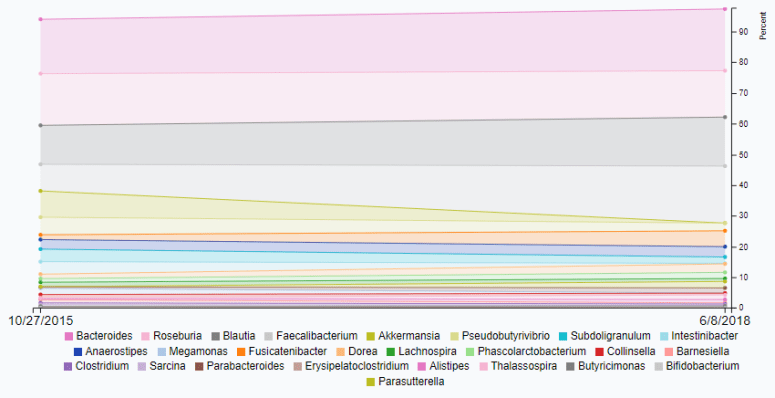
A reader wrote: “I did a followup uBiome tests (5 site explorer) to compare to my 2015 gut test (from when my CFS was super bad). Diversity scores on skin and other tests seem very low since I’m on chronic doxycycline and minocycline but I’m feeling great!

“I  believe I did mark symptoms on my 2015 gut sample in your system.

The after is basically all of those things being gone and being in a long-term remission.”
The approach this reader tookis the Rickettsia/Jadin approach, covered in this earlier this month post. An approach with > 85% remission rate.

Symptoms that disappeared

    • Autonomic Manifestations: light-headedness
    • Autonomic Manifestations: Postural orthostatic tachycardia syndrome (POTS)
    • Comorbid: Multiple Chemical Sensitivity
    • General: Fatigue
    • Immune Manifestations: general malaise
    • Immune Manifestations: new food sensitivities
    • Immune Manifestations: recurrent sore throat
    • Immune Manifestations: tender lymph nodes
    • Neurocognitive: Slowness of thought
    • Neuroendocrine Manifestations: abnormal appetite
    • Neuroendocrine Manifestations: intolerance of extremes of heat and cold
    • Neuroendocrine Manifestations: sweating episodes
    • Neuroendocrine Manifestations: Excessive adrenaline
    • Neuroendocrine Manifestations: Rapid muscular fatiguability
    • Neuroendocrine Manifestations: worsening of symptoms with stress.
    • Neurological – Vision: inability to focus eye/vision
    • Neurological-Audio: hypersensitivity to noise
    • Neurological-Sleep: Chaotic diurnal sleep rhythms (Irratic Sleep)
    • Neurological-Sleep: Insomnia
    • Neurological-Sleep: Sleep Reversal
    • Neurological: Impairment of concentration
    • Neurological: emotional overload
    • Neurological: Executive Decision Making (Difficulty making)
    • Neurological: Short-term memory issues
    • Neurological: Slowed speech
    • Neurological: Word-finding problems
    • Onset: less than 02 years since onset
    • Post-exertional malaise: General
    • Post-exertional malaise: Inappropriate loss of physical and mental stamina,
    • Post-exertional malaise: Rapid cognitive fatigability,
    • Post-exertional malaise: Rapid muscular fatigability,
    • Sleep: Unrefreshed sleep


End Products Shifts

Scanning through the various comparison for the earlier and later samples, items of note:
  • Serotonin production went up almost four fold
  • Amount of bile End Product being produced almost doubled
  • Biogenic amines doubled
  • D-Galactose dropped
  • Fucose dropped
  • Histamine dropped
  • Propionate dropped

Taxonomy Changes

  • Phylum
    • Verrucomicrobia normalized
    • Synergistetes normalized
    • Proteobacteria normalized

Visuals for each level of the hierarchy are below.

L1

L2

L3

L4

Bottom Line

Needless to say, I am happy about reading the changes and the reader willingness to share their results.

On the plus side for this reader:

  • Ability to get continuous antibiotics
  • First sample was done less than 2 years after onset (dysbiosis was likely not strongly established)
  • Verrucomicrobia seems to be a key player for this person (may not apply to others)

On a note: I would be tempted to take breaks between courses of antibiotics, very slowly increasing the length of the break.


Product Review: Alflorex (UK market) – aka ALIGN

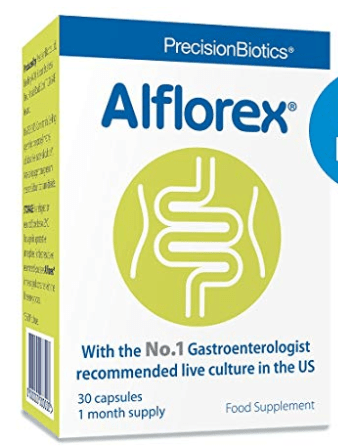
A reader asked me to review this new probiotic. It has some “compelling marketing” — which likely raised flags of concerns to the reader. (Amazon UK Link)

Alf

Analysis

Obtuse labeling:  bacterial culture 35624 — What the Taxonomy is this bacteria!!!!

Exploring on their site we see it is “Bifidobacterium 35624 ” with the claim:

“The 35624 culture in Alflorex has been shown in 2 clinical trials and in scientific publications to remain active right through the digestive system and to reach the bowel with its properties intact.”

With some digging, we find that it is Align (Bifidobacterium longum subsp. longum 35624™)  i.e. “Bifibobacterium longum subsp. longum 35624™ strain (formerly named Bifidobacterium longum subsp. infantis)” [2016]

End Products

So we know it’s end products are:

  • ?-Amino butyric acid (GABA)
  • Biotin (Vitamin B7)
  • Folate (Vitamin B9)
  • Lactic acid
  • L-Tryptophan
  • Pyridoxine
  • Thiamine (Vitamin B1)
  • Urolithins

Pub Med Studies

  • “Additionally, the treatment with Bifidobacterium infantis 35624 in CFS patients, during the same period, reduced inflammatory biomarkers” [2018] – this does not say that symptoms improved … just lab tests.
  • “This study found that 2 weeks of B. infantis 35624 (Align) supplementation affects lactulose breath test assessment for SIBO by significantly increasing methane, but not hydrogen, excretion after lactulose administration. Methane levels reached values that would be considered positive for SIBO patients. This study suggests that patients undergoing LBT should discontinue probiotics prior to the test as these supplements may alter the test results.” [2018]
  • ” Treatment with single probiotic B. infantis didn’t impact on abdominal pain, bloating/distention, or bowel habit satisfaction among IBS patients. ” [2017]
  • “B. infantis 35624 did not show a significant improvement in the mean severity of symptoms of abdominal discomfort and bloating in a non-IBS-patient population.” [2017]
  • “Supplementation significantly increased fecal B. infantis 35624 excretion vs. placebo in IBS subjects; excretion in healthy subjects receiving supplement was quantitatively similar. Fecal levels of the probiotic declined and approached baseline once dosing ceased, documenting that colonization is transient. ” [2013]

I did an earlier post in 2013 on Align —  some readers reported histamine issues (which agrees with published studies).

Bottom Line

If SIBO is your diagnosis — stop taking it, the taking of it may be causing a POSITIVE breathe test!!!!

If you have IBS or CFS, do not expect any symptom improvement.

Cost:

  • UK: £24.94 ($33) for 30 capsules for $1.10/capsule
  • US: $0.73/capsule


Quick Note: Study found Microbiome and DNA related

While doing my monthly update of the manually curated database behind http://microbiomeprescription.azurewebsites.net I came across this article.

The presence of genetic risk variants within PTPN2 and PTPN22 is associated with intestinal microbiota alterations in Swiss IBD cohort patients.  July 2018

Study compared two DNA variations PTPN2 (rs1893217) and PTPN22 (rs2476601)

“RESULTS:

In PTPN2 variant UC patients, we detected an increase in relative abundance of unassigned genera from Clostridiales and Lachnospiraceae families and reduction of Roseburia when compared to PTPN2 wild-type (WT) patients. Ruminoccocus was increased in PTPN22 variant UC patients. In CD patients with severe disease course, Faecalibacterium, Bilophila, Coprococcus, unclassified Erysipelotrichaeceae, unassigned genera from Clostridiales and Ruminococcaceae families were reduced and Bacteroides were increased in PTPN2 WT carriers, while Faecalibacterium, Bilophila, Coprococcus, and Erysipelotrichaeceae were reduced in PTPN22 WT patients when compared to patients with mild disease. In UC patients with severe disease, relative abundance of Lachnobacterium was reduced in PTPN2 and PTPN22 WT patients, Dorea was increased in samples from PTPN22 WT carriers and an unassigned genus from Ruminococcaceae gen. was increased in patients with PTPN2 variant genotype.”

Recap on Histamine Issues

I have done several posts on histamine issues over the last few years — some people close to me have these challenges. Past posts are below:

My Ongoing Dilemna

My problem (i.e. too well trained in scientific method) is the lack of evidence for successful treatment. There are individual stories of success — but such always occur by happenstance for every condition (Cancer, diabetes, etc).  One of the most recent pubmed summaries says it well:

Increased concentration of histamine in blood can occur in healthy individuals after ingestion of foods with high contents of histamine, leading to histamine intoxication. In individuals with histamine intolerance (HIT) ingestion of food with normal contents of histamine causes histamine-mediated symptoms. HIT is a pathological process, in which the enzymatic activity of histamine-degrading enzymes is decreased or inhibited and they are insufficient to inactivate histamine from food and to prevent its passage to blood-stream. Diagnosis of HIT is difficult.” [2015]

  • Histamine-induced food intolerance is not IgE-mediated. Skin-prick testing and specific IgE to food allergens are typically negative….The suspected reason is a diminished histamine degradation based on a deficiency of diamine oxidase.” [1993]
  • “RESULTS: Reduced diaminoxidase serum levels leading to occurrence of HIT symptoms like chronic headache, dysmenorrhea, flushing, gastrointestinal symptoms, and intolerance of histamine-rich food and alcohol were significantly more common in patients with AE than in controls. ” [2006]
  • “HIT apparently develops as a result of an impaired diamine oxidase (DAO) activity due to gastrointestinal disease or through DAO inhibition, as well as through a genetic predisposition which was proven in a number of patients.  The intake of histamine-rich foods as well as alcohol or drugs which cause either the release of histamine or the blocking of DAO can lead to various disorders in many organs (gastrointestinal system, skin, lungs, cardiovascular system and brain), depending on the expression of histamine receptors. Dermatologic sequels can be rashes, itch, urticaria, angioedema, dermatitis, eczema and even acne, rosacea, psoriasis, and other” [2012]

Reduce Histamine or Increase DAO?

My natural inclination is to work to increase DAO. DAO is the body’s natural substance and thus that restoration is important.  Reducing histamine intake runs the risk of triggering a feed-back loop: because there is less histamine coming  in, DAO production may go into atrophy because of less need — forcing histamine intake to be continuously reduced (usually by excluding most foods and having an incomplete diet.

DAO is fortunately available as a supplement, in fact, I took some this morning because my face swelled up (angioedema) which seems to happen once or twice a year to me once I passed 64. [The underlying mechanism typically involves histamine or bradykinin.[1] ].

  • “We found that 10 out of 14 patients had serum DAO activity<10 U/mL, which was the threshold suggested as a cutoff for probable histamine intolerance. Moreover, 13 out of 14 patients subjectively reported a benefit in at least one of the disturbances related to food intolerances following diamine oxidase supplementation. The mean value (±SD) of diamine oxidase activity in the cohort of patients with histamine intolerance symptoms was 7.04±6.90 U/mL compared to 39.50±18.16 U/mL in 34 healthy controls (P=0.0031).” [2016]

The problem is DAO supplements are relatively expensive: $2.00 or more per serving. There is still the risk of a feed-back loop, but at least the diet will be more complete.

DNA/SNP Dimension

The problem may be in your DNA, if you have done a DNA test, you may wish to check

  • ” The minor allele at rs2052129, rs2268999, rs10156191 and rs1049742 increased the risk for a reduced DAO activity whereas showing a moderate protective effect at rs2071514, rs1049748 and rs2071517 in the genotypic” [2011]

Microbiome

Looking data on histamine issues and microbiome at http://microbiomeprescription.com/Data/SymptomEndProductExplorer?site=gut&filter=133 we see:

  • Low 2-Butanone
  • Low 2-Methyl-butanal
  • Low Cadaverine
  • High Vitamin B12
  • Low Hydrogen cyanide
  • Low Methyl thiocycanide
  • High Vitamin B5
  • Low Vitamin K

Smaller sample size for http://microbiomeprescription.com/Metabolite/Explorer?filter=133

  • LOW D-Arginine and D-ornithine metabolism
  • LOW alpha-Linolenic acid metabolism

And by bacteria http://microbiomeprescription.com/Data/SymptomExplorer?site=gut&filter=133

At the class level — shifts everywhere, especially with Gammaproteobacteria (13/15 were low or had none)

Histamine

  • At the genus, all had some Lactobacillus, but everyone was low. Same also for Lactonifactor, Anaerotruncus, Candidatus Soleaferrea,

Bottom Line

This is an update of my ongoing posts on histamine. Due to the recent contribution of microbiome samples with symptoms, we can see some shifts that may be responsible for low DOA production. Once I get 30 samples with symptoms, I will see about generating diet suggestions based on the major shifts seen.

Addendum from a Reader

“My mom gets plugged nose especially when eating foods high in histamine like lactic producing products such as sauerkraut.
Quite by accident we found out that if we give her a little B6 and zinc, within a short time her nose starts to clear. Later I found websites that say B6 and zinc are needed for our bodies to make the DAO enzyme. Infantis also helps. “