An interesting comparison between 2 ubiome for the same person

A reader wrote:

“Hi Ken,

I just got back my second uBiome result. I took the first in December and it indicated very high bifidobacteria and bilophila with lactobacillus and many others being very low. I followed my recommendations religiously, having eaten almost nothing I haven’t prepared myself since getting my recommendations in January (mostly curries and vegetable dishes high in fat since fats were highly recommended, especially saturated).
In terms of fatigue, I began feeling better almost instantly since a lot of the foods I was eating were contributing to my overgrowths and I have seen slow but steady improvement on this front since. To put it in perspective, the fatigue was so bad in December I had fallen into deep depression and was feeling truly hopeless for the first time since becoming ill. I’m a long way from that place now (though far from being healthy) and am on the cusp of looking for writing work I can do from home. Thank you so much for this.
My new April uBiome shows that my adherence has paid off as I appear to have wiped out my overgrowths, or so a quick glance would suggest. My problem now, however, is that my recommendation list is empty for my newly uploaded results unless I switch to “some evidence” under “restrict to items with”. I was hoping you might have some broad suggestions in terms of where to go from here. In addition, I want to ask if you would dive into my changes. I’ve attached my .json files below. #### is the older one, from December 9th 2017 and ###### is the new one from April 10.
Thank you again for the work you’re doing on your site. I’d be grateful for any insight you can offer. “

Standard Analysis

At a high level, we see metabolism has moved closer to normal but concerning:

  • symptoms have increased
  • all profiles have increased

despite the subject report of improvement.  Symptom reporting tend to be unreliable because if a few symptoms dominate in severity, less symptoms may be reported When Symptoms are less severe, more may be noticed.

Concerning profiles, see below:

Sample Id   Dec 2017   April 2018
* All Profiles 117 151
* Metabolism Average 0.96 0.98
* Metabolism Std Dev 0.20 0.21
* Symptoms 34 87
ADHD 10 5
Allergies 6 6
Alzheimer’s disease 5 9
Autism 6 10
Autoimmune Disease 3 4
Brain Trauma 6 9
Chronic Fatigue Syndrome 9 15
Crohn’s Disease 4 8
Depression 7 10
Fibromyalgia 1 1
Gout 4 8
Hashimoto’s thyroiditis 3 5
High Blood Pressure 3 3
Histamine Issues 2 2
Histamine Issues From Ubiome 5 5
Inflammatory Bowel Disease 4 5
Irritable Bowel Syndrome 4 5
Metabolic Syndrome 3 3
Mood Disorders 3 6
Rheumatoid arthritis 10 8
Schizophrenia 0 0
Systemic Lupus Erythematosus 14 15
Type 2 Diabetes 4 6
Ulcerative colitis 1 3

The only symptom that showed significant improvement was ADHD, a proxy for the ability to focus (which agrees with feeling good enough cognitively to seek writing work).

A followup email potentially explained what is happening.

“I stopped taking almost anything that wasn’t on my take list, especially vitamin d because I remember seeing it promoted bifidobacteria. I took melatonin and valerian throughout purely to help me sleep, a lot of monolaurin as it was a recommendation and for possible antiviral benefits, and curcumin (if I stop taking it I get really bad lower back pain). I took Lactobacillus gasseri for two weeks (made me feel great while taking it) and symbioflor 2 for 1 week which also made me feel better but less so.

I started taking niacin after the latest ubiome and it stopped my diarrhea for about 2 weeks, which has never happened before, and came with severe flushing.
When I took my December ubiome I was at a full 10, definitely worst cfs I’ve had. In April I was more like a 5 (and probably around 3 when I took the l gasseri in March.)”
This is the second uBiome comparison that I have seen worst profiles (I will be posting the other one shortly). BOTH had the same issue — stop taking everything on the general support list and keep only to the take/avoid list.
At the bottom of the recommendations/ suggestions, I stated:
stable
Clearly I need to SHOUT THIS OUT — especially for the brain-fogged and distracted CFS reader.

Going forward Recommendations

#1 Get back on core set of recommendations for CFS/FM/IBS — click here to review

#2 For dealing with HIGH counts — there was nothing on the default recommendations. When I changed to LOW counts,  a lot of things appeared.  (Remember — the original recommendations ONLY dealt with High counts, the site has evolved from there).

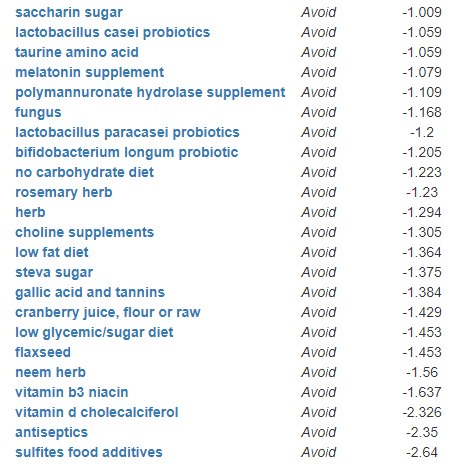
take

Avoid

REMINDER: the numbers are NOT the degree of effectiveness, they are the confidence that this would change bacteria based on the number of studies reporting it.  Olive Oil may be 100x better than inulin — but inulin has 4 times the number of studies!!! In general, relative effectiveness is not available in studies. Studies are usually, “Olive oil decreases…..”

As a result of this, I modified my profile summary page to report high and low separately, as shown below:

update

Clearly, most of the change was due to more bacteria dropping below normal, almost a 35% increase in low counts.

Hand Curated List

I am trying not to do this (time consuming and only benefits one person), but in this case it may be of general benefit.  The settings I used was LOW COUNTS, not aggregated, some evidence; then it’s common sense or remember this or that odd fact from reading.

  • Given some extract (often sold as a supplement) and the real whole food that contains it, I always favor the real whole food!

Take

  • Apples — especially Pink Lady
  • Pomegranate
  • Blueberries
  • Black raspberry
  • Jerusalem artichokes / Inulin
  • Sea Weed — snacks or supplement
  • Walnuts
  • choline supplements
  • fish oil
  • barley and oats porridge for breakfast
  • Probiotics:
    • bacillus coagulans
    • clostridium butyricum miyairi probiotics
    • General Biotics’ Equilibrium
    • lactobacillus acidophilus
    • lactobacillus reuteri
    • Prescript Assist
    • saccharomyces cerevisiae

Avoid:

  • No Vitamin D (which is usually part of the standard recommendation 😦 )
  • Neem
  • Rosemary
  • Thyme
  • Triphala
  • L-Taurine supplements
  • Stevia, sulfites
  • Monolaurin
  • Probiotics:
    • bifidobacterium longum bb536
    • lactobacillus rhamnosus
 Remember — you should NOT view this as a “You must do everything on this list”, these are suggestions of modification you should do (keeping the core supplements unless there are explicitly excluded — like Vitamin D).
I have explicitly added the two soil based organism (which were not on the list) — Prescript Assist and Equilibrium. We are dealing with low counts across the autoimmune  board, and this ‘feels’ like a good way to address it.

Bottom Line

The earlier recommendation targeted at high counts only, appear to have worked based on two pieces of evidence:

  • Subjective report from reader (Improving from a 10 down to a 5 for severity)
  • No recommendations for high counts!

We are now moving over to repopulating the low counts. Once that is done, we may find that another adjustment is needed. It is not a one-step linear path to rebalance the microbiome.

This is an education post to facilitate discussing this approach with your medical professionals. It is not medical advice for the treatment of any medical condition. Always consult with your medical professional before doing any  changes of diet, supplements or activity. Some items cites may interfere with prescription medicines.


Adding Common Name to Drugs and anti-viral reflection

From medical literature I have added several hundred drugs and their likely impact on the microbiome. A common problem with CFS patients is that they are only aware of some trademark name and not the standard scientific name.

I have started (it’s a long process) adding the common or trademark names to various drugs — for example Antivirals:

Before

Now becomes

after

This process will likely take a few weeks to complete.

Antivirals and CFS

I have posted about this in the past ,”Valganciclovir antiviral and CFS[2016]” and  “Valacyclovir, EBV and CFS [2016]”.

I decided to look at the microbiome shifts seen with the valacyclovir hydrochloride  antiviral,  And was quite surprise to see a high number of bacteria taxonomy are reduced — which may account for the success reported in the above post “All patients were treated subsequently with valacyclovir, with 93% having a positive response” [2014]. The other antiviral, Valcyte or Valganciclovir, is not in my sources.

So, the question must be asked — was it’s antiviral nature OR microbiome modification nature that causes the reported improvement?

Taxonomy Rank Effect
Bacteroidaceae family Decreases
Bifidobacteriaceae family Decreases
Clostridiaceae family Decreases
Coriobacteriaceae family Decreases
Desulfovibrionaceae family Decreases
Enterobacteriaceae family Decreases
Eubacteriaceae family Decreases
Fusobacteriaceae family Decreases
Lachnospiraceae family Decreases
Peptostreptococcaceae family Decreases
Porphyromonadaceae family Decreases
Prevotellaceae family Decreases
Ruminococcaceae family Decreases
Streptococcaceae family Decreases
Veillonellaceae family Decreases
Verrucomicrobiaceae family Decreases
Akkermansia genus Decreases
Bacteroides genus Decreases
Bifidobacterium genus Decreases
Bilophila genus Decreases
Blautia genus Decreases
Clostridium genus Decreases
Collinsella genus Decreases
Coprococcus genus Decreases
Dorea genus Decreases
Eggerthella genus Decreases
Escherichia genus Decreases
Eubacterium genus Decreases
Fusobacterium genus Decreases
Odoribacter genus Decreases
Parabacteroides genus Decreases
Peptoclostridium genus Decreases
Prevotella genus Decreases
Roseburia genus Decreases
Ruminococcus genus Decreases
Streptococcus genus Decreases
Veillonella genus Decreases
Akkermansia muciniphila species Decreases
Bacteroides caccae species Decreases
Bacteroides fragilis species Decreases
Bacteroides ovatus species Decreases
Bacteroides thetaiotaomicron species Decreases
Bacteroides uniformis species Decreases
Bacteroides vulgatus species Decreases
Bacteroides xylanisolvens species Decreases
Bifidobacterium adolescentis species Decreases
Bifidobacterium longum species Decreases
Bilophila wadsworthia species Decreases
Clostridium perfringens species Decreases
Collinsella aerofaciens species Decreases
Dorea formicigenerans species Decreases
Eggerthella lenta species Decreases
Escherichia coli species Decreases
Fusobacterium nucleatum species Decreases
Lactobacillus paracasei species Decreases
Odoribacter splanchnicus species Decreases
Parabacteroides distasonis species Decreases
Parabacteroides merdae species Decreases
Peptoclostridium difficile species Decreases
Roseburia hominis species Decreases
Roseburia intestinalis species Decreases
Streptococcus parasanguinis species Decreases
Streptococcus salivarius species Decreases
Veillonella parvula species Decreases
Lactobacillus casei group species_group Decreases

Contradicting Antibiotics and Prescription Impact on the Microbiome

I am just finishing a course of high dosage antibiotics for cellulitis that sent me to the hospital last week. With the http://microbiomeprescription.azurewebsites.net website data, I realized that I do not need to do random things to recover from the antibiotics.

First, the antibiotic that I was using was a cephalosporin i antibiotics that antibiotics and many many antibiotics and prescription drugs are listed at http://microbiomeprescription.com/Library/GutModifiers.

Clicking on it showed what changed:

cephalosporin i antibiotics

The following are impacted

Taxonomy Rank Effect Citations Links
Enterobacteriaceae family Increases Studies Also modified by
Pseudomonadaceae family Increases Studies Also modified by
Streptococcaceae family Increases Studies Also modified by
Citrobacter genus Increases Studies Also modified by
Kluyvera genus Increases Studies Also modified by
Pseudomonas genus Increases Studies Also modified by
Streptococcus genus Increases Studies Also modified by

I just added a link below the table:

Recommendations to contradict the shifts

When I click this, it takes me to the recommendations page.

Recommendations from cephalosporin i antibiotics Lab Results

Item    Action    Confidence value
bacillus probiotics Take 14.341
herb Take 8.041
gallic acid and tannins Take 3.507
fruit Take 3.396
antiseptics Take 2.911
triphala herb mixture Take 2.842
vitamin d cholecalciferol Take 2.773
lactobacillus casei probiotics Take 2.585
fungus Take 2.585
lactobacillus rhamnosus probiotics Take 2.585
low/no meat diet Take 2.495
neem herb Take 2.426
lactobacillus plantarum probiotics Take 2.426

etc,

Bottom Line

I have recommendations of what to take and to avoid that are specific to the antibiotic / prescription drug that I took! No random picking of stuff from the air.

In the near future, I will extend this to allow microbiome information from ubiome to be incorporated (i.e.  if you are low, and the prescription item increases it — then we attempt no correction).

This is an education post to facilitate discussing this approach with your medical professionals. It is not medical advice for the treatment of any medical condition. Always consult with your medical professional before doing any  changes of diet, supplements or activity. Some items cites may interfere with prescription medicines.
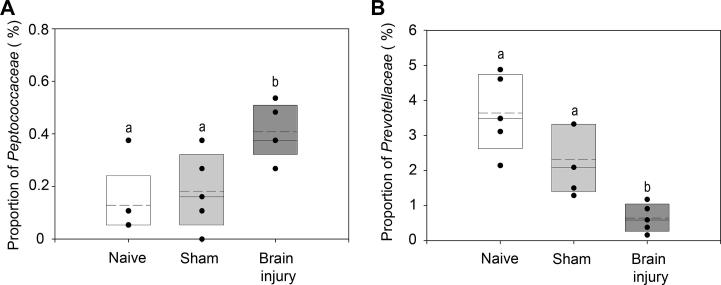


Brain Trauma’s Microbiome

On my commute today I had a conversation with an old colleague whose teenage daughter had a physical brain trauma(included cerebral ischemia) in January. As she described her symptoms, I recognized a lot of symptoms that are often seen with CFS. I also recall reading some articles about gut shifts seen with physical trauma.

Cognitive impairment is common with CFS and other autoimmune conditions.

Bottom Line

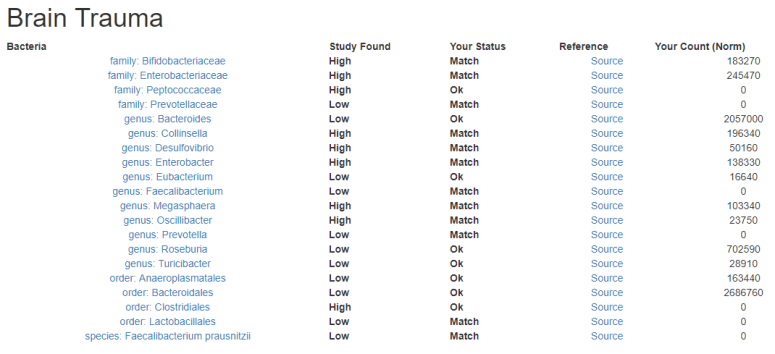
The number of bacteria taxonomy identified is lower than with other conditions but it is definitely work creating a profile on. An example with the demo ubiome result is shown below.

BT

Analysis Web Site:  http://microbiomeprescription.azurewebsites.net

This is an education post to facilitate discussing this approach with your medical professionals. It is not medical advice for the treatment of any medical condition. Always consult with your medical professional before doing any  changes of diet, supplements or activity. Some items cites may interfere with prescription medicines.
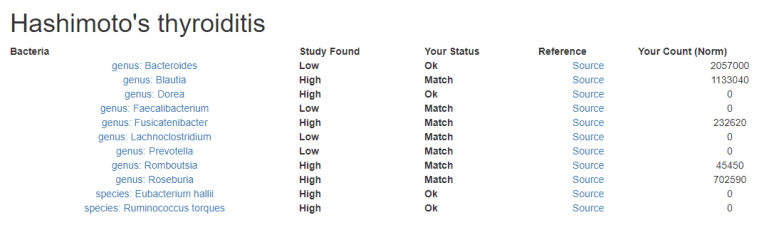
Hashimoto’s thyroiditis Microbiome Profile Added

Today I got a comment from someone with Hashimoto’s thyroiditis, often co-morbid with CFS, IBS etc.  I thought that I would check to see if there had been any microbiome work done on this condition. I was delighted to see a February, 2018 article, “Alterations of the Gut Microbiota in Hashimoto’s Thyroiditis Patients.”  and converted it results into a profile that can be applied to uBiome results.

ht

This is added to the existing series shown below

  • ADHD – Attention-deficit syndrome
  • Alzheimer’s Disease
  • Autism
  • Autoimmune Disease
  • Chronic Fatigue Syndrome
  • Diabetes Type 2
  • Crohn’s Disease
  • Depression
  • Fibromyalgia
  • Gout (Arthritis)
  • Hashimoto’s thyroiditis
  • High Blood Pressure
  • Histamine Issues
  • Inflammatory Bowel Disease
  • Irritable Bowel Syndrome
  • Metabolic Syndrome
  • Mood Disorders
  • Rheumatoid arthritis
  • Schizophrenia
  • Systemic Lupus Erythematosus
  • Ulcerative colitis


Analysis Web Site:  http://microbiomeprescription.azurewebsites.net