Reducing Actinomyces genus

For updated information see Microbiome Prescription

The mouth appears to the most common source of this genus.

DataPunk.Net Data

Nothing

PubMed Data

There are 7300+ articles on PubMed

Disease

Diet

  • Actinomyces HOT-169 were significantly reduced following use of maltitol chewing gum in patients. ”  [2017]
  • “The numbers of Bifidobacterium, Actinomyces, and Enterobacteriaceae species, as well as S-forms of E. coli were significantly increased in the Salem[lacto-ovo-vegetarian diet]-group, as compared to the school-children.” [1983]

Prebiotics

Probiotics

  •  ‘”In group EP-HN019 (with Bifidobacterium animalis subsp. lactis ), there were greater proportions of Actinomyces and Streptococcus-like species and lower proportions of Veillonella parvula, Capnocytophaga sputigena, Eikenella corrodens, and Prevotella intermedia-like species than group EP. ” [2017]
  • Antimicrobial Effect of Lactobacillus reuteri on Cariogenic Bacteria Streptococcus gordonii, Streptococcus mutans, and Periodontal Diseases Actinomyces naeslundii and Tannerella forsythia [2015].
  • “the count of cecal Actinomyces in birds treated with [B. subtilis and L. acidophilus ] probiotics was significantly lower compared with the control group. ” [2014]
  • “Lactobacillus gasseri. All the tested strains inhibited S. mutans and A. viscosus; only one did not inhibited F. nucleatum and 52 strains inhibited slightly the growth of P. gingivalis. ” [2013]
  • “Only a few strains inhibited Actinomyces pyogenes 96/393,… Most of the strains were identified as Lactobacillus fermentum, a few as Lactobacillus gasseri and one as Lactobacillus rhamnosus.” [2006]
  • “Periodontal dressing consisting of collagen and Lactobacillus casei 37 cell suspension (cell concentration 108 cells/ml) was created and used in combined treatment of patients with chronic generalized parodontitis. Efficacy of the developed isolation was explained by a considerable decrease of the number and frequency of isolation of aggressive microbial representatives (pigment synthesizing Bacteroids, Actinomycesand Str. intermedius) in periodontal pockets and also Fungus (Candida albicans). This periodontal dressing provided remission up to 10-12 months.” [2004]
  • Sugar increases vs whole grains and oats decreases [1992]

Antibiotics

Bottom Line

Avoid

  • Bifidobacterium animalis subsp. lactis
  • Sucrose (ordinary sugar)
  • lacto-ovo-vegetarian diet

Take

  • Lactobacillus gasseri
  • Lactobacillus reuteri
  • Lactobacillus rhamnosus
  • Lactobacillus fermentum
  • Lactobacillus casei
  • Maltitol
  • Oats
  • Whole Grains

Reducing Granulicatella genus

For updated information see Microbiome Prescription

The mouth appears to the most common source of this genus.

DataPunk.Net Data

INHIBITED BY

ENHANCED BY

ANTIBIOTIC RESISTANCE

PubMed Data

There are 170+ articles on PubMed

Disease

Diet

  • “An Italian-style gluten-free diet caused increases in the abundance of Granulicatella, Porphyromonas and Neisseria and decreases in Clostridium, Prevotella and Veillonella, altering the ‘salivary type’ of the individuals.” [2015]

Prebiotics

Probiotics

  •  L. reuteri intake correlated with increased S. oralis/S. mitis/S. mitis bv2/S. infantis group and Campylobacter concisus, Granulicatella adiacens, Bergeyella sp. HOT322, Neisseria subflava, and SR1 [G-1] sp. HOT874 detection and reduced S. mutans, S. anginosus, N. mucosa, Fusobacterium periodicum, F. nucleatum ss vincentii, and Prevotella maculosa detection.  [2015]

Antibiotics

  • ” All isolates were susceptible to vancomycin and >90% were susceptible to levofloxacin.” [2017] [2016]
  • “62% of G. adiacens isolates were ceftriaxone nonsusceptible.” [2016]

Bottom Line

Avoid

Take

Reducing Eisenbergiella genus

For updated information see Microbiome Prescription

DataPunk.Net Data

INHIBITED BY

ENHANCED BY

PubMed Data

There are 4+ articles on PubMed.

  • “The isolate produced butyrate, lactate, acetate and succinate as major metabolic end products. ” [2014]

Diet

  • “On the other hand, proportions of the following bacterial genera were decreased significantly at day 4 of a [Vegetable/fruit juice-based diets] compared to baseline (percent of baseline): Streptococcus (8%), Subdoligranulum (30%), Eisenbergiella (40%), Ruminiclostridium (50%), and Dialister (67%)” [2017]

Bottom Line

Avoid

Take

A Spanish Microbiome Test and Analysis

A reader in Spain forward the results they received from Estudios Analiticos Aplicados a la Clinica, Madrid, Spain. I have done two other reviews using sample reports recently (A US Microbiome Test: GI-MAP and Another German Microbiome Test Review), It is nice to do one  with actual patient data.

Evaluation

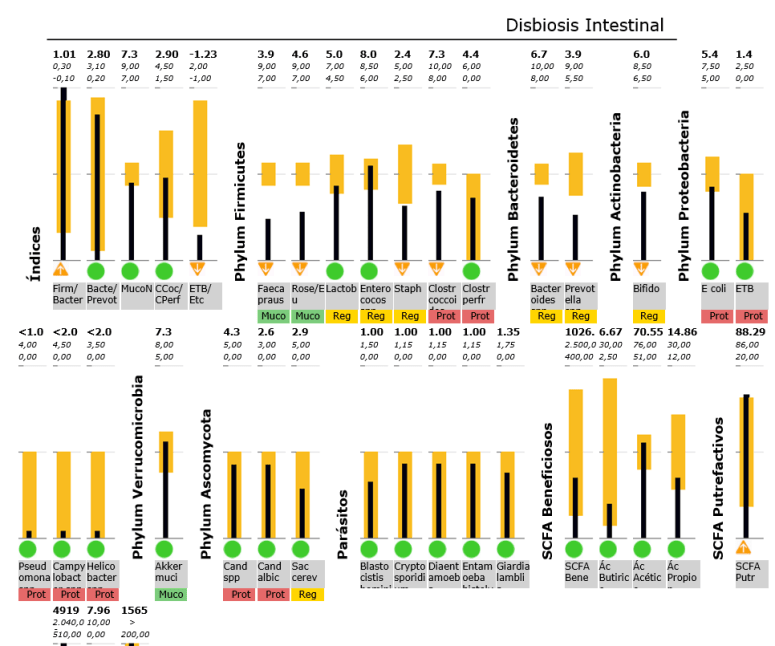
Criteria: Look at the current list of deep dives of 69 bacteria genus(which comes from high values seen in uBiomes from CFS readers) and count the number of matches, just like I did in posts above. We get 8 or 12% covered by this test (discussion at bottom).

This Report Result

First — I like this report visually and it’s content

  • There are ranges based on Spanish population
    • Less variation due to genetics
    • Less variation due to differences in diets
  • There are RANGES, if you look at the first chart below we see some ranges are huge and some ranges are small.
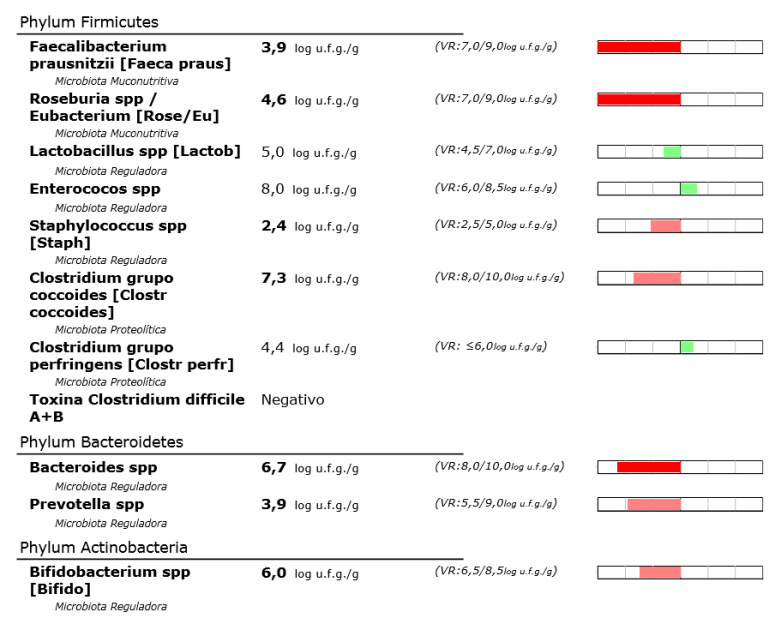
    • Because uBiome lacks ranges, I have arbitrary picked 1.5x as a threshold. Looking at Bacteroides below we see the normal range is 8-10. A 11 would be an abnormal high. Using my rule of thumb we have 9 x 1.5 = 13.5 as the threshold for abnormal high so a value of 12 would be deemed normal for me but abnormal using ranges (the correct answer).

es1.PNG


es2es3

es4

es5

es6

es7

Bottom Line

A nice summary is provided at the bottom of abnormalities. Some abnormalities are not cited because they are clinically significant by traditional standards:

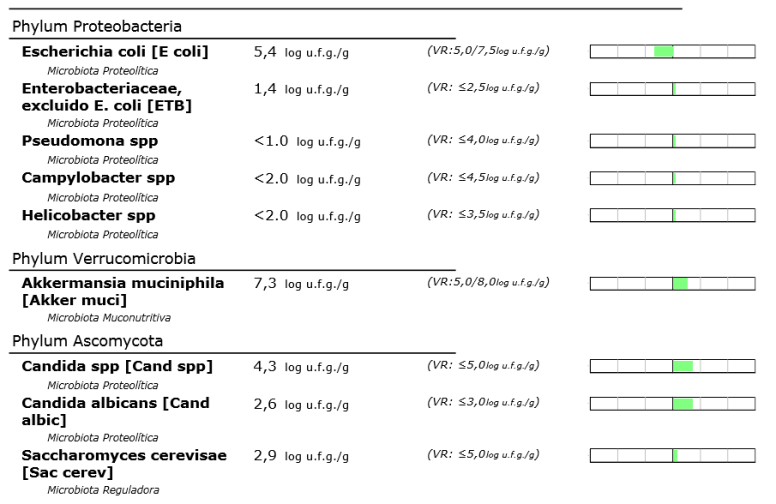
  • E.Coli is low normal:  5.4 on a range of 5-7.5
  • Bifidobacterium is low: 6.0 on a range of 6.5-8.5
  • Lactobacillus is low normal: 5 on a range of 4.5-7
  • Firmicutes is low: 8 on a a range of 8.5 -11
  • Akkermania is normal: 7.3 on a range of 5-8
  • Bacteroidetes is low: 7.04 on a range of 8 – 11
    • Note: the Firmicutes:Bacteroidetes normal ratio on this test would be 1.02 to 1 NOT 2.1:1 reported on uBiome — we may have differences of lab process being involved 😦
    • The ratio here is 1.09, high (ALTO)
  • We have significantly low pH (5.5 vs normal range of 6.0- 7.2) – thus excessive acid.

All of the items below are for low (BAJO) bacteria genus – not overgrowths (ALTO)!

es8

The short coming

The report is centered at the Phylum (50’000 meter view) level with a few specific genus being checked (i.e. Enterobacteriaceae, Pseudomona, Campylobacter, Heliobacter, Akkermansia, Saccharomyces, Bacteroides, Prevotella, Clostridium, Staphylococcus, Enterococos, Roseburia, Eubacterium, Faecalibacterium). Of these, 8 or 12% are on the list of bacteria genus seen with CFS. This means that there is about a 50% chance of seeing any highs bacteria genus (assuming 8 genus are high in a CFS patient’s ubiome).

In other words, you may have major overgrowth causing the low bacteria genus detected by this test but not a single high bacteria genus reports!

Personal View

The test presentation and information is a big positive. The very limited coverage of bacteria genus is a negative — but it is a lot better than the two prior tests that I reviewed.

I would say that taking this test PLUS uBiome would be a good combination. If you happen to be high in one of the 8 covered bacteria genus — then having the local population based ranges is superior to my rule of thumb of 1.5x.

Advise to the reader – this is tough because I can only give advice to alter the Firmicutes:Bacteroidetes ratio, see this post

Avoid

  • capsaicin [2016] Chili Peppers
  • Dairy products [2016]
  • Proton pump inhibitor [2016]

Take

  • Resveratrol [2014]
  • Lactobacillus Fermentum [2017]
  • Pea Fibre [2017]
  • Melatonin [2017]
  • Cranberry [2017]

… and get a uBiome done.

This is an education post to facilitate discussing this approach with your medical professionals. It is not medical advice for the treatment of CFS. Always consult with your medical professional before doing any  changes of diet, supplements or activity. Some items cites may interfere with prescription medicines.


ubiome analysis of a friend in Seattle

Reader Summary

ONSET:

Gradual onset (or as I call it, “Gradually Sudden”).

  • Began high-stress job 9/1994 managing a large old apartment building where I worked with pesticides, fungicides, paints, paint thinners, and was exposed to mold from plumbing leaks on many occasions.
  • 4/1996: Came back from Mexico w/montezuma’s revenge.  Noted ‘never felt this weak in my entire life’ a week later, before herbs (haritaki, etc) stopped it.  But didn’t really recover 100%.
  • Continued with stressful 24/7 job, managed to stay afloat, but stressors took theirtoll by fall ’97 and I ended up in ER June 3rd, 1998.
  • After that got worse each year until a little rebound in early 2015, and a distinct one in March 2016 (thanks mainly to niacin – a two-edged sword – helps w/triglycerides, but can make histamine issues worse). I was so bad in Feb 2016 that I needed a cane to get out of bed, and after falling into the bedroom window, used a walker – inside my apartment – probably 85-90% of the day, as I was just unbelievably weak and my balance unstable.  After 2 weeks of niacin, I needed the walker maybe 20-25%…)
  • Hindsight is always 20/20.  I started to develop reddish-brownish, semi-crusty patches/rashes in a couple spots on my legs in early 2008.  By late 2010-early 2011, I stopped sweating and my skin started really drying out.  By late 2011 to present day, I have at times overall body dandruff – mostly on my lower legs though, but can be anywhere.  This is no doubt due in part to not being able to bath or take a shower since about mid-2012 – so I dry brush or do spot bathing – but it’s mainly due to insulin resistance/metabolic syndrome/pre-diabetes. No one could tell me what the patchy reddish-brown areas were, so I googled and came to a site w/55 different types of rashes.  The one that matched my main ‘patch’ was called “stasis dermatitis”.
  • More googling revealed stasis dermatitis is connected to venous insufficiency, which can be connected back to diabetes, along with other vascular issues.  It might be a tiny bit better than a year ago – I’ve been taking quercetin w/vitamin C and the main spot doesn’t seem to be so bad, but the circulation to my feet is still BAD.
  • Rich Van Konynenburg reviewed for me back in September of 2010(!).  And my muscle has definitely broken down.  My calves are basically jelly-like, what’s left of them anyway.
  • And Medicaid doc agrees I definitely have developed fatty liver.  My legs are like sticks, but my gut looks like I’m six months pregnant(Update, now I’m maybe 4 months pregnant.)  B. longum to the rescue?:
  • I also had a test for gluten sensitivity back in 2007.  Looking at it in hindsight,only one of the four-part test was positive, and mildly so.
  • Can only tolerate a few spices, mainly because of the histamine issue.  But nothing pungent (dries me out, and sometimes causes severe muscle cramps) or anything too bitter (makes me constipated).  But can do dill, some small amounts of basil from time to time, small, very small amounts of onion.
  • Also, in addition to the l. plantarum for histamine and dust mites above, I want to mention two other probiotic strains that I know have been helpful:  b. infantis, and b. longum BB536.  Both helped w/histamine issues.  And now in 10/2017, the b. longum – at a higher dose – 4-6 10billion caps/day – seems to be helping w/the chronic constipation.

Standard Items:

  • Diversity: 76%ile
  • Lactobacillus:  0.19x
  • Bifidobacterium: 0x
  • Akkermansia: 0x
  • Firmicutes:Bacteroidetes: 2.8:1 (Normal  2.1:1)
    • More bacteriodetes undergrowth than firmicutes overgrowth.

Typical CFS profile

Uncommon Bacteria

None – 8.6% common was the rarest (threshold is 5%)

High Bacteria

Bacteria
Ratio
Sarcina: 2.23 X
Phascolarctobacterium: 3.03 X
Dorea: 2.51 X
Sutterella: 2.04 X

Reference


Bottom Line Suggestions

The lists below are done by merging the lists from the deep dives linked above. Some items may encourage one genus and discourage another genus — those are removed (unless it seems that it strongly predominates on one). The impact on Lactobacillus, Bifidobacterium and E.Coli are intentionally ignored [See this post for the logic]. This is all based on applying logic to the results of studies — thus theoretical. This is an addition (not a replacement) to this overview post.

Avoid

  • Animal-based diet
  • Barley
  • Berberine
  • BPA bottles
  • Helminth infections
  • High Fat Diet
  • Lactobacillus rhamnosus
  • Polydextrose
  • Saccharomyces boulardii
  • Soluble corn fiber
  • Stress
  • Walnuts (and likely pomegranates)

Take

  • Acarbose
  • Bifidobacterium Longum
  • Enterococcus  faecalis
  • Fennel
  • Flaxseed
  • Fructooligosaccharides (FOS)
  • Fumarate
  • Galactooligosaccharides (GOS)
  • Gluten free diet
  • High Protein Diet
  • High resistance starch
  • Lactobacillus Casei
  • Lactobacillus paracasei
  • Lactobacillus plantarum
  • l-glutamine
  • lycheerambutanguaranakorlanpitomba, Spanish lime and ackee. [fam-Sapindaceae]
  • Metronidazole
  • Oral Iron Supplements
  • Polymannuronic acid
  • Resistant starch (type II)
  • Sodium chloride (Table Salt)
  • Vitamin D3
  • β-glucan

Personal Comment

The reader has self-discovered two probiotics that helped him: (Bifidobacterium Longum and Lactobacillus plantarum) — both were on his Take list, as well as three more suggestions:

  • Enterococcus  faecalis
  • Lactobacillus Casei
  • Lactobacillus paracasei

Other easy supplements are: L-Glutamine, Vitamin D3, oral Iron Supplements, beta-glucan. He should see if he tolerate Fennel and Flaxseed in low dosages and work up.

  • Acarbose is a prescribed medication that is often used with pre diabetes — he may be amble to get a physician to prescribe it.

I should note that some of the studies found that 24 BCFU/day of a specific probiotic was often needed to get effective results — you need enough of them to overwhelm the cartels (at least temporarily).

This is an education post to facilitate discussing this approach with your medical professionals. It is not medical advice for the treatment of CFS. Always consult with your medical professional before doing any  changes of diet, supplements or activity. Some items cites may interfere with prescription medicines.