A US Microbiome Test: GI-MAP

As the microbiome become a more main stream medical tool, there will be more and more providers. A reader forwarded me an example from Diagnostic Solutions – GI-MAP. This is the only test that their physician are willing to accept.

Their 2015  literature state “Diagnostic Solutions Laboratory is pleased to offer you the GI Microbial Assay Plus (GI-MAP). The GI-MAP includes the first comprehensive pathogens assay that is FDA approved, the GPP assay by Luminex Corp. The pathogen targets include bacteria, parasites and another first for the market, viruses!”

Evaluation

Criteria: Look at the current list of deep dives of 69 bacteria genus(which comes from high values seen in uBiomes from CFS readers) and count the number of matches, just like I did in my last microbiome test review.

As with the prior report, we do get Lactobacillus, Bifidobacterium and Escherichia species.

GIMAP2

We have 3 of the overgrowth bacteria genus listed on this report. 3/69 or just 4%. Statistically, the reader may have major over growths of a dozen bacteria genus and the test will report no issues.

Redeeming Aspects

This test does report on common parasites and Fungi/Yeast issues

GIMAP

Bottom Line

The reader has a potential problem — their physician wishes to keep to familiar ground, and thus tests that they know what to do with the results.

The reader may wish to bring this paper to their physician to expand the physician perspective.

GIMAP3

Another German Microbiome Test Review

As the microbiome become a more main stream medical tool, there will be more and more providers. A reader wrote:

“I have another question. Do you think this German test might be beneficial? https://www.vimedics.de/media/pdf/Musterbefund_Florastatus.pdf

In contrast to KyberKompakt (that you recommend) they don’t test: Akkermansia muciniphilia, Faecalibacterium prausnitzii, H2O2 Lactobacillus. But it is cheap and easy to get as there is no doctor necessary to order it. 

Do you think that I will get enough information from it to start with probiotics? “

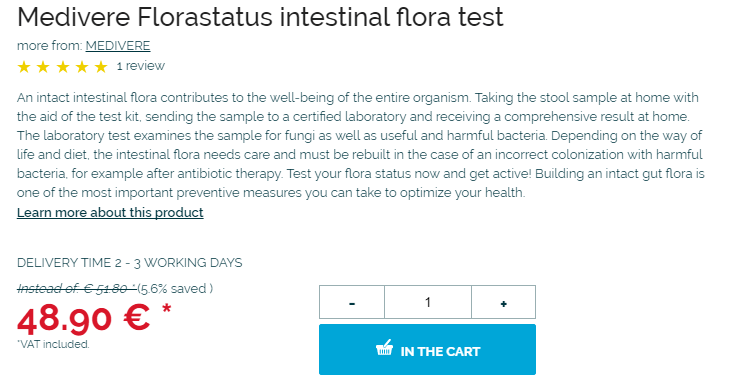
Analysis of Medivere Florastatus intestinal flora test

Medivere Florastatus intestinal flora test

floras

Criteria: Look at the current list of deep dives of 69 bacteria genus(which comes from high values seen in uBiomes from CFS reders) and count the number of matches – we have just 4 or 6%.  It does has explicit reading for Escherichia coli, Bifidobacterium and Lactobacillus — as such, it is good as a indicator of prs obable CFS/IBS/FM.

Bottom Line

The cost is about $60 US, uBiome is $89 for one time purchase ($72 for subscription). The slight reduced costs for significant reduction of information is not a wise decision.

Revisiting old Ubiome’s “L”

A year ago, several readers shared their ubiome for me and I did a series of post looking for patterns. See this post on the Genus Numbers.

It is time that I do deep dives for these early sharers.

Results L:

  • on Canadian consensus criteria1) post-exertion fatigue and malaise I meet all criteria (A B and C)
    2) both unrefreshing sleep and a new pattern (trouble getting to sleep and staying asleep and some nights without sleep
    3) yes muscular aches and pains in legs and arms face neck and head, and headaches, forehead back of head and sides + of course the migraine
    4) A, B C (issues with noise and sound, re perhaps also anxiety I find it very hard to watch tv and often have to skip anxiety inducing bits or things that are too emotional.) D if vertigo and tinnitus count (but I had these before and associate them with migraines) . E  lots of brain fog type confusion.
    5)A: 2(POTS) 3 (Vertigo) 5 (IBS the alternate type but mostly D) 6 (palpitations), , 8 respiratory irregularities, I seem to overbreathe a lot and often find I am overinflated.
    B:I think 1 and 5, I have had low auxiliary basal body temperature clustering around 35C; and I do not handle stress at all.
    C:1 2 3 and 4
    6) yes 13 yrs
Genus L
Erysipelatoclostridium 3.29
Adlercreutzia 3.1
Bifidobacterium 2.86
Clostridium 2.41
Marvinbryantia 2.26
Flavobacterium 2.2
Anaerostipes 1.8
Dorea 1.71
Roseburia 1.63
Blautia 1.54

Deep Dive References

Bottom Line Suggestions

The items from each of the deep dives aligned very nicely for this microbiome, for example, Inulin was listed many times.

The lists below are done by merging the lists from the deep dives linked above. Some items may encourage one genus and discourage another genus — those are removed (unless it seems that it strongly predominates on one). The impact on Lactobacillus, Bifidobacterium and E.Coli are intentionally ignored [See this post for the logic]. This is all based on applying logic to the results of studies — thus theoretical. This is an addition (not a replacement) to this overview post.

Avoid

  • Animal-based diet
  • Arabinoxylans
  • Bacillus probiotics
  • Bacillus subtilis
  • barley
  • Bifidobacterium adolescentis
  • Bifidobacterium longum
  • Bifidobacterium animalis
  • brown rice
  • Butyrate producing probiotics
  • Chicory root
  • Chili pepers
  • Cholic acid
  • Dairy
  • Dietary fiber
  • Dopamine
  • flavone
  • Fluoroquinolone
  • Fructooligosaccharides
  • Getting Cold
  • Glucose foods (fructose [fruit sugar] appears to be fine)
  • Helminth infections
  • high grain diet
  • inulin
  • Isoniazid-
  • Lactobacillus plantarum
  • Lactobacillus rhamnosus
  • Lactobacillus salivarius
  • L-sorbose
  • Metformin
  • Minocycline
  • N-Acetyl-D-glucosamine
  • Omega 3
  • Penicillin
  • Polymannuronic acid
  • Pyrazinamide
  • Raspberries
  • Resistant starch (type II, IV)
  • Rifampin-
  • Rosemary
  • Saccharomyces boulardii
  • Safflower oil
  • Sleepless nights
  • Sodium butyrate
  • Stress
  • Walnuts
  • Walnuts (Omega 3)
  • xylitol


Take

  • Bacillus licheniformis
  • Bifidobacterium longum
  • Bifidobacterium Breve
  • Bile acid
  • Chitosan supplements
  • Chocolate!
  • Epinephrine
  • Flaxseed
  • Fructo-oligosaccharides
  • Galactooligosaccharides
  • Grape seed polyphenols,/ Wine
  • High animal protein diet
  • High meat diet
  • Ketogenic diet
  • Lactobacillus Casei
  • Lactobacillus kefiri LKF01
  • Lactobacillus paracasei
  • Lactobacillus rhamnosus probiotics
  • L-glutamine
  • Low carbohydrate diet
  • Mutaflor (E.Coli Nissle 1917)
  • Oral Iron Supplements
  • Oranges (pectin/flavanones)
  • Polymannuronic acid
  • Prescript Assist
  • Streptococcus Probiotics
  • Tea
  • Vitamin D3
  • Vitamin K2

This is an education post to facilitate discussing this approach with your medical professionals. It is not medical advice for the treatment of CFS. Always consult with your medical professional before doing any  changes of diet, supplements or activity. Some items cites may interfere with prescription medicines.

Revisiting old Ubiome’s “K”

A year ago, several readers shared their ubiome for me and I did a series of post looking for patterns. See this post on the Genus Numbers.

It is time that I do deep dives for these early sharers.

Results K:

  • Lyme diagnosis, chronic fatigue, inability to exercise, and pain. My biggest complaints are neurological. My brain fog is so intense most days
    • K 3/29/2016
Genus K
Thalassospira 2.3
Parasutterella 2.27
Subdoligranulum 2.14
Faecalibacterium 1.83

Deep Dive References

Bottom Line Suggestions

The items from each of the deep dives aligned very nicely for this microbiome, for example, Inulin was listed many times.

The lists below are done by merging the lists from the deep dives linked above. Some items may encourage one genus and discourage another genus — those are removed (unless it seems that it strongly predominates on one). The impact on Lactobacillus, Bifidobacterium and E.Coli are intentionally ignored [See this post for the logic]. This is all based on applying logic to the results of studies — thus theoretical. This is an addition (not a replacement) to this overview post.

Avoid

  • Berberine
  • Bifidobacterim Breve
  • Bifidobacterium adolescentis
  • Bifidobacterium catenulatum
  • Bifidobacterium pseudocatenulatum
  • Enterococcus probiotics
  • High Fiber Diet
  • Jerusalem artichoke, Inulin, Chicory
  • Lactobacillus Casei
  • Lactobacillus salivarius
  • Metformin
  • Omega 3
  • red wine (or grape seed extract or reservatol)
  • Rifaximin
  • Saccharomyces boulardii
  • Vitamin K2
  • VSL#3 Probiotics
  • Walnuts

Take

  • Alchohol
  • Bacilus Coagulans probiotics
  • Berbine
  • Bile salts
  • chitosans
  • Enzymatically modified resistant starch
  • Gluten-free diet
  • Green Tea (Gallate)
  • High Fat Diet
  • High fat/ animal protein diet
  • Inulin
  • Iron supplements
  • Lactobacillus paracasei probiotics
  • Low fiber diet
  • Navy bean (Cooked)
  • Omega 3 fatty acids (600 mg of omega-3 daily for 14 days cited in studies )
  • Thyme

This is an education post to facilitate discussing this approach with your medical professionals. It is not medical advice for the treatment of CFS. Always consult with your medical professional before doing any  changes of diet, supplements or activity. Some items cites may interfere with prescription medicines.

Revisiting old Ubiome’s “J”

A year ago, several readers shared their ubiome for me and I did a series of post looking for patterns. See this post on the Genus Numbers.

It is time that I do deep dives for these early sharers.

Results J:

  • This is a relapse of episodes that have occurred for ~15 years.No diagnosis Key symptoms: Severe 24/7 specific point pain in umbilical area Malaise and feeling unwell Some nausea Other key biomarkers Enlarged mesenteric lymph nodes on CT scan Elevated WCC (specifically neutrophils) Very high SIgA levels My own view is a chronic infection – see biomarkers above No probiotics when the change happened
    • J1 9/29/2015
    • J2 10/23/2015
    • J3 12/4/2015
Genus J3
Sutterella 4.12
Odoribacter 3.37
Lachnospira 2.96
Bacteroides 2.17
Parabacteroides 2.01
Barnesiella 1.86

Deep Dive References

Bottom Line Suggestions

The items from each of the deep dives aligned very nicely for this microbiome, for example, Inulin was listed many times.

The lists below are done by merging the lists from the deep dives linked above. Some items may encourage one genus and discourage another genus — those are removed (unless it seems that it strongly predominates on one). The impact on Lactobacillus, Bifidobacterium and E.Coli are intentionally ignored [See this post for the logic]. This is all based on applying logic to the results of studies — thus theoretical. This is an addition (not a replacement) to this overview post.

Avoid

  • Allergens
  • Amoxicillin-Clavulanate antibiotics
  • Animal-based diet
  • Aspirin (other NSAID’s are fine)
  • Bacillus subtilis
  • Bifidobacterium Animalis subsp. Lactis BB-12
  • Bifidobacterium catenulatum
  • Bifidobacterium pseudocatenulatum
  • BPA bottles
  • Broad beans  and lupin seeds
  • Canole Oil
  • fermented Korean soybean paste
  • Fructo-oligosaccharides
  • Gallic acid
  • Glutten
  • gum arabic
  • High meat diet
  • Lactobacillus casei
  • Lactobacillus acidophilus
  • Lactobacillus paracasei
  • Lactobacillus rhamnosus
  • L-citrulline
  • Lingonberries
  • Low fat diets
  • Oligofructose
  • Pomegranate
  • Proton-pump inhibitors (PPI)
  • Resistant Starch
  • Resistant starch (type IV)
  • Resveratrol (Grapes, wine) Red wine, Grape Seed Extract
  • Rhubarb
  • Saccharin
  • Saccharomyces boulardii
  • Stevia
  • stress
  • Tannic acid
  • Vegetables
  • Walnuts

Take

  • Bacillus licheniformis
  • Bifidobacterium Longum
  • Bifidobacterium infantis,
  • Bifidobacterium bifidum,
  • Bifidobacterium adolescentis
  • Bifidobacterium breve
  • Bile supplements
  • Capsaicin(chili peppers)
  • Flaxseed
  • Garlic
  • High Fat diet
  • Lactobacillus kefiri
  • Lactobacillus reuteri
  • Lactobacilluskefiri LKF01
  • Low calories High protein diet
  • Metronidazole antibiotics
  • Oligosaccharide prebiotics
  • Polymannuronic acid
  • Sucralose (Splenda)
  • Thiamine
  • Walnuts
  • Whole-grain barley
  • Xylitol
  • β-Glucan

This is an education post to facilitate discussing this approach with your medical professionals. It is not medical advice for the treatment of CFS. Always consult with your medical professional before doing any  changes of diet, supplements or activity. Some items cites may interfere with prescription medicines.