Long time ME/CFS after Fluoroquinolones

This is from a reader that I have been corresponding with since 2017 and known from online groups for decades..

Okay, you don’t want the full saga 😀 (joking ) and so I’ll write the first current impressions of a ME/CFS patient since 1998. I am someone who has tried everything; really everything.
First of all, as I had already told you in chat, I use as a criterion of improvement in the disease the increase in cardiovascular tone, which actually happened for a short time as long as I kept a diet that was not exactly ironclad, but very difficult for me: it involved cutting out all refined sugars.

For those interested, I talked about it here : https://www.fable.it/fluorochinoloni-hrv-dieta-e-me-cfs/ (in Italian — use Google translate) . For the first seven days of the diet nothing changed, nothing! After these 7 days suddenly, keeping to this diet , cardiovascular tone started to increase until … well … I kept the rest of the diet but reintroduced sugars (but not alcohol). Then improvement stopped (but maintained existing improvements).

From Reader

Recent significant events are:

  • fluoroquinolones toxicity in 2020
  • supplements of akkermansia muciniphila one month before last sample  (see below for his experience)

Ancient Test Results

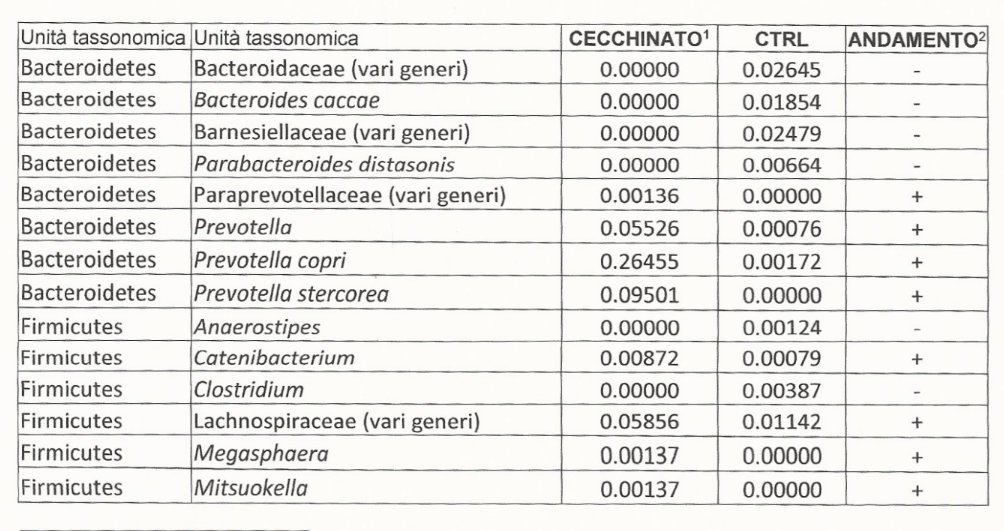
A test result from 23 August 2016 is below. The test show only few bacteria without any ranges of normal valid. We will compare the few items reported with the latest Biomesight test. There was little change over 7 years.
Any persistent Fluoroquinolones artifacts?

I did a behind the UI Meanings? Comparison of what Fluoroquinolones changed with his sample. Although it has been 3 years, I am curious. No impact would have 50-50 agreement. In the result? We have 64 bacteria showing the effect that that Fluoroquinolones would cause, and 43 showing the opposite effect. This results in a P-Value of 0.0423 from chi-square. A P-value below 0.05 is deemed statistically significant in medical studies. So, this is evidence that the impact of Fluoroquinolones is still there after 3 years.

This is an interesting observation — picking the wrong antibiotic may have effects that persists for years.

Comparing to Ancient Test Shown Above

Each lab uses their own methodologies to measurements (See The taxonomy nightmare before Christmas… for why and Comparing Microbiomes from Three Different Providers for actual example). So we cannot determine if the levels have gone up or down.

The microbiome was been relatively stable over 7 years. In fact, the Biomesight test clarify how extreme the values are (which is not clear from the earlier report).

Where do we go from here?

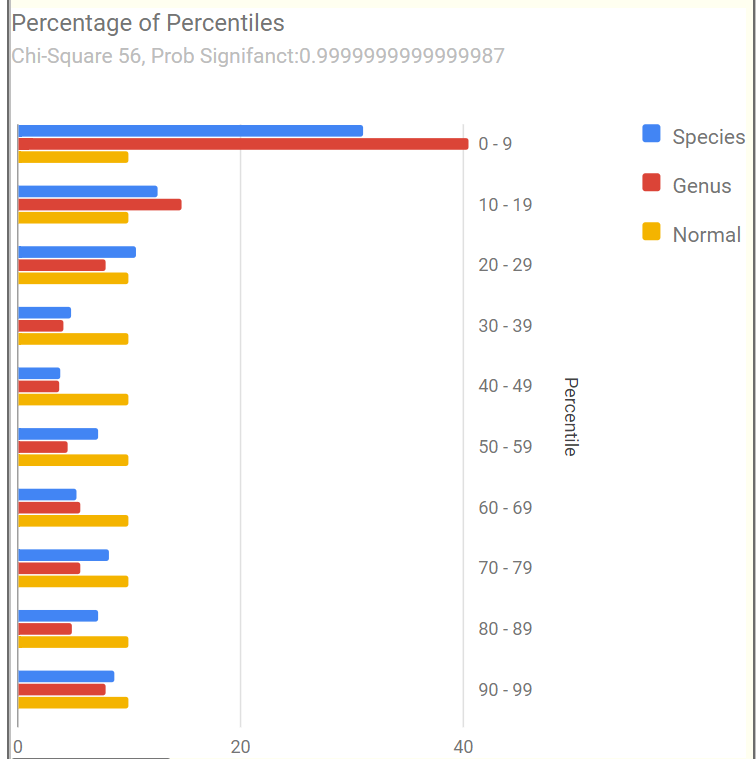
The Percentage of Percentiles pattern shown below is a match for that seen with many ME/CFS or Long COVID microbiome.

Nerdy Explanation: Using percentiles, the data is transformed to an uniform distribution. An unbiased sample (a.k.a. normal or healthy), would have the same number in each 10%ile range. It does not. We have the typical spike in the 0-9%ile range (i.e. too many species and genus that have token representation).
The most important/concerning bacteria identified was Prevotella copri. This bacteria made up 43% of the microbiome!!!! This bacteria is often associated with mycotoxin being present in the environment [2020]. In simple words, Prevotella increases when there is mold in the environment, the chemicals that the mold gives off, feed this bacteria. This usually means examining the living space for mold and fungi, as well as avoiding foods likely to have mold (see WHO for more information). His response to this comment was:

Yes, I live in a north-oriented flat where there is never sun on the walls. Only in a bedroom not used anymore as bedroom I have visible mold (picture attached). I have tried treating with chlorine bleach. In February 2023, I called in a painter. He treated with anti mold solution and thermal painting (which can be dangerous. I wouldn’t lived in that bedroom till the smell went away.
And yes, being in the sun recharge me. I don’t know if it also affects mycotoxins. However in my block / area where I live, we never have less than 60% humidity, but in summer usually we have 70-75% so… humidity is a concern.

From Reader

There are many sites providing suggestions on this issue, a few are: [Aircare Hawaii] and this
Is mold related to humidity?
European and Italian homes are typically built with reinforced concrete frames and brick walls.
Walls and ceiling surfaces are finished with mortar/plaster and water base paint. As water base
paint is not waterproof, plaster finishing tends to absorb and retain humidity.
These areas can
become damp or wet as a result of a water leak or condensation of vapors produced by appliances
and normal household activities.

The use of a waterproof paint after cleaning (and running a dehumidifier) in the bedroom is one possible approach. Reader responded (to his delight) that water proof paint was used!

Mold and ME/CFS Relationship

“Urine specimens from 104 of 112 patients (93%) were positive for at least one mycotoxin” from Detection of Mycotoxins in Patients with Chronic Fatigue Syndrome [2013]

Environmental factors – exposure to mold or toxins has been suspected as a trigger for ME/CFS. However, associations of specific environmental factors with ME/CFS have not been established.” [CDC]

Prevalence of Aspergillus-Derived Mycotoxins (Ochratoxin, Aflatoxin, and Gliotoxin) and Their Distribution in the Urinalysis of ME/CFS Patients [2022]

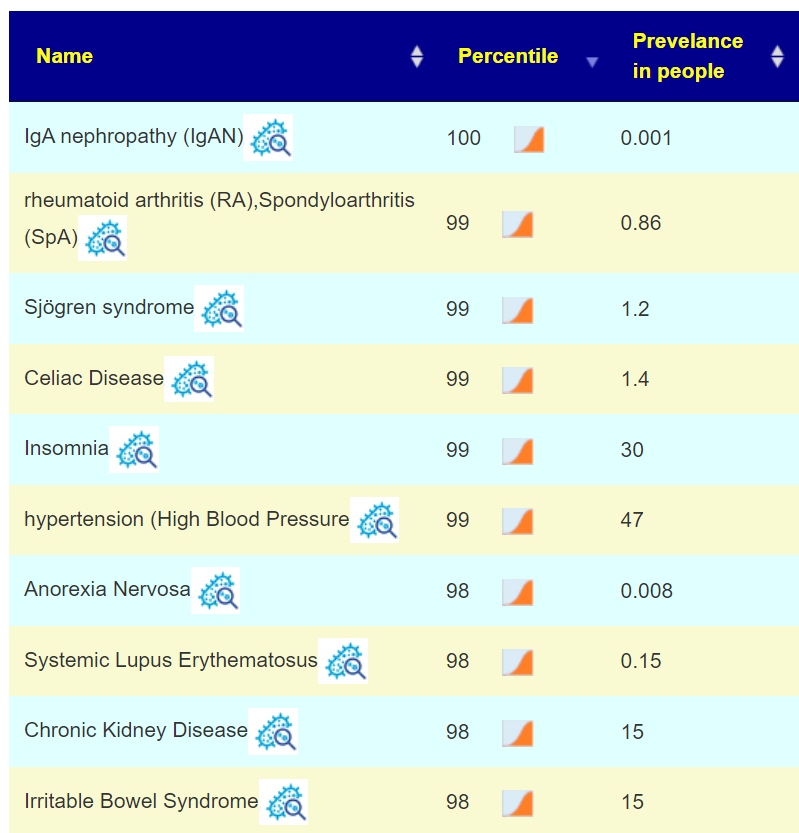
This plus other shifts, matches to a host of conditions shown below. Many are co-morbid with ME/CFS.
The Computed Probiotics from KEGG Enzymes had some very high numbers (over 600!). High numbers mean that there count of many enzymes being produced by your microbiome is very low. This is important because processing of food may be disrupted. Some of these are available in probiotics, with the top feasible suggestions being:

Two retail probiotics for the Bacillus above are: Energybalance / ColoBiotica 28 Colon Support and microbiome labs/ megasporebiotic. The person is in Europe, so the two E.Coli probiotics: Symbioflor-2 and Mutaflor are available. For others, see Probiotic Mixtures.

I will defer the rest of the suggestions to the PDF, attached below. It is interesting to note that akkermansia muciniphila probiotics is well recommended (see experience below).

In this case, we have good positive reader experience happening before the suggestion was made! It should encourage the reader to trust the other suggestions (after all, “one suggestion worked before he got it!” 🙂 )

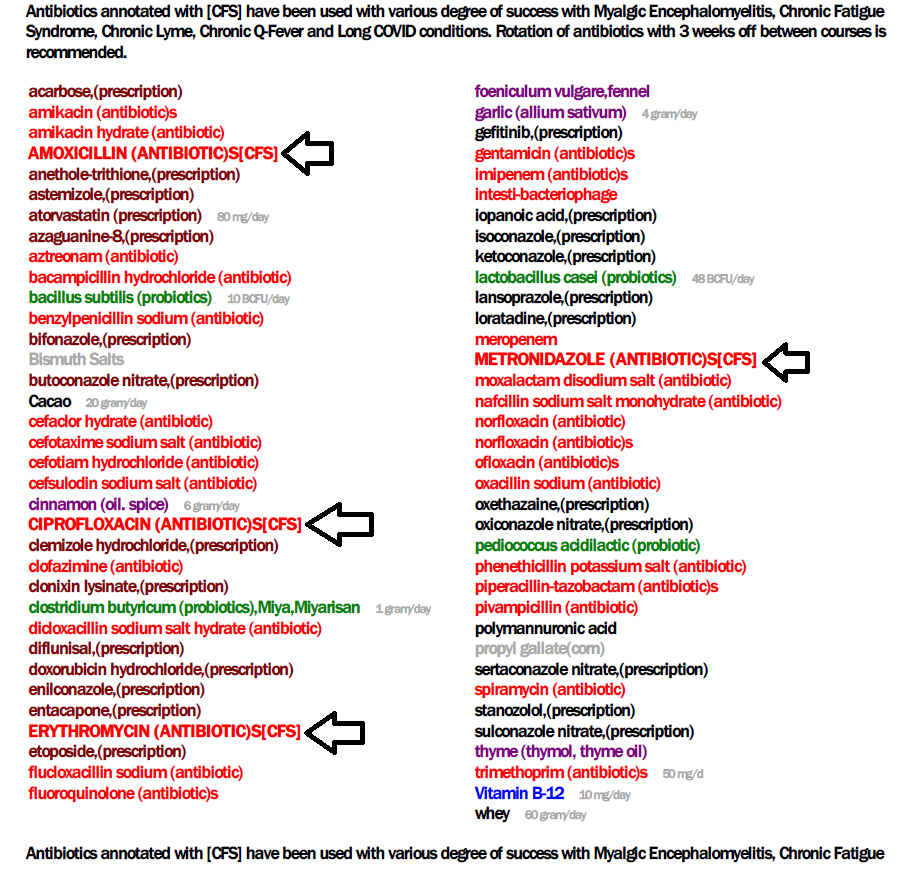
I also looked at the MD version which suggested a few antibiotics:

None of these are typically used for ME/CFS (but other tetracyclines are). We have one big target: P.Copri. I am hoping that you have a cooperative MD. I checked around for information on antibiotics which often have little effect on P.Copri, these studies have extensive lists.

Akkermansia Muciniphila Experience

Another thing Ken, is the sensational discovery this year of Akkermnasia Probiotics (in my case from Metagenics). In my first two days I went from going to the bathroom once a day to going three four times. How many times have we read that a normal bowel transit involves 1 evacuation a day to one every 2-3 days ? No ! The ideal transit is to go to the bathroom about half an hour after eating ! Well, this happened to me while supplementing Akkermansia once a day. And it is only one strain !!! Not only that ! I felt less “Fight or Flight” but more serene, even when I woke up from my night sleep. Even with scabs on my eyes that who knows how many years I haven’t found (how many of us have perpetually dry eyes ?). I stopped the supplementation after a month and am now resuming it.

Why am I writing you this Ken ? To waste your time !!! No, I am writing this to you because I had first read about this Akkermansia three years ago on the label of an Austrian product, Omni Logic Plus, which contains a lot of good stuff (FOS, GOS , etc.) to feed this specific bacteria, Akkermansia . Three years of supplementation every day has not improved anything.
After just a few days of Akkermansia , that is, the strain that that Omni Logic Plus was supposed to feed, did the miracle happen! What do I mean by all this ? That , my thought is that rather than depending on the food, if they are available as supplements, little bacterial strains should be introduced, for a far better effect.

From Reader

Questions:

Q: When the “nutrients” of the supernumerary bacteria are present they grow. If you cut off their nutrients, the effect on microbiota diversity is extremely “reactive” !!! Did this happen when I removed the sugars ?? Do you agree with my reasoning ?

  • A: Yes — consider a human population that is well fed (obese even). If you suddenly impose strict rationing on them, their behavior changes greatly (often with criminal actions).

Q: Is it more effective to remove the food that feeds the overrepresented bacteria and simultaneously supplement the underrepresented strains not so much with diet and food, but with probiotics ?
An example of my personal case ? When in the report generated by your site I see among the recommendations clostridium butyricum , which I’ve never tried in my life.

  • A: The algorithms effectively does that — identifies suggestions reduced high bacteria while checking that it does not further reduce low bacteria of concern. Also the reverse, suggestions increases low bacteria while checking that it does not further increase high bacteria of concern.. You can try to calculate these manually — but its a massive amount of reading and searching. Microbiome Prescription uses some 1.8 million facts pulled from almost 12,000 studies.

Q: Who knows if it can give me the same benefits as Akkermansia? After years where for weeks on end , I have tried various products. Like everyone else, I have been spending hundreds of Euros. For example:

  • probactiol duo ( billions of Saccharomyces boulardii)
  • 8.5 billion of a probiotic blend – HOWARU blend (Lactobacillus acidophilus NCFM®, Bifidobacterium lactis Bi-07®, Lactobacillus paracasei Lpc37™, Bifidobacterium lactis Bi-04™)
  • A: The purpose of Microbiome Prescription is to compute the most likely ones based on your microbiome and what studies reports the effects of various probiotics are. This means greatly increased odds of positive effects! Much better (and cheaper in the long run) than trying things suggested by influencers or which worked for someone with a very different microbiome.

Your list is very short — 50% is what you recently discovered works!!
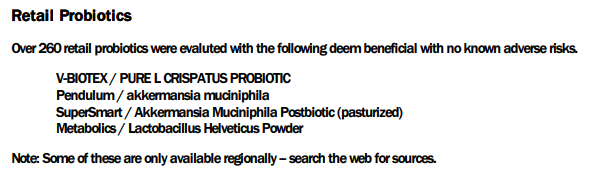
For probiotics, do one at a time for 10 days then rotate to another. Why? Their effect is often due to natural antibiotics that they produce. Keeping on them continuously allows “natural antibiotic resistance” to develop.

Postscript – and Reminder

I am not a licensed medical professional and there are strict laws where I live about “appearing to practice medicine”.  I am safe when it is “academic models” and I keep to the language of science, especially statistics. I am not safe when the explanations have possible overtones of advising a patient instead of presenting data to be evaluated by a medical professional before implementing.

I can compute items to take, those computations do not provide solid information on rotations, dosages, etc.

I cannot tell people what they should take or not take. I can inform people items that have better odds of improving their microbiome as a results on numeric calculations. I am a trained experienced statistician with appropriate degrees and professional memberships. All suggestions should be reviewed by your medical professional before starting. Some suggestions may be counterindicated for other medications you are taking and medical conditions.

The answers above describe my logic and thinking and is not intended to give advice to this person or any one. Always review with your knowledgeable medical professional.

Recap on Coagulation Complexities

In my last post, many studies cited proteins being altered.

I asked ChatGpt to list the proteins involved. The answer matched my memories (and saves time digging up citations)

Coagulation, also known as blood clotting, is a complex physiological process that involves a series of protein interactions. The main proteins associated with coagulation are part of the clotting cascade, which can be divided into two pathways: the intrinsic pathway and the extrinsic pathway. These pathways eventually converge to activate a common pathway leading to the formation of a stable blood clot. Here are some key proteins involved in these pathways:

Intrinsic Pathway:

  1. Factor XII (Hageman Factor): It initiates the intrinsic pathway by becoming activated upon contact with exposed subendothelial surfaces.
  2. Factor XI (Plasma Thromboplastin Antecedent): Activated by factor XIIa, it then activates factor IX.
  3. Factor IX (Christmas Factor): Activated by factor XIa, it forms a complex with factor VIIIa and calcium ions to activate factor X.
  4. Factor VIII (Antihemophilic Factor A): This protein, along with von Willebrand factor, is involved in stabilizing factor IX and preventing its premature degradation.
  5. Factor X (Stuart-Prower Factor): Activated by the factor IXa-factor VIIIa complex, it is a critical point where the intrinsic and extrinsic pathways converge.

Extrinsic Pathway:

  1. Tissue Factor (Factor III): Released from damaged tissues, it combines with activated factor VII to initiate the extrinsic pathway.
  2. Factor VII (Proconvertin): Activated by tissue factor, it forms a complex with tissue factor to activate factor X.

Common Pathway:

  1. Factor X (Stuart-Prower Factor): Activated by both intrinsic and extrinsic pathways, it forms a complex with factor V to convert prothrombin (Factor II) to thrombin.
  2. Factor V (Labile Factor): Forms a complex with factor X to accelerate the conversion of prothrombin to thrombin.
  3. Thrombin (Factor IIa): Generated from prothrombin, thrombin is a central enzyme in coagulation. It converts fibrinogen to fibrin, activates factor XIII, and also plays a role in platelet activation.
  4. Fibrinogen (Factor I): Thrombin cleaves fibrinogen to form fibrin monomers, which then polymerize to create a fibrin mesh that stabilizes the blood clot.
  5. Factor XIII (Fibrin-Stabilizing Factor): Activated by thrombin, it crosslinks fibrin strands, contributing to the stability of the clot.

This cascade of protein interactions ultimately leads to the formation of a stable fibrin clot that helps prevent excessive bleeding at the site of injury. It’s important to note that coagulation is a tightly regulated process, and any imbalance can lead to bleeding disorders (if clotting is impaired) or thrombotic disorders (if clotting is excessive).

From Coagulation Cascade

For FM, ME/CFS and Long COVID — different enzymes!

The amount of each protein is often determined by a person’s DNA. For example, I have a Prothrombin G20210A defect A.K.A. Factor II mutation since that is what it impacts. A person may have multiple DNA coagulation defects. The typical impact of a defect is to create a bottleneck in the normal process resulting in micro-clots, sticky blood and other manifestations. For myself, there are several documented fibrinolytic substances (dissolvers of fibrin) which I use periodically. It works for my defect (it may not for other defects).

The usual problems are:

  • Getting DNA testing, many labs and MDs will only test some items: “When testing is indicated, we only screen for the G20210A variant and not for the other rare F2 variants listed above.”[src]
  • The best general treatment is low molecular weight heparin (Lovenox is one brand) – why, because it usually has all of the proteins in it — thus an absence is compensated. The downside is that if you have a surplus of one protein it may make things worse — i.e. bleeding risk.

Fibromyalgia pain may be “microclots” et al

A question was asked on Facebook which I recall some studies report hypo-perfusion (too low oxygen levels) at the pain points. This aspect was first suggested/found by David Berg back in 1999 [see this post for more details]. The old studies:

I was delighted to see many more studies.

Some terms that are connected to coagulation: fibrinogen (Major component of clots). Cerebral blood flow is the amount of oxygen reaching the brain, with coagulation this decreases [the brain becomes starved for oxygen].Prothrombotic is another name for Hypercoagulable state (A.K.A. Thick Blood) 

 Elevated platelet and RBC counts, PDW values, and fibrinogen levels as well as decreased prothrombin time are all indicative of a prothrombotic state in FM patients, which may be enhanced by an increased inflammatory tone. 

Are Patients With Fibromyalgia in a Prothrombotic State? [2019]
  • ” Clear significant differences between FM … FM had associations with specific plasma proteins involved in blood coagulation, metabolic, inflammation and immunity processes.” [2020]
  • “we noted several proteins involved in coagulation and inflammation pathways with distinct expression patterns in patients with FM.” [2020]
  • “This study suggests that different plasma protein patterns are associated with different pain intensity and psychological distress in CWP. Proteins belonging to the coagulation cascade and immunity processes showed strong associations to each clinical outcome” [2018]
  • “The interplay of the complement and coagulation cascades contributes to the inflammatory process, while the activation of Liver-X Receptor/Retinoid-X Receptor and Farnesoid-X Receptor/Retinoid-X Receptor could attempt to alleviate it. Finally, we have identified two proteins, haptoglobin and fibrinogen, as potential biomarker-candidates of FM for future studies.” [2018]
  • “Significant correlations were found between thalamic Cerebral blood flow [rCBF] values and pain belief values.” [2011]
  • “These results show that brain perfusion abnormalities in patients with fibromyalgia are correlated with the clinical severity of the disease.” [2008]
  • “in hyperalgesic FM patients, we found significant hyperperfusion in regions of the brain known to be involved in the sensory dimension of pain processing and significant hypoperfusion in areas assumed to be associated with the affective-attentional dimension. ” [2006]
  • Decreased muscle blood flow in fibromyalgia patients during standardised muscle exercise: a contrast media enhanced colour Doppler study [2006] “that muscle ischemia(an inadequate blood supply to an organ or part of the body) can contribute to pain in FM,”
  • Intramuscular hypoperfusion, adrenergic receptors, and chronic muscle pain [2002] “a prominent and consistent feature for regional myofascial pain and to a lesser degree for fibromyalgia was intramuscular hypoperfusion”
  • Tissue oxygen measurement and 31P magnetic resonance spectroscopy in patients with muscle tension and fibromyalgia [1997] – “hypoxia” — low oxygen levels

Bottom Line

This area tends to fall into a medical no-physician land. Clinical MDs are rarely familiar with coagulation and if pressed, will pass patients to what they deem to be an appropriate specialist – a hematologist. A hematologist will ask “show me the strokes, the venous clots etc” and then excuse himself from involvement. The issue is that of low grade, clinically significant, low level coagulation often known as “micro-clots” in recent Long COVID literature.

Coagulation disorders are complex. Some have well established treatments, some do not.

Some additional notes:

Sessions on Using Microbiome Prescriptions

Based on several online meeting that I had, I thought a series of online meeting for people to ask questions, be shown features, etc would benefit many.

The meetings are all at 7AM Seattle Time on Saturdays. This should work for most people around the world.

All meetings will be recorded and then posted on YouTube. By attending you consent to being recorded.

The scope of these meetings

Link to Calendar 
Click to go directly to Meeting

  • Aug 12th — Looking at information that you can just lookup. Includes getting suggestions for specific conditions.
  • Aug 19th — Working with transcribed data from a test and simple suggestions from uploaded tests
  • Aug 26th — Working with data from one test alone
  • September 2nd — Working with multiple test results (comparison, evaluating progress).

It is suggested that you write out questions you may have before the meeting and then post them into Chat box when the meeting starts.

Some General Guidance for Treating ME/CFS

I am a statistician and for ME/CFS I took an odds approach to treatment back in 1999. Two treatments reported 90% remission (not improvement) rates from conference reports. They had no apparent connection to each other. I persuaded my MD to do both. Assuming they are not connected much, the statistical odds of remission jumped to 99% doing both. It worked.

I have spent 50 years in Information Technology and tend to use successful patterns from that career. One key pattern is finding isolation points to subdivide the problem (find a wedge point) and then focus on whichever side of the issue it the cause . The other pattern is focus on fixing the problem (often without knowing the real cause of the problem). A file gets corrupted — was it a disk issue, a memory issue, a code defect in the official program using it, a code defect in the libraries (the Operating System’s DNA), a voltage spike, a virus that infected the system (which may have since been removed by an anti-virus update) or human error (from too much booze?!?) in entering or processing the data.

With ME/CFS (and other conditions), many patients and researchers seem to exhibit obsessive compulsive behavior to find the cause; instead of fixing the problem. In some cases, researchers seek fame (or at least more grants) searching for the cause — and likely more publication for their Curriculum Vitae (resume for common people).

Many years ago I started CFSRemission, this blog, with the focus on fixing the problem. Actually problems is a better term because of multiple symptoms. I chose not to work off theories but off clinical studies that improve symptoms (reduce the problem). This makes no assumptions as to the cause.

Request from a Reader

I got this email from a long time correspondent. She has been doing regular microbiome samples (via BiomeSight, discount code: “MICRO”), transferring to my analysis site (Microbiome Prescription) andusing suggestions generated from the microbiome alone (the “Advance Suggestions” mentioned below).

I’m not seeking medical advice but asking how you’d go about things: For years PERSON (CFS) has been following your basic supplement advice as on CFSremission.com, and adding to them your “advance suggestions”. Currently it’s not working for her- though it has in the past, very well! Yesterday her new lab results arrived (Biomesight – thank you very much for easy transference!).
Question #1 I’m thinking of abandoning your basic supplements and just using the “advanced suggestions” – is that what you’d do? Or do the lot as long as none of them appear on “decrease”?

Question #2 What’s the relationships between the new “just give me suggestions” and the “advanced suggestions”? Is the latter preferable to follow if we don’t have brain fog?
Question #3 To follow Jadin (see this post), do we just pick the two highest rating antibiotics and have them together for 7 days, then in 3 weeks another two antibiotics? That’ll involve that rarity, a compliant doctor!
Many thanks,

Answer #1: The material on CFSRemission are from studies — that is group of patients. Typically 80% improve 10% has no effect and 10% get worse. The group as a whole improved. This does not mean an individual will. To return to the odds motif, if you do enough of them, the odds are that you will improve. It is very similar to picking stocks — some will go up in value and some may go down… there is a little gamble involved.

In recent years, there have been more and more studies showing that the effectiveness of treatment (even for cancer) depends on the microbiome. In keeping with stacking the odds in favor of the patient, I would go with suggestions from the microbiome analysis that are also shown to help ME/CFS. You want two check marks!

The second aspect is resistance. There are many ways an infection or other “source” will survive and subsequently flourish. Whatever works today, may fail tomorrow. Back to my usual work environment, the next mutation of a computer virus may not be stopped by your antivirus software. The next infection may not come from the internet but from someone plugging in a USB drive. It may come embedded in the official release of a computer application. The human system is a lot more complex than any computer system. Many people view it as a static system made up of Lego blocks; it is far closer to a herb garden containing dozens of herbs and fruit trees. People grossly underestimate this complex system agility to adapt and evolve.

The need for regular rotation of all modifiers/substances has been growing in my understanding. The original concept came from Cecile Jadin and applied to antibiotics. Subsequently I found published studies confirming this approach produced better results. This was then extended to probiotics because they produce natural antibiotics. This was then extended to antibacterial and antiviral herbs and spices. All for the same reason, bacteria and virus adapt. The last step, rotating everything — including vitamins — is now in my suggested approach stated in the new PDFs New Reports for Medical Professionals.

Last week I was discussing this with a recently minted doctor, Chidozie Ojobor, Ph.D. who’s thesis was in this area and he was in complete agreement.

The recommended process to obtain a persistent shift of the microbiome is:
* Generate 4 lists from the suggestions with nothing repeated on another list
* Emphasize one list each week
* After 8 weeks (2 cycles), retest the microbiome to obtains the next set of course corrections
This approach allows the microbiome to stabilize towards normal.

Answer #2: The “just give me suggestions”, on Microbiome Prescription, is intended for the technically, biologically, and medically challenge. Often these people have brain fog or other neurological challenges. Its intent is to give suggestions with good odds. Advance suggestions is the person that wants to “hack themselves”. It presents a literal smorgasbord of different approaches (whatever people asked for has been tossed into it); I have also include some of my experimental approaches (especially around KEGG derived data). Adding in the consensus feature — where you can try dozen of different approaches and see what most of the approaches agree on — is a subtle attempt to stack the end-suggestions towards good suggestions (without being dogmatic).

One of the features of the advance suggestions is this: I have 6 conditions listed on the Medical Conditions with Microbiome Shifts from US National Library of Medicine page and three symptoms on Special Studies Suggestions. I want to know what I can take that is likely to help all of these. You can do each and then get your answer from the consensus page. If you have done two different labs at the same time, you can then do the Uber Consensus located on the Multiple Sample pages. The results are highly probable suggestions without debating which lab is better.

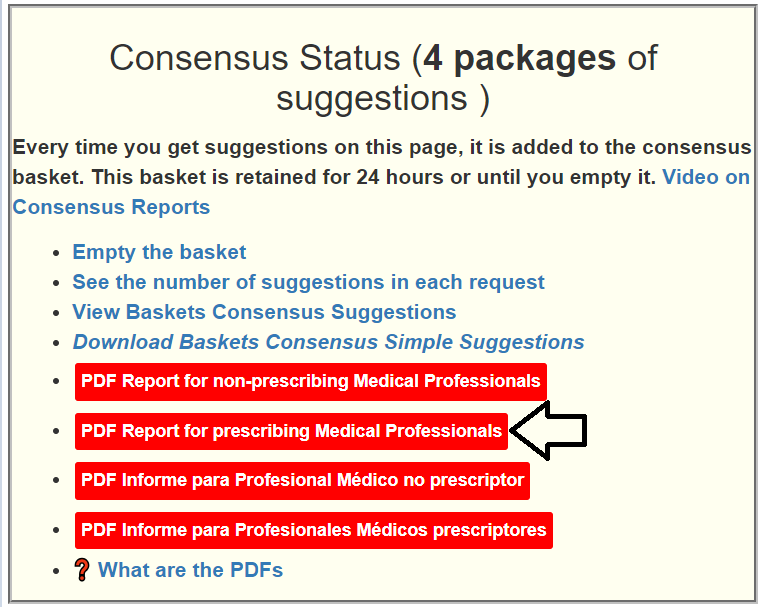
Answer #3: If you go to the Changing Microbiome tab, you will see 4 red buttons

Clicking the prescribing Medical Professional one will generate a report containing antibiotics often. Below is the latest for the person you referred to. There are 4 listed. Those are the ones that likely have the best odd — favored to correct the microbiome and also favored by Dr. Jadin (see Dr. Jadin’s Current Protocol for ME/CFS)

Beware of Social Influencers!

People saying “it worked for me” or “This is what ME/CFS is and thus this is how you should treat it” are the biggest threats to successful treatment. The microbiome influences almost every medical condition and appears to be very connected to symptoms and speed of progression. It may not be the cause — it is likely a “chicken and the egg” question (which came first); or in more computer terms, it’s a feedback loop that needs to be broken. The microbiome is a far easier target than whatever is “behind door #2”.