Increasing Coprococcus Catus

In Ian Lipkin et al 2017 study, low Coprococcus Catus was reported (on average). [Index to all posts on Study] comparing all CFS patients against normal controls. As with many families, it is little studied in the past with just 5 PubMed citations despite being discovered in 1974.

  • “the capacity to produce propionate or butyrate from hexose sugars resided in different species (C. Caus) [1974]
  • Coprococcus catus, and Streptococcus mitis that were strongly ureolytic on isolation later lost this ability.” [1974] – produces urease.
  • “On teat skin… but not in milk”[2012]
  • “uses lactate …known to be able to switch from butyrate ( butyryl-CoA:acetate CoA-transferase route when grown on fructose) to propionate(acrylate pathway) production on different substrates.” [2014]
    Slide 1
  • “Next-generation sequencing revealed that obese and non-obese subjects had different gut microbiota compositions and that certain bacterial species were significantly associated with each group… C.Catus ..significantly associated with the obese group: ” [2015]
  • “with Preeclampsia ….a reduction in probiotic bacteria Coprococcus catus” [2017]

The chart below shows its relationship to similar bacteria.

Bottom Line

To grow more, we need to feed more — and acetate producing bacteria (upstream) are likely desired.

  • E.Coli is an acetate producer [1990] and also reported low in CFS
  • Bifidobacterium longum subspecies: longum JCM 1217T (BL), infantis 157F (BF), or longum NCC 2705 (BN). are acetate producers [2012] Other bifidobacterium are not.

What is the general impact of acetate?

  • Reaches the portal vein and is metabolized in various tissues
    Intestinal effects
  • Is a minor energy source for the colon epithelial cells
  • Decreases the pH of the colon (which decreases bile salt solubility, increases mineral absorption, decreases ammonia absorption, and inhibits growth of pathogens)
  • Has anti-inflammatory effects
  • Increases colonic blood flow and oxygen uptake
  • Is used by cross-feeding species as a co-substrate to produce butyrate
    Other effects
  • Is a substrate for cholesterol and fatty acid biosynthesis in the liver
    Is an energy source for muscle and brain tissue

Oh boy! low acetate levels appears to be happening in CFS… and hence the low level of the bacteria consuming it.  Two major families producing acetate (E.Coli, Bifido) are also known low, hence this appears to be a downstream cascade.

THIS IS NOT MEDICAL ADVICE — this post is an education summary of what has been reported on PubMed. Always consult with a knowledgeable medical professional before changing diet, supplements and prescription drugs.
Decreasing Clostridium Methylpentosum

In Ian Lipkin et al 2017 study, high clostridium methylpentosum was reported (on average). [Index to all posts on Study] . This bacteria was first identified on 1989.

  • “An intestinal bacterium isolated from a human subject utilized only two methylpentoses (L-rhamnose and L-fucose) and two pentoses (L-lyxose and D-arabinose) as fermentable substrates, among many compounds tested..This organism may participate in intestinal digestive processes by metabolizing rhamnose released via the enzymatic depolymerization of dietary pectin.” [1989]

Bottom Line

We do not know if any antibiotics are effective. The only option is starvation by reducing intake of two methylpentoses (L-rhamnose and L-fucose).

Increasing Bacteroides Caccae

In Ian Lipkin et al 2017 study,  low bacteroides caccae was reported (on average). [Index to all posts on Study].

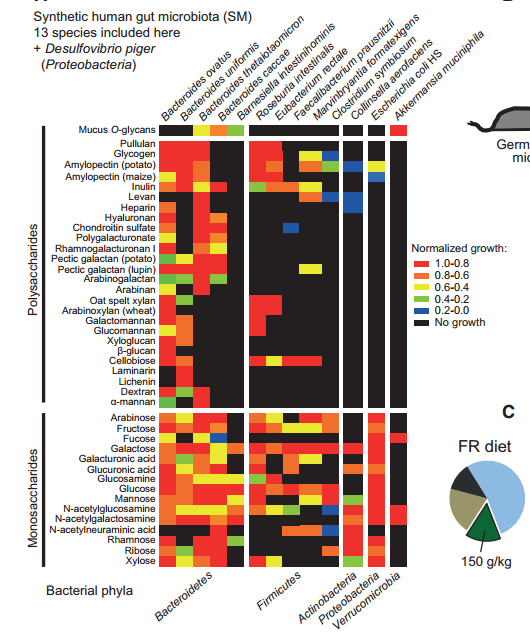
I almost gave up on finding more information until I found the diagram below (which also contains Faecalibacterium prausnitzii which is also low!)

From A Dietary Fiber-Deprived Gut Microbiota Degrades the Colonic Mucus Barrier and Enhances Pathogen Susceptibility (2016)

bc

The best growth medium are:

  • Xylose Amazon
  • Ribose (shown to help CFS in studies) Amazon
  • Rhamnose – very expensive
  • N-actylneuraminic acid
  • Glucuronic acid
  • Arabinose Amazon
  • Inulin
  • Mannose  –  Amazon
  • Glucose (which also is liked by two other low bacteria)
  • Chondroitin sulfate
  • Pectic galactan (potatoand lupin)

Bottom Line

It looks like Inulin and Ribose are again on our list, and many of the above are also available on Amazon etc.

Decreasing Anaerotruncus Colihominis

In Ian Lipkin et al 2017 study, high Anaerotruncus colihominis was reported (on average). [Index to all posts on Study] . “The species is found only relatively infrequently in the human gut. The presence of Anaerotruncus colihominis does not appear to be associated with any particular health disorder.” [uBiome]. It was identified in 2004.

cp31773-f2

  • “It produces Indole and utilises glucose and mannose…It produced indole and β‐gluocosidase, and used glucose and mannose but not arabinose, cellobiose, glycerol, lactose, maltose, mannitol, melezitose, raffinose, rhamnose, salicin, sorbitol, sucrose, trehalose or xylose.” [2006]
  • “Cells are sensitive to vancomycin (5 µg) and kanamycin (1000 µg), but resistant to colistin sulphate (10 µg)”[2006]
  • The major fermentation products from glucose include acetate, ethanol, hydrogen, and carbon dioxide; lactic acid, propionate, and succinate are not produced.” [2015]

Bottom Line

Antibiotics or trying to starve them (without starving other low bacteria).

Decreasing Bacteroides Vulgatus

In Ian Lipkin et al 2017 study, high bacteroides vulgatus was reported (on average). [Index to all posts on Study

  • refined wheat breads .. the abundance of bacteria related to Bacteroides vulgatus, decreased..” [2013].
  • PolydextroseBACTEROIDES: species (B. fragilis, B. vulgatus, and B. intermedius) decreased” [2000]
  • “Rats on the all-rice diet had significantly lower faecal concentrations of the main menaquinone-producing bacterial species (Bacteroides fragilis and Bacteroides vulgatus) than animals on either of the other two diets ( a rice + beans diet or a stock diet)” [1990]
  • The suppressive effect of bifidobacteria on Bacteroides vulgatus, a putative pathogenic microbe in inflammatory bowel disease[2003].
    • Bifidobacterium infantis 1222 highly inhibited the growth of B. vulgatus in the coculture”
    • bifidobacteria-fermented milk…showed a significant reduction in the relative proportion of B. vulgatus” [2003]
  • L. reuteri strain…Bacteroides vulgatus were decreased,” [2014]
  • “Lactobacillus rhamnosus GG or Lactobacillus plantarum 299v ..did not prevent colitis in B vulgatus” [2003] — technically no effect
  • “pulverized petal of Rosa rugosa… the growth of Bacteroides vulgatus, Escherichia coli, Staphylococcus aureus, and Bacillus cereus was completely inhibited” [2008]

Bottom Line

Above we see a lot of items to avoid. In terms of items to take, we have just a few

  • L. Reuteri probiotics
  • Bifidobacteria probiotics
  • Reduce consumption of beans

THIS IS NOT MEDICAL ADVICE — this post is an education summary of what has been reported on PubMed. Always consult with a knowledgeable medical professional before changing diet, supplements and prescription drugs.