Increasing Sutterella Wadsworthensis

Another low bacteria is sutterella wadsworthensis reported by Ian Lapkin et al 2017 paper [Index to all posts on Study]. Identified in 1996.

  • (Lactobacillus acidophilus NT and Bifidobacterium longum NT) and type strains (L. acidophilus JCM1132(T) and B. longum JCM1217(T) ) …inhibit the growth of Sutterella wadsworthensis.” [2015]
  • Doripenem, a synthetic 1-beta-methyl carbapenem, has a broad-spectrum of activity against almost all species of anaerobic bacteria, including all Bacteroides fragilis group species,..(with the exception of Sutterella wadsworthensis). [2009]
  • “No metronidazole resistance was seen in gram-negative anaerobes other than S. wadsworthensis (18% resistant);” [2002] [1999]
  • ” Over 95% of S. wadsworthensis are susceptible to amoxicillin“[2004]

This is a patent for using S. wadsworthensis to treat Rheumatoid arthritis as a probiotic. [Patent filed 2014]

Bottom Line

We may have a probiotic available (at least in China) that may increase this bacteria in the near future.

Decreasing Clostridium Asparagiforme

Another high bacteria is clostridium asparagiforme reported by Ian Lapkin et al 2017 paper [Index to all posts on Study].  This bacteria was first identified in 2006 and The organism produced acetate, lactate, and ethanol as the major products of glucose fermentation. It ferments glucose. It also produce an enzyme, Threo-3-hydroxy-L-aspartate ammonia-lyase, whose role is unclear but is also produced by other bacteria in the study:

  • Alistipes putredinis, which is low.
  • Anaerostipes caccae which is high
  • Bacteroides caccae which is low
  • Bacteroides fragilis, which is high
  • Bacteroides vulgatus, which is high
  • Dorea formicigenerans, which is low
  • Eubacterium hallii, which is high

To have this enzyme shared by so many bacteria in the report is very curious and warrants research.

In terms of its simpler production

  • Lactate overproduction may contribute to D-lactic acidosis, and
  • Ethanol overproduction to the overgrowth of Pseudoflavonifractor capillosus also cited in the paper.

A closely related bacteria is  vancomycin-resistant[2009]

  • “(Clostridium asparagiforme) phylums as containing a peptide that seems to activate killer T cells, which are a natural component of the human immune system, to target and latch onto pancreatic beta-cells, rendering them useless to produce vital insulin.” [2016 blog]
  • “A large cluster including Gordonibacter pamelaeae, Clostridium asparagiforme, Eggerthella lenta, and Lachnospiraceae bacterium as well as small clusters containing strains such as Lactobacillus sp., Bifidobacterium dentium and Ruminococcus lactaris were enriched in the gut of RA patients.” [2016]

Bottom Line

We know nothing about this bacteria that can translate into clinical action.

Increasing Dorea Formicigenerans

Another low bacteria is dorea formicigenerans reported by Ian Lapkin et al 2017 paper [Index to all posts on Study].  This bacteria was formerly known as Eubacterium formicigenerans [2002].

  • Bacteria> Firmicutes> Clostridia> Clostridiales> Clostridiaceae> Dorea> Dorea formicigenerans
  • Conditions with low Dorea:
    • Parkinson’s Disease [2017]
    • Functional Abdominal Pain in Children With Autism Spectrum Disorder. [2016] But without pain, Dorea is increased [2017]
  • “An adequate bowel cleansing (Moviprep),…notably increased the levels of Proteobacteria, Fusobacteria and bacteria related to Dorea formicigenerans.” [2015]
  • “decreased after treatment only in the antibiotic (amoxicillin, tetracycline and metronidazole for 2 weeks)  group. Eubacterium rectale, Dorea formicigenerans,”

That’s it!  Moving up the tree to Dorea, we have:

  • “prebiotic (fructo-oligosaccharides (FOS) and inulin mixture)..revealed a lower abundance of Dorea” [2017]
  • “bacteria (arabinogalactan and inulin) belonging to Gemmiger, Dorea, Roseburia, Alistipes, Lactobacillus and Bifidobacterium genera were found to be highly abundant or stimulated by the prebiotics in the lean microbiota” [2016]
  • Alcohol …  significant reductions in genra Clostridium IV and XIVb (p<0.001), Dorea (p<0.01), [2017]
  • “animal-based diet caused a significant increase in the relative abundance of Bilophila, Odoribacter, Dorea and Ruminococcus (belonging to Lachnospiraceae) and a significant decrease in the level of Bifidobacterium after five days of intake.” [2016]
  • High Molecular Weight Barley β-Glucan .. decreased Dorea” [2016]
    • whole-grain barley and barley malt, decreases” [2015]
  • Oral Iron …was associated with decreased abundances of operational taxonomic units assigned to the species Faecalibacterium prausnitzii, Ruminococcus bromii, Dorea sp.” [2017]  – IV Iron should be the preferred treatment in CFS
  • L-glutamine .. had statistically significant reduction. [2015]
  • L. rhamnosus hsryfm 1301.. positive correlation was observed between Ruminococcus spp. and serum triglycerides, Dorea spp. ” [2014]

Bottom Line

Above we see a lot of items to avoid. In terms of items to take, we have just a few

  • Inulin or arabinogalactan and inulin are beneficial
  • Lactobacillus rhamnosus
  • If you  are low in Iron, stop taking Oral Supplements and switch to IV Iron.

THIS IS NOT MEDICAL ADVICE — this post is an education summary of what has been reported on PubMed. Always consult with a knowledgeable medical professional before changing diet, supplements and prescription drugs.

Decreasing Bacteroides fragilis

In Ian Lipkin et al 2017 study, high bacteroides fragilis was reported (on average). [Index to all posts on StudyThis bacteria is well studied with over 5000 articles on Pub Med. Some antibiotics are effective, but there is increasing resistance [MedScape].

It is also strongly implicated with Alzheimer’s Disease and Parkinson’s (see these posts for details). For the most current list of items that impact this bacteria see my Analysis Site.

It produces butaric acid.

  • Probiotics
  • Diet
    • Mediterranean diet.. reduces”[2016]
    • “the relative abundance of Bacteroides fragilis was greater than the control from feeding the Chardonnay grape diet.” [2015] Chardonnay are white wine (green-skinned) grapes.  In the same study,  Cabernet Sauvignon [red wine, purple] grapes did not increase.
    • “a strict vegetarian diet (SVD) for 1 month..an increase in commensal microbes such as Bacteroides fragilis” [2013]
    • oat bran…lower numbers of Enterobacteriaceae, Akkermansia and Bacteroides Fragilis” [2013]
    • “Population of Bacteroides fragilis significantly decreased after elemental diet” [2012]
    • polydextrose ingestion…species (B. fragilis, B. vulgatus, and B. intermedius) decreased, whereas LACTOBACILLUS: and BIFIDOBACTERIUM: species increased.” [2000]
    • “Rats on the all-rice diet had significantly lower faecal concentrations of the main menaquinone-producing bacterial species (Bacteroides fragilis and Bacteroides vulgatus) than animals on either of the other two diets ( a rice + beans diet or a stock diet)” [1990]
  • Tannic acid, propyl gallate and methyl gallate, but not gallic acid, were found to be inhibitory to the growth of intestinal bacteria Bacteroides fragilis ATCC 25285″ [1998]
  • “whole-grain barley…decreased the Bacteroides fragilis group, but increased the number of Bifidobacterium only when dietary fat was consumed at a low level.” [2015]
  • Nisin growth curves of an a peptide reducing the growth of the B fragilis” [2014]
  • Inulin …decreased numbers of Bacteroides fragilis,” [2002]
  • ” With the exception of selective inhibitory action of n-hexane extract of Nigella orientalis on growth of Bacteroides fragilis (MIC = 0.5 mg/mL),” [2009] — specific seed extract is needed and then only some impact.
  • “The fecal levels of B. fragilis were significantly increased by the inclusion of cholesterol(1%) in the diets.” [1985]
  • Human fecal flora: variation in bacterial composition within individuals and a possible effect of emotional stress 1976]. Stress increase it. Tetracyclines work on some strains but other strains are resistant.

Bottom Line

During my readings, I came across the following results which validate a speculation that I had: individual strains different mixtures produce different chemicals. So starting with hundred of thousands strains, we need to see how each interact with each other….  if we want to be strictly scientific [All of the computer storage in the world would not be enough to store the results]. Alternatively, guided trial-and-error is viable.

  • “Therefore, cocultures of Bifidobacterium and Bacteroides can behave differently against fermentable carbohydrates as a function of the specific characteristics of the strains from each species.” [2013]
  • “When stressed, overpopulated or pathogenically stimulated, B. fragilis releases a remarkably complex array of endotoxins and exotoxins (such as fagilysin), lipooligosaccahrides (LOS), lipopolysaccharide (LPS), including an extremely proinflammatory B. fragilis LPS (BF-LPS), microRNA-like sncRNA, and a wide variety of bacterial-derived amyloids (91156576466). ” [2018]

For the most current list of items that impact this bacteria see my Analysis Site.

Increasing Alistipes Putredinis

Another low bacteria from  Ian Lipkin et. al [2017] study  [Index to all posts on Study] was Alistipes putredinis was formerly known as Bacteroides putredinis (Weinberg et al., 1937) [2003]. Like the prior two bacteria, it is a butyrate producer. It is in the the lysine pathway [2014]

  • “There was one isolate of Bacteroides putredinis resistant to chloramphenicol” [1999]
  • “Adding meat back in to a vegan diet caused an immediate increase in the bacteria (Bilophila wadsworthia, Alistipes putredinis and species in the genus Bacteroides) that grow with exposure to bile, which increases when a person eats more fat.” [From Nature]
  • Alistipes putredinis, and Eggerthella spp. were associated with cruciferous vegetable intake” [2009]

We have very little information on increasing this one, but there is a hint that should be followed up.

Looking at Butyrate Producers

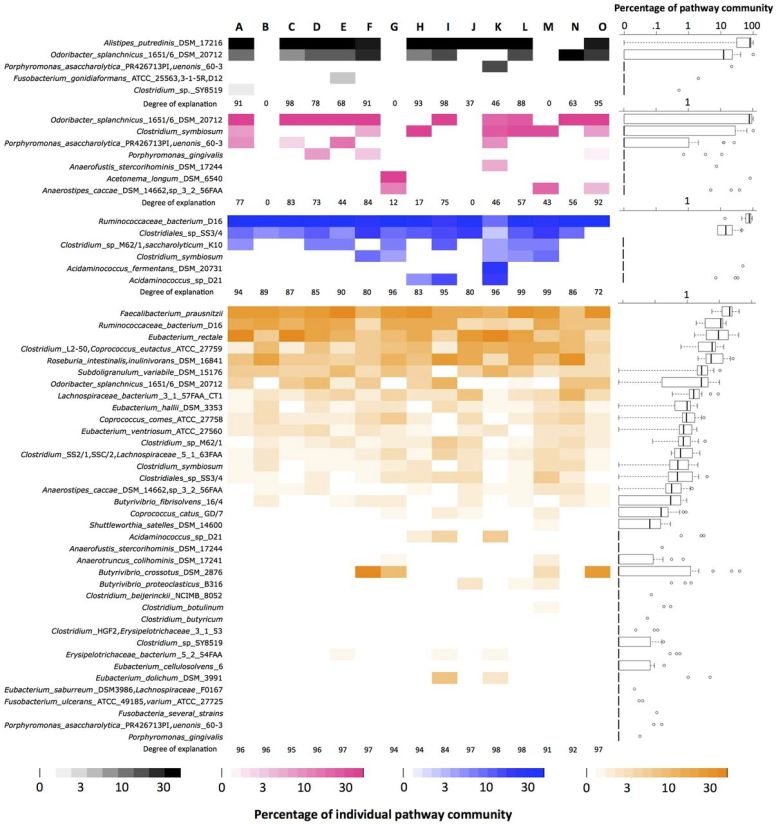
There are four main pathways (acetyl-CoA pathway, orange; glutarate pathway, blue; 4-aminobutyrate pathway, pink; lysine pathway, grey)[2014]. Shown below are these pathways.

One is missing, the lactate->butyrate path which is used by Clostridium Butyricum (while listed below — is blank).
f5-large

This raises the question: is the low level due to the low level the “intake food the bacteria uses to produce butyrate”?? That is:

Suggested Clinical Trials

As with the last post, 10 patients have their microbome measured before and then 2 weeks after the end of the interventions listed below. There should be a separate trial for each of the following.

  • Lysine supplementation
  • Valine supplementation
  • Leucine supplementation
  • Isoleucine supplementation

Additional trials could be done on specific cruciferous vegetables.

Bottom Line

Eat cruciferous vegetables! But no broccoli (see earlier post)! Supplementation with amino acids listed above could help — but we need trials.

THIS IS NOT MEDICAL ADVICE — this post is an education summary of what has been reported on PubMed. Always consult with a knowledgeable medical professional before changing diet, supplements and prescription drugs.