Fisetin – MCAS and Histamines Update

The site of this post has disappeared (https://www.syndromea.org/2019/07/23/could-fisetin-be-a-new-treatment-for-me-cfs-autism/ ) and a reader asked me to repost it’s content from a saved copy. I have done an earlier post Fisetin – an off the radar flavonoid. At the bottom I am adding some additional notes.

NOTE: Suggested dosage: for 110lb person – 1000mg/day (see Comments)

In my very first post on this site, I reported that I have a remarkable response to high dose biotin. It reduces my ME/CFS (myalgic encephalomyelitis/chronic fatigue syndrome) symptoms like severe fatigue and the mental confusion that people with ME/CFS call brain fog. It also reduces my autistic symptoms, relieving anxiety and irritability while improving my ability to read people.

A natural substance called fisetin gives me similar but better results and ▪️▪️▪️fisetin’s effects can last for days and possibly weeks for me. On high dose biotin, I relapse badly if I miss a twice daily dose. I have switched from biotin to fisetin because fisetin seems to improve the function of my brain and body for longer periods of time.Fisetin is found in many fruits in vegetables, but is found in the highest quantities in strawberries.

Fisetin helps pull me out of post-exertional malaise. As a mild ME/CFS patient, I could historically expect to get a few days to a couple of weeks of postexertional malaise after mild exercise like moderate digging in my garden. With fisetin, I am able to dig significantly more without a problem and recover more quickly when I overdo it. Things like going on a bike ride around the block will trigger about 2 days of PEM instead of 5 or 7. Not a panacea, but an improvement.Day to day, in the absence of attempting to exercise, I am so much clearer and sharper mentally. My memory and focus is so much better and I feel less physically weak and forgetful.

Like a lot of autistic people and like many people with my connective tissue disorder, Ehlers-Danlos syndrome, I deal with a lot of anxiety. Three capsules of fisetin reduces my anxiety greatly within 24 hours. It’s like meditation in bottle. Fisetin also helps a great deal with the constant low level depression that I have had most of my life, that many people with autism have.A bottle of fisetin will generally tell you to take 1 capsule. I have never had results with less than three capsules and have taken 5 capsules twice daily with good effects. Fisetin has exceptionally low toxicity. Existing fisetin research might shed light on why it works for me.

✅✅Fisetin Inhibits Mast Cell Activation

Like many people with ME/CFS, Ehlers-Danlos Syndrome and autism, I also have mast cell activation syndrome (MCAS), an inflammatory disorder of a certain type of immune cell called a mast cell. MCAS caused the bouts of flushing and I hives I got when I first became ill with ME/CFS.

This 2007 article found that fisetin downregulated mast cell activation in part by suppressing one of the major inflammatory molecules in the body: NF-kappaB. NF-kappaB

NF-KappaB is considered the master regulator of the inflammatory response in the body. Indeed, fisetin has other effects in the body related to suppression of NF-KappaB activation. In animal study published last year, fisetin inhibited airway inflammation and hyperresponsiveness in an animal model of asthma by interfering with NF-KappaB. In another study, fisetin reduced signs of disease in an experimental animal model of inflammatory bowel disease. In a chronic inflammatory disorder such as ME/CFS, it might make sense to try something that broadly downregulates the inflammatory response. Ischemia-Reperfusion InjuryI actually chose fisetin to try specifically because it seems to protect the body and brain against the effects of a type of damage called ischemia-reperfusion (I/R) injury. I/R injury occurs when cells are temporarily deprived of blood and then blood is re-introduced. Cells don’t do well being deprived of oxygen, but serious damage also occurs when the oxygen supply is re-established.

I have been concerned that some version of mild I/R injury in the brain occurs in ME/CFS because we tend to have low blood pressure as well as syncope or light-headedness when standing.

Low blood pressure makes it hard to pump adequate blood to the brain all the time and syncope is a sign that the brain doesn’t have enough blood. A number of studies have found problems with blood flow to the brain in ME/CFS.I am also concerned that changes in the circulatory system in the body produce conditions of periodic blood impairment to cells. Research from the Open Medicine Foundation has found that red blood cells in ME/CFS fail to deform and flow smoothly through small blood vessels, a situation which would cause cells to be periodically denied oxygen. Fisetin has been found to prevent I/R injury in the heart as well as the brain and protect mitochondria from the damaging effects of I/R injury.Fisetin, Leaky Gut & Microglial Activation.

ME/CFS patient have show elevated antibodies to LPS, a component of bacteria that inhabit the gut. When this component ends up in the blood stream in larger than normal quantities, it can potentially trigger sepsis, an often deadly inflammatory response to bacterial infection.While the quantity of LPS in the blood of ME/CFS patients doesn’t reach that of sepsis patients, one of our researchers has suggested that ME/CFS is like a slow, chronic sepsis.

One part of the body that circulating LPS affects is the brain and many of the symptoms of ME/CFS seem to emanate from the brain, in particular flu-like malaise and brain fog. In animals, LPS exposure causes a depression-like response that may be related to the sensations of fatigue, depression and malaise that people feel when exposed experimentally to LPS. Brain inflammation in general causes feeling of fatigue, malaise, pain and depressed and anxious mood, regardless of the trigger. This response is related to the activation of immune cells in the brain called microglia.

  • Fisetin inhibits the microglial inflammatory response to LPS, and reduces the depression-like response to LPS.
  • Fisetin may be able to broadly suppress brain inflammation caused by microglial activation, even if the cause is something other than LPS exposure.

For more about the involvement of brain inflammation and microglial inflammation in ME/CFS, check out Jarred Younger’s work. He is making really interesting progress with imaging brain inflammation in ME/CFS.Children with autism have also been found to have an ongoing neuroinflammatory process involving microglial activation.Fisetin Affects Pathways Connected to Autism☄️☄️mTOR is a molecule frequently implicated in the pathogenesis of autism. It is involved in the development of the brain and the communication between brain cells. ( Taube added : see Dr Alex Vasquez on NAC inhibiting mTOR ) In animal models, cow’s milk allergic animals show autistic symptoms when exposed to cow’s milk and this effect appears to be caused by ☄️☄️☄️increased mTOR signaling in the brain. My food allergies trigger autistic symptoms in me.

Fisetin inhibits mTOR signaling in the brain.

Fisetin also inhibits a molecule implicated in autism called p38 MAPK. p38 MAPK triggers microglial inflammation as well as ☄️high serotonin levels, which are often seen in autism. Glutathione is one of the most important antioxidants in the body. Oxidative stress is high in autism and in ME/CFS while glutathione is low (here and here) in both conditions. Animal studies suggest that fisetin is able to increase glutathione levels in the presence of oxidative stress.

Fisetin also counteracted a neurotoxin called aluminum chloride. Fisetin blocked aluminum chloride’s effects on inflammation and oxidative stress and protected against the neurobehavioral deficits alumnum chloride can cause, in part by restoring glutathione levels.

Fisetin With Mast Cell Stabilizers When I started taking fisetin, I was already on a very helpful mast cell stabilization regimen that includes ketotifen and Benadryl. I don’t know exactly what difference fisetin would have made for me without additional mast cell stabilization, but added to a mast cell stabilization regimen, fisetin is sort of like a wonder treatment for me.

Comment by Jeff A

Additional Notes

N-acetylcysteine and histamine/allergies

In my last post on vagus nerve and IBS, I noticed some of the discussion mention impacts on acetylcysteine. This caused me to wonder about NAC and histamines/allergies/Mast cell issues. I know someone with severe allergies that was advised to take NAC for liver support by her naturopath.

Since the late 1970s N-acetylcystein has been used as an antidote after paracetamol intoxication. The treatment is traditionally given as three consecutive infusions for 20 hours and 15 minutes. The total dose given is 300 mg/kg. Half of this amount is given as a bolus during the first 15 minutes of treatment. This regime has proven very efficient in avoiding liver injury. However, side effects, caused by histamine release, are common (10-15%). 

Simplified N-acetylcystein treatment after paracetamol overdose – new recommendations from Swedish Poisons Information Centre [2019]

Similar citations:

  • “exposure to antihistamines prior to NAC treatment may protect against these [anaphylactoid] reactions.” [2020]
  • ” Anti-histamine treatment (for NAC anaphylactoid drug reactions) was prescribed for 163 (11.0%) patients” [2019]
  • ” Previous studies suggest the incidence and severity of non-allergic anaphylactic reactions (NAARs) are influenced by the rate of acetylcysteine infusion.” [2015]
  • “N-acetylcysteine (NAC) enhances the release of histamine induced by the fluoride-calcium system” [1991]

Histamine now seems to be an important mediator of the response [to NAC], and there is evidence of variability in patient susceptibility, with females, and those with a history of asthma or atopy are particularly susceptible. … The pattern of reactions differs with oral and intravenous dosing, but reported frequency is at least as high with oral as intravenous. The reactions to the intravenous preparation result in similar clinical features to true anaphylaxis, including rash, pruritus, angioedema, bronchospasm, and rarely hypotension, but are caused by nonimmunological mechanisms.

Adverse reactions associated with acetylcysteine [2009]

Bottom Line

If you are female with histamine issues, asthma or allergies — taking NAC will make some of your worst or more sensitive. If your MD or ND have recommended NAC and you have told them about allergies, asthma etc. you should print this off to inform them. It has been known since at least 1991, just 30 years ago.

Vagus nerve stimulation and ME/CFS/IBS

A reader messaged me:

There reports of people improving using VNS recently; came across this.

https://bioelecmed.biomedcentral.com/articles/10.1186/s42234-018-0004-9
How could this affect the good vs bad bacteria in one’s microbiome?

A reader via facebook

 We have recently reported in a 6 month follow-up pilot study that VNS improves active Crohn’s disease. Preliminary data of another pilot study confirm this interest. Similarly, VNS has recently been reported to improve rheumatoid arthritis, another TNFα mediated disease

Is-there a place for vagus nerve stimulation in inflammatory bowel diseases? [2018]

As a starting point, let us look at how the mind impacts the microbiome due to stress. We see a relatively long list of bacteria associated with stress reported on the national library of medicine. The state of the mind impacts the microbiome; also the microbiome impacts the state of mind (depression, sleeplessness etc). Some readings:

The study above is also cited in

Back to a mechanical/chemical approach to the analysis. What do we know change with vagus nerve stimulation. Remember, a change of circulating chemicals will influence bacteria growth.

The central nervous system recognizes peripheral inflammation via afferent vagus nerve signaling. The brain can attenuate peripheral innate immune responses, including pro-inflammatory cytokine production, leukocyte recruitment, and nuclear factor kappa β activation via α7-nicotinic acetylcholine receptor subunit-dependent, T-lymphocyte-dependent, vagus nerve signaling to spleen.

The vagus nerve and the inflammatory reflex: wandering on a new treatment paradigm for systemic inflammation and sepsis [2012]

Bottom Line

Vagus nerve stimulation alters the chemicals in the body. Studies in mice with electronic stimulation indicate that it can make inflammation worse or better — depending on the parameters. There are a wide variety of methods to stimulate the vagus nerve — a few common ones[src] are:

  • Cold Exposure. …
  • Deep and Slow Breathing. …
  • Singing, Humming, Chanting and Gargling. …
  • Probiotics. …
  • Meditation. …
  • Omega-3 Fatty Acids.
  • Exercise. …
  • Massage.

The use of electronic means should be done with caution because the setting used can have an adverse effect (according to mice studies). This may also apply to exercise with ME/CFS.

While I could not find studies explicate for CFS/ME, I did find some for items often co-mobid with ME/CFS

I have concern over arbitrary vagus stimulation with ME/CFS, especially electronic means. I know too many people that have adverse reaction to exercise, humming, singing etc. In some of these cases, it is possible that the adverse reaction may be connected to a vagus nerve infection.

Is ME/CFS a case of CBIS?

A reader asked me to review a new paper “Chronic bacterial intoxication syndrome under the mask of CFS/ME” that is being discussed a lot on Phoenix Rising. I tend to have an interesting perspective:

  • being in remission from CFS/ME I have deep desired to be current but far from desperate
  • many people reading and discussing are desperate. Desperation often diminished critical analysis
  • I am well trained professionally — not only in the scientific method, but also in statistical analysis.

Key Weakness of CBIS paper

Over the last few decades, it is common for a forlorn hope discovery to be done solely on some finding of a group of ME/CFS patients. The critical test is a simple one: a third party lab confirming the findings with a different group of ME/CFS patients with a matching control/healthy group. The ideal is multiple labs confirming this. Failure to replicate is too frequently the slow death of theories (but many “believers” will continue to advocate the theory – they want something to believe in).

Participants: All patients (children up infancy and adults aged till 80 years) who seeked advice in
clinics during 2009-2020 with complaints consistent with a diagnosis of CFS, which was previously
diagnosed in almost a third of patients on former stages of examination and treatment.

There are no Controls being cited. Additionally all of the patients appears to be from two clinics in the Ukraine. This may be an environmentally homogenous group (shared DNA, shared diet, shared vaccine history).

In all patients with typical features of CFS there was revealed a focus of chronic bacterial infection
in the kidneys, which more often remained clinically locally asymptomatic and was called Nephro
dysbacteriosis.

The term “Nephro dysbacteriosis” is not found on PubMed, so how can it be “was called

The issue of being “asymptomatic” is a term of today, with asymptomatic COVID being an echo. The concept is not new, with hypercoagulation model — we have it being asymptomatic in terms of expected symptoms (strokes,  Deep Vein Thrombosis etc) but symptomatic with fertility issues. Similarly with Cecile Jadin model, we have “occult infections” which do not appear with typical tests, but are detected with specialized tests.

If it is true, what should be forecasted? Well, a chronic low level kidney infection should manifest itself with kidney diseases and lab tests over time. Over the last many decades, there appears to be only a single paper, with no commonality.

 Increases in pain distribution were associated with reductions in serum essential amino acids, urea, serum sodium and increases in serum glucose and the 24-hour urine volume; however the biochemistry was different for each pain area. Regression modelling revealed potential acetylation and methylation defects in the pain subjects. 

Widespread pain and altered renal function in ME/CFS patients[2016]”

Skipping the 14 pages of the paper is reciting history and many more pages on individual histories, we come to identification of the bacteria

Bacteria that had to live naturally in our intestines and work there productively, providing human life. But which, apparently by mistake, but purposefully settled in the kidneys. Most often they were enterococci and enterobacteria-Escherichia coli, Klebsiella, Proteus, Enterobacteriaceae, Morganella, Acinetobacteria, Hafnia,
Seratia and others, in no single cases – Staphylococcus and Streptococcus, less often – Nosocomial Pseudomonas aeruginosa.

“A toxicological blood test, the results of which will be presented in Report 8, was considered as a laboratory confirmation of the diagnosis CBIS.” – problem is this, a blood test is not kidney specific. We could be detecting bacteria escaping from the guts only.

Note also, this is not a test normally available — it is “a toxicological blood test using the “Toxicon” diagnostic system developed by a group of Ukrainian scientists

What is their treatment?

The treatment are “bacterial vaccines”. This is a concept not well known in the west and will likely be at least a decade before any significant approval would be granted in the west. A 2018 review is well worth readin , Vaccine development for enteric bacterial pathogens: Where do we stand? (Full article PDF). Two quotes from the paper:

“During the first course of immunization with bacterial autovaccine, the intensity of pain in all patients decreased
significantly, and after 2-3 courses – completely passed. During follow-up observation there were no recurrences of trigeminitis.”

“There was prepared bacterial auto vaccine and was carried out immunization with a course of 10 injections. Already during vaccination and for the next 2 years of the follow-up observation there were no more abdominal pain attacks.”

Attitude Issues

The following indicate bravado and bias — they can be effective in winning an audience and a following. Often this helps with raising funds for the person to continue research.

  • the new revolutionary previously unknown diagnosis Chronic Bacterial Intoxication Syndrome (CBIS) that gives such a long-awaited in-depth clinical understanding and discovery of the true basic etiological and pathogenetic causes of the long-known and worldwide-spread, but still etiologically mysterious CFS/ME”
  • “Moreover, it was found that in at least 90% of patient’s nephron dysbacteriosis and CBIS had developed precisely after thoughtless, expansive and aggressive antibiotic therapy, which often began in childhood.” — someone is on soap box describing a popular demon.

Bottom Line

A vaccine against a kidney bacteria will also have direct impact on the same bacteria in the gut microbiome. On the flip side, appropriate antibiotics would also impact the same bacteria in the Jadin’s protocol using antibiotics will also impact kidney infections.

There is one important difference: vaccines have a longer life of action(typically a year or more) than an antibiotics. Also be aware that the study cited that up to 10 courses of vaccines were needed with some. This sounds a bit like 10 rounds of antibiotics!!

Is it Kidney or Gut? Do we need to use a vaccine or bacteria phages or antibiotics or other forms of microbial manipulations?

Their asserted results are similar to that asserted from both Jadin’s antibiotics protocol and the Hemex protocol (which often uses antibiotics with anticoagulants like heparin).

In 30/35 (85.7%) cases there was almost complete clinical remission in the course of both fibromyalgia and in general CBIS, which in 23/35 (65.7%) patients lasted from 3 to 5 years (observation period).

page 48

The statement that in the basis of chronic fatigue in various diseases there is a single pathogenetic mechanism – persistent chronic bacterial intoxication due to nephrodisbacteriosis may be a little premature.

page 82.

To my mind, for treatment of CFS/ME, the root cause is excessive growth of multiple bacteria with both this model and my microbiome model. The goal is to correct this — vaccine, antibiotics, phages, diet and supplement changes? Whatever works. The key factor is that it is NOT a cure, it is a remission — one that needs to be worked on to maintain.

Until vaccines become available, appropriate multiple courses of the right antibiotics is available today (MD willing!!!). Unfortunately, most MDs are not trained on addressing multiple bacterial infection without nuking the gut.

Their results are creditable, their treatment is creditable — their model may not be

An early twenties CFS Patient Analysis

The patient is in the mid 20’s male and under treatment with a very well known CFS specialist. “although he is stable we aren’t seeing any further improvement….  He doesn’t meet the official CFS definition since he only has the PEM (Post-exertional malaise), general on-going fatigue, and maybe some sleep issues.”

This is the first of two parts, the second part is after the first Pfizer covid shot. This will be interesting to see the shifts.

“Also, after this sample was sent into Thryve he had his first Pfizer covid shot and then had a crash – so I got another sample at that time that I should get results for in a few weeks.”

Walk thru of this blog

KEGG Results

KEGG Probiotics

I am going to do a multiway compare in the hope of clustering a consensus from different algorithms. Using advance suggestions

I tend to favor KEGG because the data it is working from is significantly complete. Using Net Benefit and Advance suggestions — we got only weak results (usually against) or no results, except for Lactobacillus paracasei. This would be my first choice for trying a probiotic except it is a histamine producer.

Probiotic (available commercially)
Bacillus thuringiensis or
Bacillus mesentericus
Clostridium butyricum
Lactobacillus paracasei (D-Lactic acid producer [2013] )
Bifidobacterium adolescentis

Enterococcus faecalis
Lactobacillus kefiri

Probiotic Suggestions Analysis

Look at the Lactobacillus Genus, we see that this person is at the 87%ile (i.e. much higher than most people). Bifidobacterium is 29%ile, i.e. in the normal range. It is not surprising that these two are low as suggestions. On the other side, there was ZERO bacillus reported (not unusual, Thryve only reports Bacillus 45% of the time) which seems to be reflected in the top suggestions being Bacillus probiotics.

Having high lactobacillus can contribute to ME/CFS Symptoms. In general, lactobacillus probiotic should be avoided unless verified to not be d-lactic acid producers (if no information, assume they produce!!)

KEGG Supplements

As with probiotics, I tend to favor KEGG suggestions for similar reasons. The list below is where their generated values falls in the bottom 5%. All of them are available on Amazon, iHerb and other suppliers

As always consult with your medical professional. A pattern to discuss: start at 1/8 of the suggested dosage and increase every 4 days (usually doubling). Do one at a time, keeping those that have apparent benefit. If you stop giving one, wait 4 days before starting the next, on occasion, stopping may reveal that it helped — just slowly.

Most of the suggestions above appears to agree with studies as illustrated above. We have 3 suggestions that are novel (unstudied) for ME/CFS: Phytase, Molybdenum, L-Lysine.

This strong agreement to studies is reassuring for using the KEGG model. The model knows only the bacteria, no lab tests or diagnosis. Far more critical (for modelling), it appears to explain that the lab results can be reliability attributed to the ME/CFS microbiome population!

Core Supplements

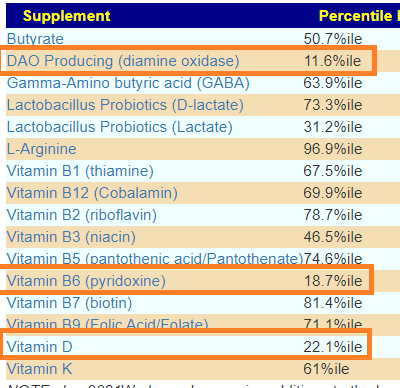
While core supplements has largely been replaced by KEGG, it is still available. There was only one supplement computed that strongly suggests supplementation, DAO. There is no studies on PubMed for CFS and DAO, however DAO does reduce histamine levels — it is a possible experiment to try. I know several people with ME/CFS that have histamine issues, in some cases, severe hay fever. There is some literature in this direction:

The second lowest is Vitamin B6

The third lowest is Vitamin D, a well establish lab result for CFS. Generally “low level” supplementation does not work because the ME/CFS microbiome does a poor job absorbing it. A collection of PubMed Studies, and my prior blog posts

An important observation

All of the above suggestions came solely from the microbiome of the person (no diagnosis information at all!!!). The suggestions agree with significant subsets of ME/CFS patients. Using the microbiome, we appear to be able to be uber-specific to the person. We are not working off “general treatment suggestions” for ME/CFS. The suggestions in this post may not apply to a different ME/CFS patient — they have a different microbiome! Likely similar, but different!

Philosophy

The concept is to supplement what is not being produced by reduced bacteria creating a more normal environment. The hope is that a more normal environment will trigger feedback loops in the microbiome that will increase the reduced (or excessive) bacteria. The microbiome is a city – with a city, reducing the crime rate can often be the result of eliminating causes like: poverty, education, job opportunities, etc.

National Library of Medicine Comparison

In general, the bacteria identified for Chronic Fatigue Syndrome in Studies is not suitable for strong pattern matching. Chronic Fatigue Syndrome has a spectrum with many subsets. This variety is reflected in the studies.

I went to the Component Analysis / Medical Conditions page and then clicked under the Count Column, i.e. by the 📚 for Chronic Fatigue. I then Clicked on Direction to put all of the flagged items (💥) at the top. I then put checked the checkbox besides them (family, genus, species). On this page the 💥 is NOT outside of the Kaltoft-Moltrup Normal Range, but above 75%ile or below 25%ile. The Change Your Microbiome / Medical Condition (PubMed) Outliers applies the 💥 with the K-M ranges (in this sample, there were actually zero outliers!!!)

Only 5 matches.

Why this change? The studies reported averages were above or below for Chronic Fatigue Sydrome compared to controls. The studies did not report extreme values (which is the K-M goal).

Using Hand-picked Bacteria

Above we have the Hand-Picked Suggestions (which uses only the above).

First, we see that two of my favorites (as a person who has dealt with ME/CFS personally) is at the top of the list: Slippery Elm and Triphala. All of the probiotics suggested are non-lactic acid producers: Bifidobacterium. We do have a disagreement with CORE suggestions on Vitamin B6 (CORE says levels may be low, above says avoid). Given that the avoid list is full of B-Vitamins, I would tend to avoid.

Other ways of Getting Suggestions

Since ME/CFS often have cognitive challenges, I have a canned computation ( Changing Your Microbiome / For Chronic Fatigue Syndrome./ Brain Fogged ). The suggestions are below.

Above I did the path that I felt was best focused a person for Chronic Fatigue Syndrome. The scopes here is less bacteria and also flags high Lactobacillus. We could add Lactobacillus to the hand picked bacteria (exercise for the reader), but I am inclined not too because lactobacillus will dominate suggestions because there are so many studies for it, the other bacteria will fade off the suggestions.

Bacteria NameAnalysis
  Dorea longicatenaToo Low
  LactobacillusToo High
  Odoribacter splanchnicusToo Low

There are some others options on the site:

Dr. Jason Hawrelak Guidance

His results are based on general health and not ME/CFS. With this sample, we see these bacteria being selected. There is nothing in common with our first analysis, and only lactobacillus with our one above.

Bacteria NameAnalysis
  AkkermansiaToo Low
  BifidobacteriumToo Low
  BlautiaToo Low
  Faecalibacterium prausnitziiToo High
  LactobacillusToo High
  RoseburiaToo Low


I would not run with these suggestions — they are simply not focused on ME/CFS.

Symptom Prediction – Citizen Science

The bacteria pattern found with some 1700 prior samples appears to match. This implies that many symptoms are microbiome bacteria caused — something that may be modified. Many of the prediction agrees with what we know. One item is new, Carbohydrate intolerance which is hinted at by our Phytase (Enzyme) recommendation from KEGG.

It also lines up with the iron recommendation and suggests the mechanism for iron being low:

Antibiotics?

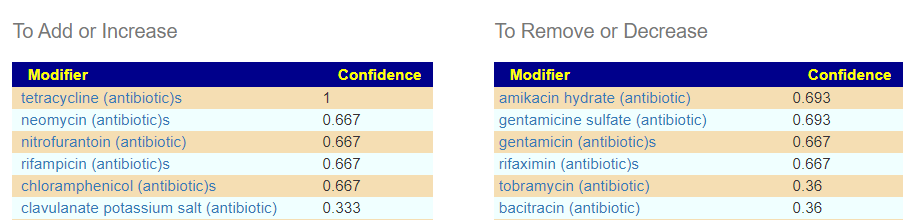
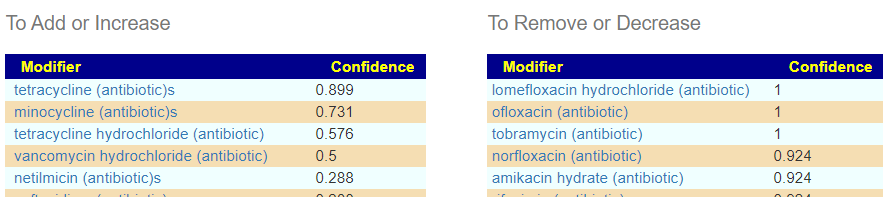
The physician being worked with is not dogmatically opposed to using antibiotics. So I did antibiotics only suggestions with the results shown below. Remember this is off label use of these antibiotics.

From the original handpicked selection
From Canned ME/CFS suggestions
Using Dr. Jason Hawrelak’s Significant Bacteria

We have everyone agreeing!!! The Tetracycline family (which includes minocycline and doxycycline). My personal preference in minocycline. Not only do we have agreement between methods — we have agreement with protocols reporting success (to various extents) with ME/CFS. [Success or failure is likely connected to each patience’s microbiome]. This approach fell out of favor during the crackdown on “inappropriate use of antibiotics to prevent antibiotic resistance”, and appears to be considered again in 2021.

In this case, “prescribing antibiotics to address a microbiome dysfunction” (which is exactly what we are doing), would likely fly with most medical review boards 🙂

Bottom Line

We have come up with some very specific suggestions based on the person’s microbiome and ME/CFS as a condition. We have also looked at some less specific approaches. These approaches would often be the “stock-in-trade path” that many medical professional will walk. IMHO, they are “ok” but not as “good” or “awesome” as a really focused approach.

Remember, all suggestions should be discussed with a medical professional before doing. The Microbiome Prescription site goal is to model a variety of diseases and compute theoretical candidates for treatment. In some cases, like this post, we find that many candidates have been tested with positive results. Other candidates have not been and thus are potential ones (with logic and studies inferring their benefit).