Potentiators: Often the difference between success and failure

In dealing with ME/CFS I came across a group of supplements/drugs that I continue to use. The main reasons are:

  • They are biofilm breakers, thus weaken the defenses of some bacteria
  • Blood thinners of diverse mechanisms – I deal with a Prothrombin 20210 A/G defect (85+% of ME/CFS patients are believed to have coagulation defects – often due to epigenetics)
  • They make antibiotics more effective because a much (up to 10x ) higher amount of the antibiotics makes it into tissue.
  • Last, it reduces my risk of blood clots; remove much of blood vessel fibrin deposits that reduce the amount of oxygen you receive.

This is a short summary of my main ones with their literature.

Serrapeptase 

This in an enzyme derived from silk worms. It is produced for the silkworm to escape it cocoon. It is effective against some types of coagulation.

Benefits:

Nattokinase

This is an enzyme that exhibits strong fibrinolytic activity. Natto is a kind of fermented soy bean-cheese used in Japan. This characteristic is not from the soy but the fermentation (produced from Bacillus subtilis Natto).

Lumbrokinase

This is strong fibrinolytic enzyme was readily obtained in saline extracts of the earthworm.

  • digested fibrinogen and inhibited platelet adhesion [1991]
  • fibrinogen decreased significantly. Inhibition of intrinsic coagulation pathway and the activation of fibrinolysis via an increase of t-PA activity.  [2000]

Bromelain 

This is an extract from pineapple stem.

Bottom Line

These should not be taken continuously.

Warning 1:Most are anticoagulants which means that the risk of easy bruising and failure of the blood to clot is high.

Warning 2: With antibiotics, they can change a minor herx into needing to crawl on the floor herx. With 10x the concentration, you are effectively increasing the antibiotic dosage 10x!

Appropriate dosage and duration should be done in consultation with your medical professional.
Patents and ME/CFS

A reader forwarded me a copy of a 2019 patent application Therapeutic agent for chronic fatigue syndrome. Patents are an interesting mining source because often they come from unpublished studies. The last time that I did a patent review, I found some interesting stuff.

On the flip side, the inclusion of ME/CFS in the patent application rarely means that the focus is ME/CFS. Patents are written to be ascribe every possible use just in case someone later discover a use. I have several patents and have written over a half dozen of them.

This is a quick review of a few of the more interesting patent applications that mentions ME/CFS:

Bottom Line

Only one was CFS specific, Japanese horseradish (wasabi) . There were many dealing with FMT — I enjoyed seeing the “Fecal Floral Transplant” – A shit by any other name (to paraphrase Shakespeare)

Looking at wasabi or horseradish, I found no significant literature on it’s impact on the microbiome. I found just 140+ studies citing wasabi

Since the western diet is relatively devoid of deeply-colored fruits, vegetables and other plant-derived culinary items (e.g., turmeric, ginger, seaweeds, purslane, wasabi, Brassica-family sprouts, and regional spices) this represents a loss of complex phytochemicals that would otherwise make their way into the gastrointestinal tract

The Microbiome and Mental Health: Looking Back, Moving Forward with Lessons from Allergic Diseases [2016]

Wasabi does appear to have significant benefit for a variety of stomach ailments. It is likely beneficial for many digestive issues — NOTE: that it may be harmful for people with the FOXO3 mutation (we are back to the DNA-Microbiome interaction complexities).

A classic marketing designed probiotic

On The Gut Club someone asked about a Slovenia Probiotic Mixture. I have great respect for some of the raw probiotics that Eastern Europe produces and often sell on to retail packagers to mix and sell.

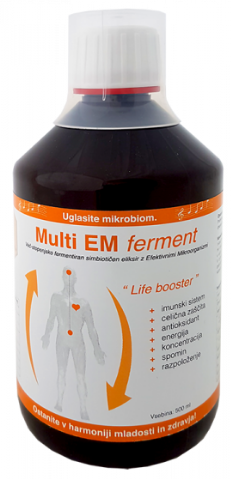
Multi EM ferment™

Today, there was a mixture which I must described as tossing in the kitchen sink!!! The mixture was literally tossing in anything and everything that could possibly have a health benefit.

What is in it? 20 BCFU consisting of:

Bacillus subtilis Lactobacillus delbrückii
 Bifidobacterium bifidum Lactobacillus farraginis
 Bifidobacterium breve Lactobacillus gasseri
 Bifidobacterium longum Lactobacillus helveticus
 Bifidobacterium infantis Lactobacillus johnsonii
 Bifidobacterium lactis Lactobacillus paracasei
 Bifidobacterium lactis Lactobacillus parafarraginis
 Enterococcus faecium Lactobacillus plantarum
 Lactobacillus acidophilus Lactobacillus reuteri
 Lactobacillus amylolyticus Lactobacillus rhamnosus
 Lactobacillus amylovorus Lactobacillus salivarius
 Lactobacillus bulgaricus Lactobacillus zeae
 Lactobacillus casei Lactococcus diacetylactis
 Lactobacillus casei Lactococcus lactis
 Lactobacillus casei Streptococcus thermophilus
 Lactobacillus crispatus

At least one of these I have never seen for sale in a probiotic before,  Lactobacillus zeae. I found almost nothing about it effects clinically and not a single safety study.

So we toss every strain on the lab kitchen shelf in… BUT WAIT, THERE IS MORE…

  • Pineapple,
  • Angelica Root,
  • Anise,
  • Basil,
  • Knot,
  • Fennel,
  • Pomegranate,
  • Blueberries,
  • Raspberry – Leaves,
  • Ginger,
  • Olive – Leaves,
  • Oregano,
  • Peppermint,
  • Rosemary,
  • Red Tea,
  • Red Clover,
  • Sage,
  • Black Cumin,
  • Sweet Root,
  • Thyme,
  • Maca,
  • Pink Root,
  • Turmeric,
  • Cinnamon,
  • Vanilla,
  • Cardamom,
  • Saffron,
  • Grapefruit Extract,
  • Terrible Roast Extract (OPC) and
  • Ganoderma lucidum

And it’s manufactured in Germany — so this must be good!

Bottom Line

This is the typical pattern that I see with a lot of supplements and probiotics. Toss in whatever marketing studies find are popular and sell it. No medical studies, and literally no science often. Just give the masses what is currently circulating as alternative medicine urban myths.

This is the new snake-oil salesmanship!

Infant/Child Probiotic Risks

Many people have a view of probiotics being a magic bullet that can do no harm and are safe for a 3 month old or a 99 year old. This post attempts to document what we know about the use with infants. The short of it is that there are significant risks.

Probiotics use has been grandfathered in without requiring safety tests in the US.

” The use of probiotics cannot be considered risk-free and should be carefully evaluated for some patient groups. “

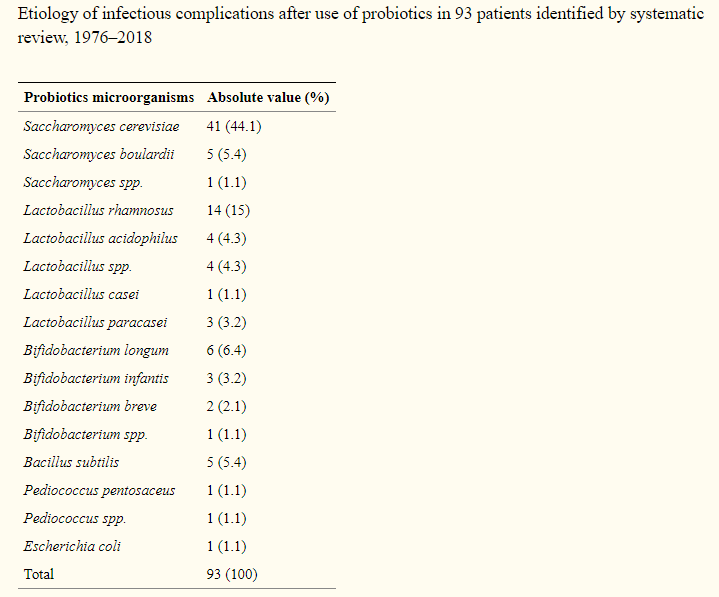
Infectious complications following probiotic ingestion: a potentially underestimated problem? A systematic review of reports and case series. [2018]

infections caused by lactobacilli, mainly endocarditis, bacteremia, and pleuropneumonia, occasionally occur. The relevance of Lactobacillus spp. and other members of the LGC as opportunistic pathogens in humans and related risk factors and predisposing conditions are illustrated in this review article with more emphasis on the species L. rhamnosus that has been more often involved in infection cases. 

Members of the Lactobacillus Genus Complex (LGC) as Opportunistic Pathogens: A Review. [2019]
  • ” Three patients were given a diagnosis of B. longum bacteremia: 2 patients in a neonatal unit in which 17 patients were given oral probiotics and 1 patient in a neonatal unit in which 31 patients were given oral probiotics…  Thus, the incidence of Bifidobacterium bacteremia is theoretically underestimated. ” [2016] So risk of developing bactermia is 3/48 or at least 6%
  • Are probiotics safe? Bifidobacterium bacteremia in a child with severe heart failure. [2019]
  • necrotising enterocolitis (NEC) –  NEC was significantly reduced in probiotic group infants fed any breastmilk [20/179 (11.2%) vs. 10/183 (5.5%); P = 0.027]. No benefits were noted in exclusively formula‐fed infants [4/54 (7.4%) vs. 6/44 (13.6%); P = 0.345] (Repa et al., 2015). [2019]
  • Probiotic sepsis: The reports of probiotic sepsis and the death of one preterm infant due to fungal sepsis from a contaminated probiotic product justify the concern about probiotic supplementation in preterm infants (Centers for Disease Control and Prevention, 2014; Bertelli et al., 2015; Esaiassen et al., 2016).
  • ” This is the largest trial to date of a probiotic intervention. It shows no evidence of benefit and does not support routine use of probiotics for preterm infants. “[2016]
  • Prophylactic administration of B.clausii to preterm neonates did not result in a significant difference in the incidence of LOS as compared with placebo. [2015]
  • Our observational data support the use of Lactobacillus acidophilus/Bifidobacterium infantis probiotics to reduce the risk for gastrointestinal morbidity but not sepsis in very low birth weight infants. [2014]

General Studies

Species resulting in infections [2018]

Bottom Line

If there is a risk/indications of necrotising enterocolitis or sepsis for an infant, studies indicate that the risk/benefit for an infant is improved with probiotics [2018, 2017]. ”  Introduction of probiotics was associated with a reduced adjusted odds for ‘NEC or sepsis or death’ in exclusively breastmilk-fed infants (OR 0.43, 95% CI 0.21-0.93, p = 0.03) only. [2016]”

My advice is to not use probiotics for a child or in fact unless there is a serious health risk that the right probiotics have been documented to actually help.

Any probiotic claiming that it is designed for children — demand that they share the clinical studies for their formulation. They are likely pissing urine to make sales (excuse my language). If you get such a study and have a sick child — you really should be asking for studies with similarly sick children.

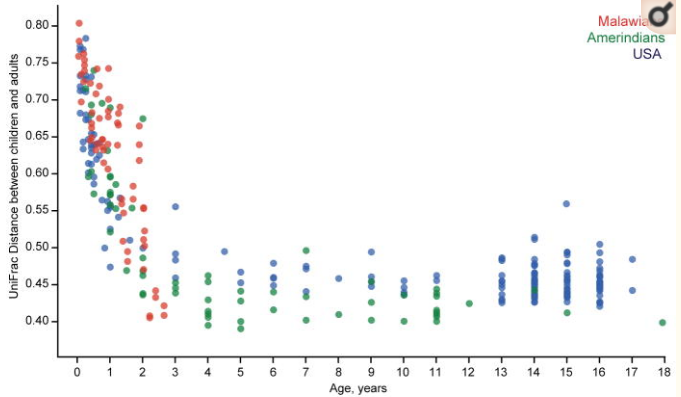
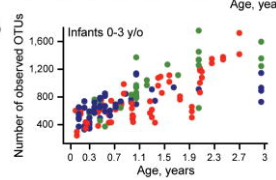
For the first four years the child microbiome is very different than adults [2012]
The number of bacteria are much fewer than adults. Invading probiotics are less likely to be handled well. [2012]

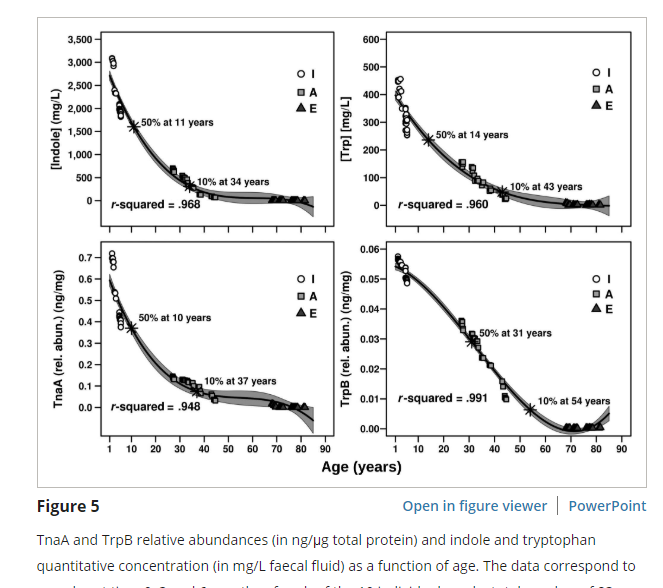
“The bacteria in your gut may reveal your true age” [2019] We actually see age specific patterns with citizen science.

It is fine for an adult to make a decision to take or not to take; but with a risk of sepsis being established with no certain benefit – IMHO, it’s inappropriate for a parent to make that decision for a child.

Addendum: More Information on Age and the microbiome

Functional microbiome deficits associated with ageing: Chronological age threshold. [2019]

Update on DNA/SNP and ME/CFS

I have done a few prior post on this, listed below. At a high level, this does not mean that ME/CFS is a DNA disease instead of a microbiome dysfunction, rather it paints a richer picture.

The microbiome and your DNA interact with each other. Your microbiome is actually much richer/more complex than your DNA. There is evidence that the microbiome and DNA cooperate with each other. So, ME/CFS is a “perfect storm” scenario. You need the right DNA mutations to coincide with the right microbiome dysfunction. To the best of my knowledge, no studies have been done combining the two 😦 .

I focus on the microbiome because it is much more actionable then DNA. You can change the microbiome, i.e. pull your ship caught in the perfect storm into a sheltered harbor…. The ship may still have its defect (DNA) issues, but without the storm beating on it, it won’t sink.

Past Posts

Extracts from Recent Studies

Someone care to extract a summary?

In the past, I have walked thru each article and produced a checklist of SNPs cited with the matching 23andMe item (if they reports it) and even recall creating a template on a 3rd party analysis site. I do not have the time for this at present.

If a reader care to do this and write up a guest post, I would love it!

In time, I would love to add these SNPs to the microbiome site to try to detect which dna-bacteria-symptoms combinations are significant. It will be another step into being uber-specific on why you have certain symptoms and thus have specific treatment based on your DNA, microbiome and symptoms.

I have added maternal haplotypes to the symptoms list now — if you know yours, please associate it with your sample. The types entered are the common one from this page.