CFS: Insomnia and Sleep Distrubance

A reader wrote “Having some great results from the probiotic therapy especially with respect to the reduction of depression, morbidity, binge eating, inability to maintain weight and cognition and energy somewhat.  Still no relief with respect to sleeping I still only sleep a 2-3 hours of deep sleep..”

I am very pleased my approach is working for at least one other. I am going to write about my research and thoughts on the sleep problem.

My training is in mathematical modelling which includes data reduction — to translate into terms more real to CFSers: I take some 80+ common symptoms and find that they could be reduced to symptoms from 8 states. Then I look at the 8 states and find that they could be reduced to the direct or collateral effect of one or two conditions – namely a dysfunction microbiome AKA a cartel of evil gut bacteria.

In my 1999 onset, I found that many CFS symptoms were found to match that of hypoxia (or oxygen starvation). The hypoxia does not need to by systemic, but may only be to the brain. Wikipedia lists the following symptoms:

Let me see… CFSers have often been referred to as “greys” (as in ETs) – wait that pallor! I will not bore the reader by citing the dozens of PubMed studies and Conference reports that have the same symptoms reported for CFS. The most common cause of hypoxia is climbing the Andes or Mt. Everest, which does not apply here.

Hypoxia has been reported in the literature as being the cause of pain points for fibromyalgia [1986, 1992 with some 16 citations on PubMed], a comorbid condition with CFS.

Hypoxemia means low oxygen levels in the blood and is known to decrease sleep quality with frequent sleep arousals.

What does apply are the following conditions which can lower oxygen delivery levels (thus causing hypoxia). The key word is delivery – your blood may have normal oxygen levels per ml of blood, but if it’s flow is 30% then normal — you will only get 70% of the normal level of oxygen delivered.

  • Coagulation (“thick blood”) – blood flow is slow
  • Vascular constriction – blood vessels tighten
  • Inflammation – tissue are sworn and impede the flow of everything (the purpose of inflammation is to slow the flow of pathogens until the body can mount a defense).

All of those triggers could be caused by chemicals (signalling molecules) produced by cartel gut bacteria. So if you nail the offending bacterias, then all three would reduce and hypoxia may disappear and a good night sleep may happen.

The gotcha is how long these artifacts persist. I will only cover one in this post, coagulation.

Taking with David Berg, I recall him telling me that soluble fibrin monomers(SFM) were the most common coagulation indicator in CFS patients. These monomers can form weak meshes in the blood and may lead to misshapen red blood cells reported by Les Simpson in Journal of IiME, Vol. 2 Issue , p. 24ff. as the red blood cells are squeezed thru them. Treating “thick blood” very much depends on why it is thick (coagulation and it’s control is a multiple step process — each process needs different treatment! 😦 ). The outcome of have SFM can be fibrin deposits which acts as barriers to red blood cells reaching tissues.

So, assuming the best case scenario (and what has worked with me):

  • Breaking down the SFM (no studies, just reported observations and own experience – via my labs)
    • Up to 8 “00” capsules of turmeric /day
    • Up to 8 800mg tablets of piracetam /day  (not close to bed time – it also stimulates the mind)
  • Dissolving old fibrin deposits:(see this earlier post)
    • Nattokinase
    • Lumbrokinase
    • Serraptase
    • Bromelain

Another cause of thick blood is platelet activation. This can be reduced by aspirin, grape seed extract, etc — it is very easy to OVER CORRECT this, resulting in a scratch bleeding very easily and very long. Many many herbs inhibit platelet activation – so some careful research is recommended.

Another item that helps blood flow is alpha lipoic acid (ALA) with some 82 PubMed articles.

Lastly, I have found that Magnolia Bark – an adaptogen with known impact on some bacteria — taken one hour before bed, seems to also help with sleep

I hope this post will put you to sleep!

P.S. As always — consult with your medical professional before making and changes in supplements. Any sign of easy bruising or bleeding requires prompt medical assistance (and immediate stopping of any and all anticoagulants).

Crohn’s Disease: Fistula – alternative approach

Fluoroquinolone are pretty standard for treating fistulas because it is so broad spectrum. Unfortunately, there are significant risks.

http://www.fda.gov/Drugs/DrugSafety/ucm365050.htm

Safety Announcement

[8-15-2013]  The U.S. Food and Drug Administration (FDA) has required the drug labels and Medication Guides for all fluoroquinolone antibacterial drugs be updated to better describe the serious side effect of peripheral neuropathy. This serious nerve damage potentially caused by fluoroquinolones (see Table for a list) may occur soon after these drugs are taken and may be permanent.

The risk of peripheral neuropathy occurs only with fluoroquinolones that are taken by mouth or by injection.  Approved fluoroquinolone drugs include levofloxacin (Levaquin), ciprofloxacin (Cipro), moxifloxacin (Avelox), norfloxacin (Noroxin), ofloxacin (Floxin), and gemifloxacin (Factive).  The topical formulations of fluoroquinolones, applied to the ears or eyes, are not known to be associated with this risk.

If a patient develops symptoms of peripheral neuropathy, the fluoroquinolone should be stopped, and the patient should be switched to another, non-fluoroquinolone antibacterial drug, unless the benefit of continued treatment with a fluoroquinolone outweighs the risk. Peripheral neuropathy is a nerve disorder occurring in the arms or legs. Symptoms include pain, burning, tingling, numbness, weakness, or a change in sensation to light touch, pain or temperature, or the sense of body position.  It can occur at any time during treatment with fluoroquinolones and can last for months to years after the drug is stopped or be permanent.  Patients using fluoroquinolones who develop any symptoms of peripheral neuropathy should tell their health care professionals right away.

A Request

A dear friend who had a fistula and developed peripheral neuropathy on the second course (quickly stopping) as me to look for alternatives. The first question was what bacteria are we dealing with – it turns out to be one family, the bacteriodes as cited in the text book below:

image

With this information, I could search for herbs and spices that were effective. It appears that there is only one herb that has been demonstrated effective (of almost 200 tested), rhubarb root (Rheum officinale)  [Anti-Bacteroides fragilis substance from rhubarb. 1987].

I found another study finding that Swedish Bitters had some effect, but looking at the ingredients, there was rhubarb root, so it’s effectiveness was thus explained.

Looking for herbs effective against peptostreptococcus, I found nothing on PubMed. There are several oral probiotics (intended for the gums in the mouth) that contain streptococcus (see prior post), which could inhibit this growth.

CFS Impact

CFS patients are low in bacteroides and thus you should avoid Swedish Bitters and Rhubarb Root.

However, rhubarb root does work well as a laxative (which may include diarrhea for a day with two 00 pills full of it) and thus may have some benefit in clearing your system for new probiotics.

For New Readers

This post is to present a reference post to suggest what should be read, especially, for the brain fog. The following four links (3 to Health Rising) should explain the model and experience that I had:

The next item is a starting point post, that suggests a starting point.

Probiotics

The first thing to realize is that Lactobacillus Acidophilus is NOT a friend to CFS patients. You want to avoid it whenever possible. Heresy – no argument from me. L.A. works well for healthy individuals. For CFSers it makes a bad situation worst.

The following probiotics are very likely to have positive effects (especially if you have IBS concurrent with CFS):

In addition to the above, Dental Oral Probiotics are recommended (again, avoid any  with L.A.)

This will give you a starting point on the journey…

Propionibacterium freudenreichii – Another Probiotic of Interest

Many thanks to Espen Samuelsen for finding another commercially available probiotic that I was not aware of: Propionibacterium freudenreichii 

It is available as NutriCology Allergy Research‘s Securil Propio-Fidus.

No, it’s not a psychoanalysis probiotic (the “Freud” in it’s name), it is actually used in making  Emmental cheese!

So what do we know about it (apart from being used to make one of my favorite cheeses!)

Looking at colitis

Bottom line: If passes my baseline criteria for use with CFS — it is effective for IBS.  “I approve this probiotic!”


Update – thanks to AM for doing further research and forwarding it.

  • “During cheese production, Propionibacterium freudenreichii ferments lactate to form acetate, propionate and carbon dioxide. The Propionate is a salt of propionic acid. Propionic acid is an organic, carboxylic acid, and is strongly anti-fungal, and supplementation with P. freudenreichii can boost the localised Propionate levels in the GI tract and help to eliminate Candida albicans and other yeasts and moulds. The Propionic acid molecule is shown below.“A bacterium used in the production of Emmental.” Genoscope. 16 Jan. 2008
  • “The five common strains of Bifidobacter include B. infantis, B. adolescentis, B. bifidum, B. longum, and B. breve. [P. freudenreichii]…provides the food that allows growth of all Bifidobacteria, so your body can maintain its own unique, health-promoting combination of the different stains. The Bifidobacteria levels remain high in your gut only while they have adequate food and stimulation to grow. ‘ [1987]
  • Propionibacterium freudenreichii ferments and converts lactate to form: propionic acid (which favors the growth of bifidobacteria) [1994]


Where to start…

As a result of some comments on another post, I realized that there appears to be a logical sequence for some of the supplements and probiotics. I suspect that this may be a good first sequence for many people because it should improve symptoms within a month.

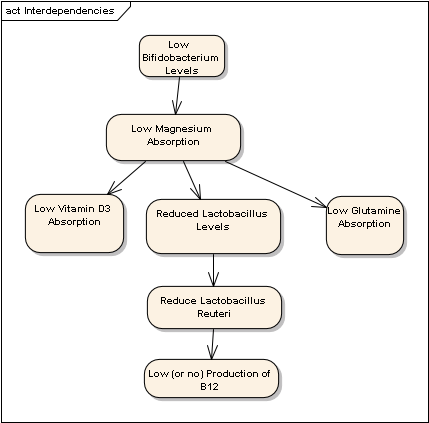
  1. Magnesium deficiency is common with CFS patients. A 2012 study revealed that one bacteria is significant for the release of magnesium from food: Bifidobacterium :   http://www.ncbi.nlm.nih.gov/pubmed/22047159.
    1. This agrees with studies finding that Bifidobacterium are low in CFS patients.
  2. Low Magnesium levels inhibits the absorption of two items where higher levels have been found to have less symptoms:
    1. Vitamin D3
    2. Glutamine
  3. Magnesium is needed by some Lactobacillus species according to http://www.ncbi.nlm.nih.gov/pubmed/23082775 [2013]
    1. Thus low magnesium levels contribute to the low Lactobacillus levels seen in CFS patients.
    2. L.Reuteri is dependent on magnesium levels  — so low or no B12 production
      1. Enhancement of alpha- and beta-galactosidase activity in Lactobacillus reuteri by different metal ions. [2010]

This suggests that taking a magnesium supplement (like Magnesium Malate), eating magnesium rich food, and taking a pure  Bifidobacterium probiotics for the first 1-2 weeks, followed by adequate Vitamin D3 (15000 IU?) and Glutamine should reduce symptoms in 4 to 6 weeks.

  • NOTE: Align is a single strain Bifidobacterium that has been shown to put IBS into remission.  I found other pure Bifidobacterium at Walgreen’s — they are often label as digestive probiotics, for example Ultimate Flora RTS – Colon Care Probiotic which has six different ones and no Lactobacillus! 🙂   (
    • Bifidobacteria species.
    • Bifidobacterium lactis (A)
    • Bifidobacterium lactis (B)
    • Bifidobacterium bifidum
    • Bifidobacterium breve
    • Bifidobacterium lactis (C)
    • Bifidobacterium longum)
    • These are different then the Bifidobacterium infantis in Align. So there are seven species at least available.
  • Remember: The more species that you take the better your odds are finding one that “clicks with your DNA and takes up residence!” and “takes an attitude to the CFS causing cartel of bacteria”
  • “Bifidobacteria, naturally present in the dominant colonic microbiota, represent up to 25% of the cultivable faecal bacteria” (http://www.ncbi.nlm.nih.gov/pubmed/16167966 2005)…. reminder: there are myths about Lactobacillus being the dominant one… it’s false. Futhermore, L.Reuteri is the dominant one of all Lactobacillus in healthy mammals (including humans) — not L.acidophilus which just flows thru your bowels (and does NOT take up residence)!

This is all theoretical.  I do know that I was taking a lot of Magnesium Malate during my second onset to moderate symptoms (and it worked) as well as 20,000 IU of vitamin D3.

To put it together as a picture:

Interdependencies

References of interest: