Safe Probiotics for ME/CFS, IBS, IBD etc. from Complex Data Model

This is a brief post that draws on the analytical approach from the methodology used in Mast Cell Activation Syndrome and Multiple Chemical Sensitivity. Atypically, we are able to determine which probiotics are likely better than others. Rather than delve into the technical details—which can overwhelm those experiencing brain fog—I’m going straight to the results for this set of symptoms:

  • ME/CFS – not specific
  • ME/CFS – with IBS
  • ME/CFS – without IBS
  • IBS
  • Long COVID
  • IBD
  • Crohn’s Disease

We are filtering to P < 0.0001 (ZScore of +/-3.72). We are also restricting to strictly safe, that is no predicted inappropriate shifts to keep the list shorted and easier to handle for the brain fogged.

The Good Count below are the number of bacterium that it has the desired effect upon. The Good value is an estimate of the amount of influence.

  • The Good Count is the number of bacteria that are likely to shift in a positive direction direction.
  • Good is an scaled aggregation of the R2 values for these bacteria. One bactieria may have a R2 and slope of (.9 and 1.5) another of (.2 and 5). The result is .9 * 1.5 + .2 * 5 =2.35.

ME/CFS (General)

NameGoodGood Count
Clostridium beijerinckii1369
Niallia circulans795

This is not unexpected because the vagueness of description results in loss of clarity.

Condition: ME/CFS with IBS

NameGoodGood Count
Bifidobacterium adolescentis167861
Bifidobacterium catenulatum110840
Bifidobacterium bifidum75031
Clostridium beijerinckii1369
Niallia circulans795

Condition: ME/CFS without IBS

NameGoodGood Count
Lactococcus lactis76535
Clostridium beijerinckii1369
Niallia circulans795

Irritable Bowel Syndrome

NameGoodGood Count
Christensenella minuta279698
Enterococcus faecium233493
Anaerobutyricum hallii231793
Lactococcus cremoris190977
Bifidobacterium adolescentis167861
Blautia wexlerae164571
Bifidobacterium catenulatum110840
Lactococcus lactis76535
Bifidobacterium bifidum75031
Clostridium beijerinckii1369
Niallia circulans795

Long COVID

NameGoodGood Count
Christensenella minuta279698
Enterococcus faecium233493
Anaerobutyricum hallii231793
Lactococcus cremoris190977
Bifidobacterium adolescentis167861
Blautia wexlerae164571
Bifidobacterium catenulatum110840
Lactococcus lactis76535
Bifidobacterium bifidum75031
Clostridium beijerinckii1369
Niallia circulans795

Inflammatory Bowel Disease (IBD)

NameGoodGood Count
Enterococcus faecium233493
Lactococcus cremoris190977
Bifidobacterium adolescentis167861
Bifidobacterium catenulatum110840
Lactococcus lactis76535
Bifidobacterium bifidum75031
Clostridium beijerinckii1369
Niallia circulans795

Crohn’s Disease

NameGoodGood Count
Christensenella minuta279698
Enterococcus faecium233493
Anaerobutyricum hallii231793
Lactococcus cremoris190977
Bifidobacterium adolescentis167861
Blautia wexlerae164571
Bifidobacterium catenulatum110840
Lactococcus lactis76535
Bifidobacterium bifidum75031
Clostridium beijerinckii1369
Niallia circulans795

Summary

This feature will not be added to the web site because the computations has taken hours to run and require a large amount of memory (most of the 32 GB available). In general, too low amounts dominated as the most significant pattern. It is not killing off high bacteria but encouraging low bacteria that seems to apply for these conditions.

It is interesting to note that Lactobacillus never appears. You may notice that some conditions are very similar which is not unexpected to me. There are commonality of low bacteria across conditions.

Note: ME/CFS With IBS suggestions include ME/CFS and IBS suggestions. IBS and IBD have some similarity but are different. Crohn’s disease seems more likely to be a progression of IBS and not IBD. The data model may be useful for seeing likely disease progression paths.

Long COVID – Current research is a hunt for the holy grail…

This evening on NPR News, I saw their story on Long COVID and pending work. You may view the segment here. From watching ME/CFS research for several decades, “I wept” for Long COVID patients — I do not expect any of this planned work to produce relief to patients.

The video below are my feeling about what Long COVID is, how to approach detection and treatment.

Key Points

  • Like with another post-infection syndrome, Myalgic encephalomyelitis/chronic fatigue syndrome (ME/CFS), decades of research has failed to find a magical single key factor nor an effective new drug to treat.
    • Their core assumption is that there must a simple single factor
    • The reality is that there are dozens of factors with commonality across patients, they are also highly individual factors.
  • Studies have constantly shown microbiome dysbiosis as a signature. A large number are shifted. What is reported in studies can be reviewed here.
  • We can see this in contributed microbiome samples from people with Long COVID. You can see those shifts on this page.
  • There are clinical issues with this approach — because of a lack of standardization of microbiome tests used in studies and clinics. See this post. There are issues which can be resolved with some effort.

Looking at bacteria from different labs, we find almost no agreement. If we use KEGG data on samples from different labs, we end up with agreement on which metabolites are abnormal across different labs.

We have demonstrated the ability to accurately predict Long COVID from microbiome samples as shown by a patient agreement with the predicted symptoms illustrated below:

We are able to generate suggestions of probiotics, supplements, etc that will reduce the symptoms with a high success rate.

Some Case Studies are here. An example of an individual protocol is Treatment Suggestions for Long COVID.

IMHO: Researchers are looking for answers in their expertise. The answers are there, there are just few people with the appropriate expertise.

Evaluating Brain Fog state

In the past, when I had active ME/CFS. I could describe it as a flare sufficient to put me on disability. I would sit on the computer playing a variety of simple puzzle games. AAs the flare eased and my cognition improved, I began to find those games boring and moved on to more mentally challenging puzzles.

Today, I am fully in remission, particularly from the cognitive issues often described as brain fog. Still, I make it a daily habit to complete two free logic problems on LinkedIn.

Zip

This is the simplest (almost boring). You need to find a path connecting all of the numbers in order and use every square.

To get to it: https://www.linkedin.com/games/zip/

Queens

This is more challenging. You need put a crown on every column and row — but only one crown per color area.

To get to it: https://www.linkedin.com/games/queens/

Other Games

LinkedIn provide additional games at https://www.linkedin.com/games/. You may need to create a FREE linkedin account to access them.

Bottom Line

I’ve found this routine valuable for several reasons:

  • It lets me compare my performance with other professionals. At 73 years old, I’m often competing against people half my age—and my times are usually better than their averages.
  • It serves as an excellent “wake-up activity” first thing in the morning.
  • It acts as a personal monitoring tool: if my performance starts to slip, it may be an early warning sign of relapse, reminding me that it’s time to rotate or adjust my probiotics.

Recent Research: Comments from an “old timer”

27 years ago, I was diagnosed with ME/CFS. Even as far back as the early 1970s, while at university, I experienced severe cognitive difficulties—including a sudden decline from managing triple honors to simply trying to finish my degree. At the time, my physician correctly attributed these issues to stress, though the biological mechanism was unclear. Today, it’s recognized that stress can readily disrupt the microbiome, contributing to dysbiosis.

During these 27 years, I’ve thoroughly reviewed most of the scientific literature on ME/CFS. I was a subscriber to the Journal Of Chronic Fatigue Syndrome throughout its publication from 1995 to 2007. I’ve experienced multiple relapses, often triggered by stress, leading me to adopt a preventative approach: avoid stress when possible. My guiding philosophy now is “Que Sera, Sera (Whatever Will Be, Will Be)”—which can be especially challenging given the current political climate in the US.

ME/CFS and Long COVID (LC) are both highly heterogeneous, varying widely in symptoms and duration; specific symptoms of LC can change or resolve unpredictably over time. Studies—including those involving twins and across genders—demonstrate that such diversity complicates the search for a universal treatment that provides consistent symptomatic relief.

My Criteria

Recently, friends have sent me several new studies asking for my feedback. Given years of seeing the field marked by repeated announcements of “breakthroughs,” my essential question remains:

  • “Do these papers suggest immediate, actionable clinical steps? “
  • “Is there robust evidence that these interventions benefit a substantial proportion of people with ME/CFS?”

To see if the papers do not met those criteria, I will quickly review them. I will neither get hopes up nor excited about them if they fail…. they are speculation. Speculation is awesome for getting grants for research but not for improving patients. Getting excited about them and the subsequent disappointment is not healthy for the microbiome.

Two Example Papers

To me the two papers that met these criteria are:

Treatments primarily involved rotating courses of appropriate antibiotics and administering suitable anticoagulants. Both methods can profoundly affect the microbiome; for example, anticoagulation improves oxygen levels, creating conditions that affect bacterial growth patterns. My guiding principle—KISS (Keep It Simple, Stupid)—leads me to focus on the belief that the underlying issue is persistent microbiome dysbiosis.

This conviction is why I dedicated substantial time and some personal resources to the development of the free Microbiome Prescription website, which was originally designed with a sole focus on ME/CFS.

BioMapAI: Artificial Intelligence Multi-Omics Modeling of Myalgic Encephalomyelitis / Chronic Fatigue Syndrome [2025]

Being a former University Instructor at Chapman University for Artificial Intelligence, my first item was check cross validations. “including ‘omics altogether (AUC=82.3%), immune (78.5%), KEGG (69.1%), species (71.5%), and metabolome (76.4%), while Glmnet excelled in Quest data (74.8%)“. The study did use Shotgun sampling but ignored The taxonomy nightmare before Christmas… (the blue whale in the room).

Two years ago, using my model, I posted “Cross Validation of AI Suggestions for Nonalcoholic Fatty Liver Disease“, I got  92% correct for to take and 83% correct for to avoid. IMHO, their model should have perform better.

Key Bottom line — There was no treatment suggestions or protocols

A ton of issues were identified …. ” This map uncovers disrupted associations between microbial metabolism (e.g., short-chain fatty acids, branched-chain amino acids, tryptophan, benzoate), plasma lipids and bile acids, and heightened inflammatory responses in mucosal and inflammatory T cell subsets (MAIT, γδT) secreting IFNγ and GzA.” but no discussion of a unified treatment for all of them. ME/CFS is complex.

My own approach, the microbiome dysbiosis, is very treatable as demonstrated by Microbiome Prescription, some examples of treatment suggestions are here. Since it is likely that the microbiome drives most of the above issues — life is simpler and improvement can happen in weeks in many cases. All of the issues cited in this paper, listed below, has evidence that the microbiome is a significant contributor.

ME/CFS is characterized by persistent fatigue, post-exertional malaise, multi-site pain, sleep disturbances, orthostatic intolerance, cognitive impairment, gastrointestinal symptoms, and other issues. This complexity not only hinders timely diagnosis but also poses significant challenges for effective treatment.1,2,3. The pathogenesis of ME/CFS is not well understood, with some triggers believed to include viral infections such as Epstein-Barr Virus (EBV)4, enteroviruses5 and SARS coronavirus6, in addition to bacterial infections and other causes7.

A Perspective on the Role of Metformin in Treating Myalgic Encephalomyelitis/Chronic Fatigue Syndrome (ME/CFS) and Long COVID [2025]

I went over to my Metformin page on microbiome prescription and saw the most often reported impacts,

Looking at studies on ME/CFS

  • Akkermansia is low with Long COVID,Gulf War Syndrome, Irritable Bowel Syndrome
  • Bifidobacterium     ⬇️ ⬇️ ⬇️ ⬇️  
  • Lactobacillus     ⬇️ ⬇️ ⬇️ 
  • Roseburia inulinivorans     ⬇️  
  • Bacteroides   ⬆️ ⬆️   ⬇️ ⬇️  
  • Prevotella   ⬆️   ⬇️  

My conclusion is simple, it is a viable candidate for treatment…. BUT….

The BUT with Single Item Treatments!

If the root issue is microbiome dysbiosis, no single item is likely to be sufficient to be a “magic cure all”. We are not talking about eliminating a single virus or bacteria. A single virus or bacteria belief has been rampant with ME/CFS researchers for decades. Why? Simple, treating a dozen shifts at the same time is too complex given the methods available. But it is not too complex with a suitable fuzzy logic expert system running of several million facts.

On the last article the reader wrote:

I find it interesting because they found the correlation with the microbiome. I wonder why researchers don’t look more at it.

The reason is simple – they lack the skills and training to deal with it. Additionally, there is the absence of data in a suitable form. IMHO what is needed?

  • Training in the full range of Artificial Intelligence methods. I have found fuzzy logic is essential. It is rarely taught in AI classes today, everything has shifted to the hottest tech: Large Language Models (LLM, ChatGPT) that is well known for hallucinations.
  • A suitable database, a summary of the data used for the fuzzy logic engine is here. Some analysis uses over 13 million facts encoded into a database. Most of these facts would not “be seen” using the bots that provides data to LLM due to paywalls and other factors.

Suggested reading (intro book with a sample of the text)

Probiotics Fundamentals: Part 4 Probiotic Selection?

Related posts:

In the first post of this series, Probiotics Fundamentals: Part 1 Specific Strains I cited strains that are available retail that has been researched. The logical starting point is to search for your needs, read the studies and then rank the probiotics in prefer order for doing a personal trial. You want to do one probiotic at a time with rotation and described in the prior post (see prior post).

To searching for strain specific studies of probiotics available retail. Click here.

No Study found or issue not listed

The next step is to look at the conditions that I have abstracted/extracted studies for, listed at “U.S. Nat. Lib. Medical Conditions Studies with Microbiome Shifts“. We are shifting from strain to species level. This gives several paths, let us examine Autism. There are

Based on Publish Studies of Species

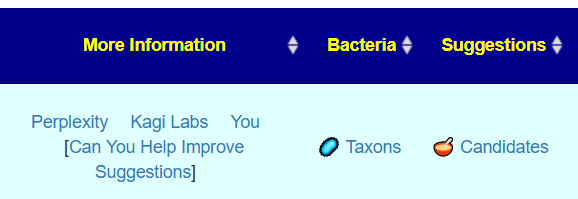
Clicking on [Can You Help Improve Suggestions] will take you to a page. At the bottom you will see “Treatment Substances” which lists things that have helped in studies. Scan it for probiotic names, for example: 

A synbiotic formulation of Lactobacillus reuteri and inulin alleviates ASD-like behaviors in a mouse model: the mediating role of the gut-brain axis. Food & function (Food Funct ) Vol: 15 Issue: 1 Pages: 387-400 Pub: 2024 Jan 2 ePub: 2024 Jan 2 Authors Wang C,Chen W,Jiang Y,Xiao X,Zou Q,Liang J,Zhao Y,Wang Q,Yuan T,Guo R,Liu X,Liu Z

Which suggests L. Reuteri with inulin may help. The source is linked. Make sure you read them.

Based on Deficiencies of Probiotic Bacteria

Clicking on  Taxons will take you to a page showing all of the bacteria shifts reported for the condition.

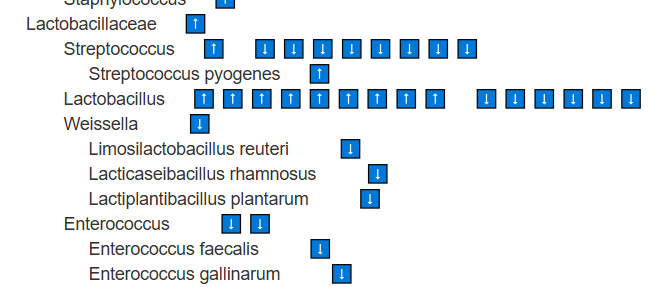
Look for Lactobacillus, Bifidobacterium,etc  with  ⬇️

These species are found at lower levels, suggesting their metabolites are also reduced. Supplementing with them as single-strain probiotics is logical. Stay at the species level (e.g., Bifidobacterium longum) rather than higher classifications such as the genus Bifidobacterium. In general, avoid probiotic mixtures, as they may include strains that are counter-indicated (e.g., Bifidobacterium catenulatum, Bifidobacterium breve) or strains for which we lack sufficient information.

Based on Modelled correction of Bacteria

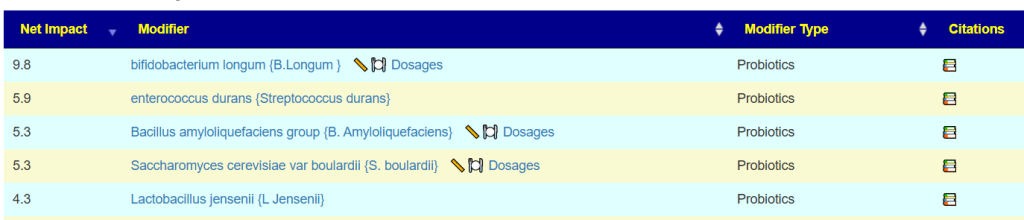
Clicking on  Candidates, will send the huge bacteria list above through a fuzzy logic expert system to compute suggestions with weights given for each one.

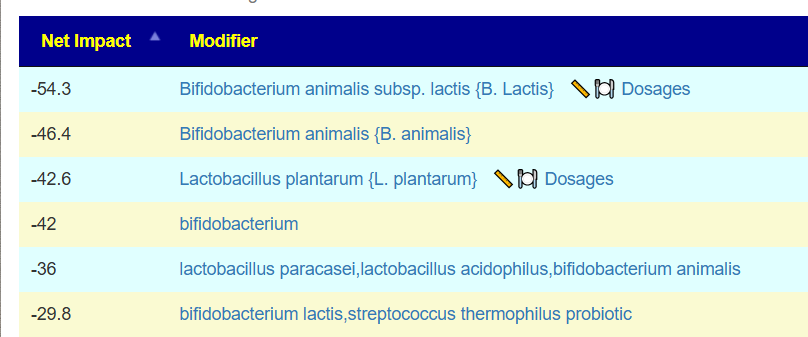
Note that this also lists ones to avoid.

Disagreements!

We can see that levels of Lactobacillus plantarum are low, but the model is telling us to avoid Lactobacillus plantarum. So what’s going on here?

The issue comes from the fact that the model/studies is based on multiple subgroups of people with Autism (or other conditions). The data might be accurate within each subgroup, but when you merge them together, you can end up with contradictions. So it’s not really a problem with the approach—it’s a problem with the data mix.

The best rule of thumb is to start with the things that show up as agreements across the data. For example: Bifidobacterium longum and Limosilactobacillus reuteri. Once you’ve tried probiotics that have clear agreements, then you can carefully experiment with the ones where there’s disagreement and see how your body responds.

The next level up in Probiotic Suggestions

It is pretty simple, get a microbiome test. My preferred tests are:

  • Biomesight for 16s (economic, low resolution)
  • Thorne for shotgun (more expensive but much higher detail)

You want to ideally get a test that reports on all of the common probiotic bacteria. Many common tests do not report many of these. For example: Diagnostic Solution GI-Map reports only

On the other hand both of the above tests report species.

When you select a test, you should check Microbiome Prescription to see what the detection rate is. For example for Bifidobacterium longum, we see how often this is detected in samples.

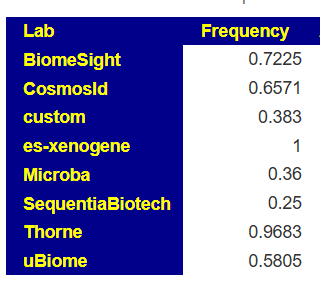
  • For the shotgun tests (Xenogene and Thorne) we see 96% and 100% of the time, if it show low, you can have confidence in taking some
  • For SequentiaBiotech we see it is seen 25% of the time. If you have none reported we are left being uncertain if you actually have none or is the none because of the test’s methodology

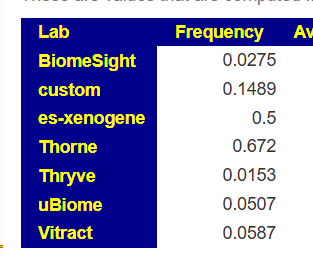
Another example is L.Reuteri where the shotgun tests find in in over 50% of samples, while some 16s finds in only 2% of samples.

Bottom Line

We’re piecing things together from lots of scattered knowledge, and there’s no single standard method—either for testing microbiomes in labs or for the studies themselves. Nothing here is clear-cut; everything’s kind of fuzzy, sometimes super fuzzy. In this post, the focus was on picking probiotics for a condition using literature (an “a priori” approach). Basically, it means trusting the data at face value, even though we know it isn’t rock-solid.

Some additional readings:

I also foreshadowed the next post: Using a detailed microbiome test to select probiotics based on the whole microbiome.