The youtube below does a walk thru of using MicrobiomePrescription.com with a person with ME/CFS, had COVID and Autism. MicrobiomePrescription.com is a free site with world class artificial intelligence system connected to a comprehensive database.
A few highlights from the video:
Correctly Predicted symptoms from their microbiome alone
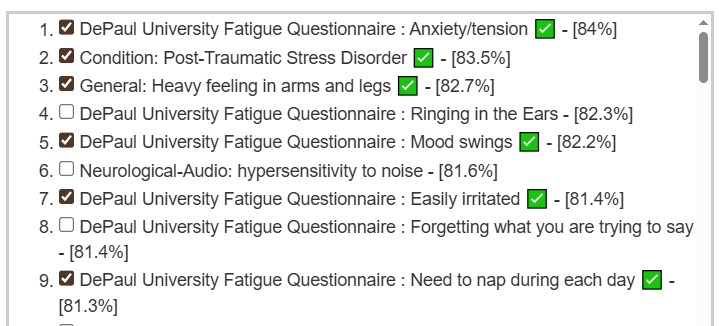
Symptoms are strongly associated to particular microbiome patterns. These patterns can be used to “guess” the symptoms that they are likely to have. As shown below, for many people it is very accurate!
PREMISE: If we correct the microbiome dysbiosis. then the symptom should be less severe or disappear.
Suggestions agree with Clinical Experience of working
The antibiotics with [CFS] are ones that have been used in studies with some good responses reported. In particular, a similar combination is used successfully by Dr. Cecile Jadin with her patients.
Good and Bad Probiotics are Identified
For this person’s sample, 9 probiotics were computed to help and 33 probiotics were computed to hurt.
Goal is Improved Odds, not a Protocol
The suggestions will be different (often very different) from person to person. Each item is computed to independently help. Take what you are comfortable with. Items to avoid should be respected (when practical).
While working on a pending post [ME/CFS after EBV in Competitive Athlete] on their microbiome sample I was pleasantly surprised to see their top suggestions have literature on the same substances helping reduce EBV. In one sense, I should have expected it, given the premise that I am working off.
Premise: An infection (including virus) alters the microbiome to be optimal for it survival. Correcting the dysbiosis, weakens the infection (i.e. you may starve it of essential metabolites)
I decided to collect these items in this post for people with ME/CFS and positive for EBV, i.e. chronic active EBV (CAEBV)
Suggestions
Note: [More Info] are links to perplexity.ai, the information may be questionable in some cases.
Magnesium plays a critical role in the immune response to Epstein-Barr Virus (EBV), particularly in individuals with genetic defects affecting magnesium transport: [more info]
Vitamin E has demonstrated inhibitory effects on Epstein-Barr Virus (EBV) transformation of human B cells, particularly under conditions of oxidative stress: [more info]
Olive leaf extract (OLE) has been shown in multiple studies to have significant antiviral and antioxidant activity against Epstein-Barr Virus (EBV): [more info]
Commonly recognized antiviral medicinal plants in Ayurveda Medicine. Those with [citation] after them have explicit literature for EBV, most have literature for other virus.
Zingiber officinale – Ginger
Caesalpinia bonducella – Fever Nut or Bonduc Nut
Allium sativum – Garlic
Glycyrrhiza glabra – Licorice or Liquorice
ts antiviral activity is clearly demonstrated by different studies on the herpes simplex virus, Epstein–Barr virus (EBV), [2023] [2020]
Ferula assafoetida – Asafoetida or Hing
Gymnema sylvestre – Gymnema or Gurmar (Sugar Destroyer)
Gossypium herbaceum – Levant Cotton or Cotton Plant
Phyllanthus niruri – Stonebreaker or Chanca Piedra
Trachyspermum ammi – Ajwain or Carom Seeds
Withania somnifera – Ashwagandha or Indian Ginseng
Andrographis paniculata – Andrographis or King of Bitters
has a pronounced effect in inactivation or the inhibition of Epstein Virus (EBV) [2021] [2021] [2021]
My general advice would be to do the mineral supplementation with appropriate dosage (This Dosages page may help) for at least 2 weeks, then start on some of the Herbs and Spices (Rotating every 2 weeks). Be warned that “die off” like effect may occur with some. Then rotate on to the probiotics for 2 weeks at a time.
–
Postscript and Reminder
As a statistician with relevant degrees and professional memberships, I present data and statistical models for evaluation by medical professionals. I am not a licensed medical practitioner and must adhere to strict laws regarding the appearance of practicing medicine. My work focuses on academic models and scientific language, particularly statistics. I cannot provide direct medical advice or tell individuals what to take or avoid. My analyses aim to inform about items that statistically show better odds of improving the microbiome. All suggestions should be reviewed by a qualified medical professional before implementation. The information provided describes my logic and thinking and is not intended as personal medical advice. Always consult with your knowledgeable healthcare provider.
Implementation Strategies
Rotate bacteria inhibitors (antibiotics, herbs, probiotics) every 1-2 weeks
Some herbs/spices are compatible with probiotics (e.g., Wormwood with Bifidobacteria)
Verify dosages against reliable sources or research studies, not commercial product labels. This Dosages page may help.
Today I had a nice 70 minute discussion with a user. This shows pretty much all of the new features and options for building your own plan. This applies also for ME/CFS. In fact, the top forecasted symptom for him was ME/CFS without IBS. He has no IBS.
“transplantation of a healthy microbiota [FMT] is associated with reduced pain and improved quality of life. ” This option is rarely available since FMT is only authorized for recurrent Clostridioides difficile infections
And “Since mice transplanted with the FM gut microbiota showed reduced levels of specific bile acids (e.g., ursocholate) and bile-acid-metabolizing bacteria (Lachnoclostridium scindens [sic: Clostridium scindens] ), we treated mice that received FM FMT with UDCA, a host-derived primary bile acid metabolized in the mouse gut into various secondary bile acids.57,58,59 “
This post is running from this data into a model and thus a theoretical protocol (not tried in any clinic) if there is evidence to support a model.
Ursocholate Deficiency
This is available as a prescription drug: Actigall, Urso 250, Urso Forte. More details from WebMD. This is not always possible to get prescribed. This leads us to look for production by bacteria. We find that we have information about it on the KEGG: Kyoto Encyclopedia of Genes and Genomes. Going though databases, we do not find any known bacteria (including probiotics) that produces it 😦 . Going to a secondary data resource we get some bacteria involved in production:
Bottom Line — No evidence confirming the proposed mechanism
Science is endless iteration of tossing out hypothesis and then testing them. Revising as needed. In the study, it is probable that FMT does help; the speculation as to the cause appears unsupported and suspect.
1. Epstein-Barr Virus (EBV) EBV, which causes infectious mononucleosis, is one of the most frequently implicated viruses in ME/CFS. Studies show that 8–15% of people who develop infectious mononucleosis go on to meet ME/CFS criteria, and a subgroup of ME/CFS patients show evidence of EBV reactivation or immune response abnormalities related to EBV5 7.
2. Human Herpesvirus 6 (HHV-6) Reactivation of HHV-6, another common herpesvirus, has been hypothesized to contribute to ME/CFS symptoms, particularly in combination with EBV reactivation7.
3. Enteroviruses Historical and contemporary evidence links enteroviruses (a group that includes polioviruses, coxsackieviruses, and echoviruses) to ME/CFS. Outbreaks of ME/CFS have coincided with enteroviral epidemics, and some researchers consider enteroviruses a likely culprit, especially in cluster cases1.
4. Influenza Viruses Influenza infection has been associated with a more than two-fold increased risk of developing ME/CFS in the years following infection17.
5. SARS-CoV-2 (COVID-19) Many individuals with long COVID meet criteria for ME/CFS, and SARS-CoV-2 is recognized as a trigger for ME/CFS in some cases67.
6. Other Herpesviruses Varicella zoster virus (which causes chickenpox and shingles) and other herpesviruses have also been reported as potential triggers7.
7. Ross River Virus This mosquito-borne virus has been linked to ME/CFS onset, likely through immune system dysregulation3.
8. Retroviruses (e.g., XMRV) Early studies suggested an association between the retrovirus XMRV and ME/CFS, but this link has been discredited by subsequent research and retraction of the original findings2.
Model
It is well known that virus will alter the microbiome. This alteration is to trick/hijack the microbiome to produce chemicals/metabolites that the virus needs (and to reduce those that hurt it) [SEE BOTTOM FOR CLARITY]. Once the virus is eliminated, then sometimes the microbiome gets “stuck” in this state. People have symptoms of the virus (symptoms caused by the metabolites!) but do not have the virus any more.
It is this persistent change of the microbiome: dysbiosis; that I believe is the path to relief and possible remission.
Virus and Microbiome Treatment
Using herbs know to be both anti-viral and anti-bacterial is my favored approach. You may get severe die-off from these (along with a herxheimer effect). Die off will usually start to ebb by day 10-14 after starting.
My personal favorites are:
Tulsi
Haritaki
Neem
Wormwood (Artemisia)
Olive Leaf
The list of Anti-viral herbs
Herb
Notable Antiviral Actions
Tulsi (Holy Basil)
Herpes, hepatitis, influenza, coronaviruses Inhibits viral replication and modulates immunity28.
Neem
Herpes simplex virus (HSV-1 and HSV-2)27, Influenza viruses:10, Dengue virus:58, Hepatitis C virus (HCV)6, Coxsackie virus, polio, and HIV57, SARS-CoV-2 (COVID-19)49.
Olive Leaf
Inhibit viruses such as herpes simplex virus (HSV), influenza virus, hepatitis B and C, human papillomavirus (HPV), HIV, and notably, SARS-CoV-2 (the virus causing COVID-19)125678.
Haritaki (Terminalia chebula)
Antiviral activity against a range of viruses, including SARS-CoV-2 (the virus responsible for COVID-19), herpes simplex virus type 2 (HSV-2), and influenza A virus. In particular, Haritaki demonstrated inhibition of the SARS-CoV-2 main protease in laboratory assays, suggesting it may halt viral replication15.
Curcumin (from turmeric):
Antiviral against influenza, HIV, hepatitis, and coronaviruses8.
Ginseng:
Traditional use for immune support and antiviral activity5
Sage
HIV-1, herpes simplex, Indiana vesiculovirus Rich in safficinolide and diterpenoids; active against HIV-1, herpes simplex virus, and Indiana vesiculovirus157.
Oregano
Rotavirus, norovirus, general antiviral Contains carvacrol and thymol; effective against rotavirus, norovirus, and other viruses1578.
Fennel
Herpes, respiratory viruses Contains trans-anethole; shown activity against herpes viruses and respiratory viruses27.
Peppermint (Mentha piperita):
Contains menthol and rosmarinic acid; antiviral against herpes simplex and influenza viruses2.
Lemon balm
Herpes simplex, respiratory viruses Contains flavonoids and essential oils; active against herpes simplex and respiratory viruses7.
Ginger
Influenza, RSV, calicivirus Contains gingerols and zingerone; effective against influenza, RSV, and feline calicivirus5.
Garlic
Influenza, HIV, HSV-1, rhinovirus Contains allicin; antiviral against influenza, HIV, HSV-1, viral pneumonia, and rhinovirus53.
Echinacea
Colds, respiratory infections Boosts immune function and reduces duration of colds and respiratory infections8.
Elderberry
Influenza, cold viruses Traditionally used for influenza and cold viruses1.
Astragalus
General antiviral, immune boost Immunomodulatory and antiviral properties1.
Aloe vera
Coronaviruses, herpes, influenza, HPV Contains compounds effective against coronaviruses, herpes, influenza, HPV, and more2.
Thyme
Herpes, influenza, general antiviral Contains thymol and carvacrol; antiviral and antimicrobial7.
Andrographis
Influenza, hepatitis C, dengue Contains andrographolide; active against influenza, hepatitis C, and dengue8.
Artemisia annua (Wormwood)
Hepatitis B & C, malaria Used for malaria; also shows antiviral activity against hepatitis B and C48.
My Personal Protocol
Do one at a time for 7-14 days, then move to the next one. Take notes on die-off or symptom changes with each. Constant rotation is strongly encouraged. Repeat but with only that cause a die-off or change.
You may or may not have a virus or re-activated virus. Most ME/CFS patients are not tested for all of the candidates virus listed above. Prescription antivirals with ME/CFS are very sensitive to which virus that a person has.
Appendix
Viruses lack their own metabolic machinery and rely entirely on host cell metabolites and metabolic pathways to reproduce. While viruses do not carry out metabolism independently, they hijack and reprogram the host cell’s metabolic processes to obtain the energy, nucleotides, lipids, and amino acids required for replication. Key findings include:
Metabolic Reprogramming by Viruses
Aerobic glycolysis (Warburg effect): Most viruses induce glycolysis to rapidly generate ATP and intermediates like pyruvate/lactate, even in oxygen-rich conditions12. This provides energy and substrates for viral genome replication (e.g., nucleotides from glucose metabolism)13.
Nucleotide production: Viruses like HSV-1 redirect the pentose phosphate pathway and TCA cycle to boost purine/pyrimidine synthesis for genome replication3.
Host Dependency Examples
Human cytomegalovirus (HCMV) increases glycolytic flux, TCA cycle intermediates, and fatty acid synthesis to support its 96-hour replication cycle13.
Herpes simplex virus (HSV) prioritizes nucleotide synthesis over glycolysis, reflecting its faster 24-hour replication timeline3.
SARS-CoV-2 hijacks folate metabolism and one-carbon pathways to facilitate RNA synthesis6. Inhibiting these pathways reduces viral replication.
Experimental Evidence
Glycolysis inhibitors like 2-deoxyglucose (2-DG) block late-stage herpesvirus assembly1.
Adenovirus activates Myc oncogene signaling to drive glycolysis and nucleotide synthesis1.
Vaccinia virus is an exception, showing minimal glycolysis dependence and instead utilizing alternative carbon sources like sorbitol1.
In summary, viruses co-opt host metabolites by reprogramming cellular metabolism to meet their replication demands. This metabolic hijacking is a nearly universal feature of viral reproduction, making host metabolic pathways potential therapeutic targets126.



 CFS Remission