With the announcement that uBiome is asking to change from a Chapter 11 (Reorganization) to Chapter 7 (Shut the doors!) – the question is what comes next?
During the company’s Chapter 11 filing, the company had indicated that it would be looking into a sale. However, according to the motion it filed in court today, the company wasn’t able to secure lending that would enable it to continue operations. As a consequence, it has requested the court allow it to cease operations and liquidate its assets in order to pay off its creditors. The bankruptcy court still needs to approve the motion. If it is accepted and the company moves to Chapter 7, the liquidation of uBiome’s assets will happen under the supervision of a court-appointed trustee.
At this point it becomes interesting — superior technology than what ubiome (also thryve, and American/British Gut) is available. There are two on interest because they are using superior technology
XenoGene – they do have viable downloads available (just uploaded some tonight by data scraping their PDF files) and my contact with them indicates they are going to be making an upload friendly version available soon
What is the difference between technologies…. well with the older technologies we are talking 400-600 taxonomies. The last XenoGene that I uploaded had over 6000 taxonomies – a factor of 10 more! This was 182 pages of data with one taxonomy per line. This does come at a cost 10x more — but I expect the price to come down rapidly. There is a market out there… the fact that it appears that 1.4+ million samples have been processed by uBiome means that opportunity is there, a $140 million dollars of potential sales!
To me, Xenogene has set a new gold standards for retail microbiome reports.
The company that grabs this opportunity, the vacuum left by uBiome may be in China, Russia, Israel, India, Denmark, Australia or Spain. Setting the right price point, picking the right equipment and designing a good friendly user site is the key.
A reader wrote today: “One thing that maybe you can comment on. Xifaxan did not show up and is the new standard for SIBO treatment. Any insight? “
I am going to do a walk through of how those of you without brain fog could do it. [Hint: I do not want to have hundreds of request to do it for other things – this reader got lucky with asking the right new question!]
First we need to decipher the trade name Xifaxan
XIFAXAN tablets contain rifaximin, a non-aminoglycoside semi-synthetic, nonsystemic antibiotic derived from rifamycin SV. Rifaximin is a structural analog of rifampin. The chemical name for rifaximin is (2 S,16 Z,18 E,20 S,21 S,22 R,23 R,24 R,25 S,26 S,27 S,28 E)-5,6,21,23,25-pentahydroxy-27- methoxy-2,4,11,16,20,22,24,26-octamethyl-2,7-(epoxypentadeca-[1,11,13]trienimino)benzofuro[4,5- e]pyrido[1,2-á]-benzimidazole-1,15(2 H)-dione,25-acetate. The empirical formula is C43H51N3O11 and its molecular weight is 785.9.
The next thing is to see if we have any information on these two – for xifaxan we have none, for rifaximin, we find it on our full list of gut modifiers that we have some information on. It’s link is here.
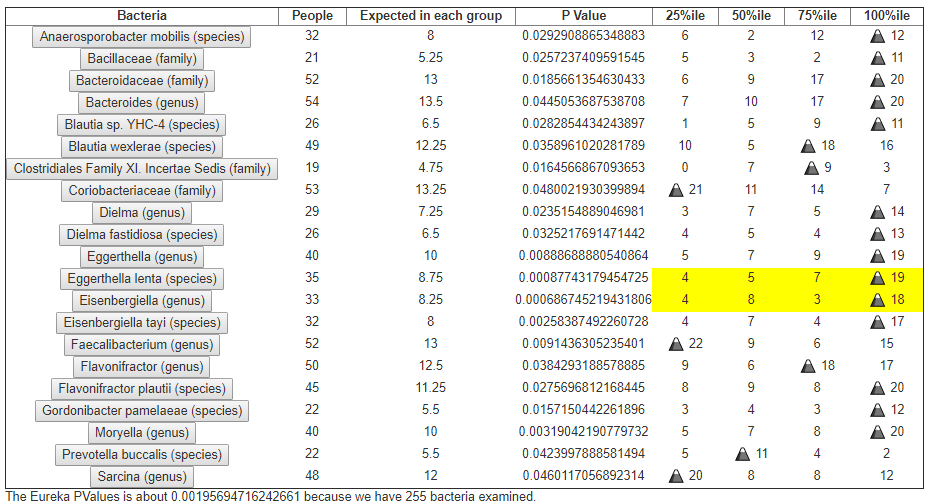
The second side of the question is microbiome shift for SIBO. We have two extremely high associations (in yellow) and a ton of associations < 0.05 (5% chance of happening at random — almost all at the high end!). I am extremely conservative in declaring significance.
The next step is easy: comparing the two lists and seeing where there “is apparent agreement”, that is, xifaxan reduces a high bacteria (or encourage a low one).
For the Eggerthella and Eisenbergia genus — there appears to be no impact.
Similarly no impact for Moryella, Flavonifractor, Dielma, , Sarcina
In terms of parents of species: Nothing on Gordonibacter,Prevotella, Anaerosporobacter
It does decrease Bacteroides
It does decrease the parent of: Blautia
Where do we get this information?
The key information is summarized on the above page (with links to the source — definitely open medicine!), but to illustrate for the casual reader:
Review article: the antimicrobial effects of rifaximin on the gut microbiota. Alimentary pharmacology & therapeutics (Aliment Pharmacol Ther ) Vol: 43 Suppl 1 Issue Pages: 3-10 PubDuPont HL : 2016 Jan Epub
Modulation of the gut microbiota composition by rifaximin in non-constipated irritable bowel syndrome patients: a molecular approach Clinical and Experimental Gastroenterology (Clin Exp Gastroenterol ) Vol: 8 Issue Pages: 309-325 Pub: 2015 Dec 4 Epub: 2015 Dec 4
Inference from above
It does not move anything is the wrong direction :-). However, it only impact 18% of the bacteria shifts at the genus level. I would expect that it would result in statistically significant improvement of a study group with enough data massaging. No remissions should be expected.
Would I take it? No, I would first try the following:
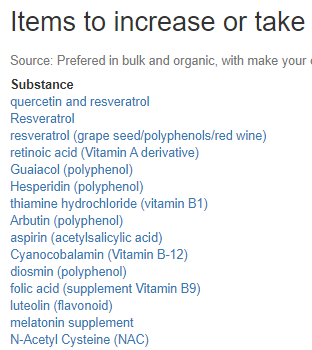
This latter approach is hunting for drugs based on reported microbiome changes; then evaluating safety and side-effect risks.If you have a condition that could warrant being prescribed them, you may wish to negotiate with your physician on a change of prescription.
Actual Studies?
” Response rates to rifaximin (550 mg three times daily for 14 days) were 47.4% for hydrogen positivity alone and 80% for both hydrogen and methane positivity. ” [2019]
” Rifaximin was not effective in improving IBS symptoms and QOL in GW Veterans with non-constipated IBS. ” [2019]
” Rifaximin therapy is well tolerated and the results are promising in terms of efficacy in eradicating small intestinal bacterial overgrowth in CF. ” [2019] “promising” is double talk for no statistically significant results but we are not willing to give future grant money to do more studies.
” Combination of amoxicillin and rifaximin may be effective in the treatment of patients with small intestinal bacterial overgrowth syndrome and concomitant H. pylori infection. ” [2018] again “may be” means that they did not get statistically significant results.
So, studies appear to support my logical conclusion using the model and our citizen science data.
Early this year I shouted EUREKA — I found it in greek. I used non-parametric statistical methods and found strong association between certain mixtures of bacteria. How strong? Statistically the chance of some happening by chance was 0.00005%. Many medical studies are published with the chance being 5%.
Over the weekend, someone asked if I could give suggestions for probiotics for mast cell issues. She had no microbiome results. While I was solving some of the site issues, I realized that I could give suggestions with good confidence that they would fit — in fact, may produce better suggestions than a microbiome sample. Why? Noise – often we have 600 bacteria/taxonomy is a microbiome sample and the nasty problem is what to focus on. This is compounded by a lack of research papers on the human impact on many of the bacteria.
Using symptoms only, we have a small subset that are likely the ones misbehaving. These are not bad bacteria, just bacteria that are too abundant or sparse. We want to inhibit or encourage them — not eliminate them.
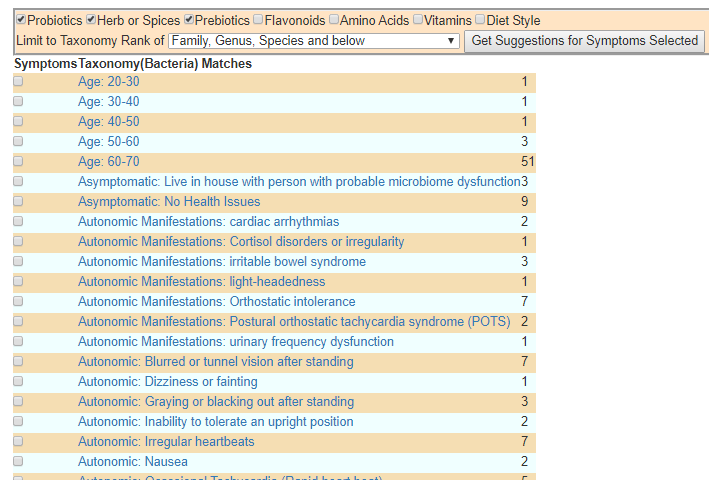
If you go to the Very Strong Bacteris to Symptom Association page, you will see a list of around 150 symptoms. Some symptoms are missing because not enough people with those symptoms have upload a microbiome and provide their symptoms — for example, Epilepsy has just one. The threshold is 16 samples with the same symptom.
Example of identified relationships
All that you need to do is:
Check the symptoms that you have.
Select at the top what type of modifiers that you are interested in
Click get suggestions for Symptoms Selected.
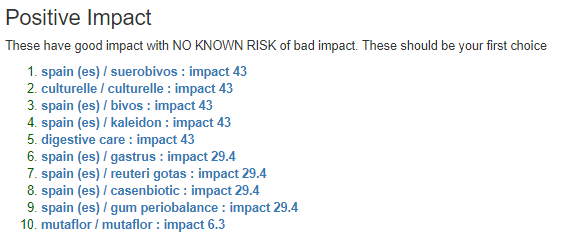
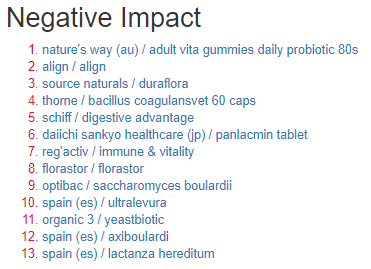
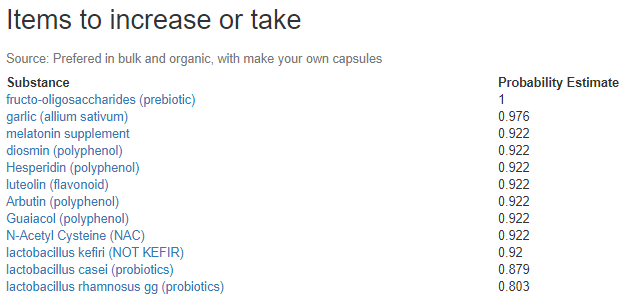
To answer the question asked about probiotics for histamine issues we see just one recommendation with no known downside. We have others that have a little risk.
A Video walk thru
Bottom Line
All of this material is theoretical produced by using an Artificial Intelligence Engine and have not be validated by clinical studies. These are suggestions. Before doing any of these, have them reviewed by a qualified medical professional familiar with your medical condition.
Back in 1999-2002 period, a chap called Dave Williams (Cap’n Dave) advocated some specific treatments to help CFS patients. He was active on the old Yahoo group that I was a co-moderator on, https://groups.yahoo.com/neo/groups/CFSFMExperimental I ended up incorporating his suggestions into my treatment regimen then. He arranged bulk purchase of supplements (L-Glutamine, CoQ10, Spezzatina (Licorice) etc. and send them free to people that made donations to his ocean health charity (SeaQuake) at that time.
Like me, he ended up successfully treating himself and also has a Master of Science which tends to bring with it a systematic approach to this illness. He has moved on with his life, but I thought a shout out of thanks was due!
With all of the microbiome research, his suggestions are in good agreement (for a significant subset). Today the lists of issues to address will be much longer than his summary in 2000.
You fail to understand that NO SINGLE TREATMENT will ever get fantastic results when used on a PWC! The single therapy approach is doomed to failure because CFS is a multiple problem caused by many months or years of hyperimmunity! People that say they have sudden onset CFS simply do not realize that they were sick for along time and never recovered. The illness they associate with the start of their CFS was simply the straw the broke the camel’s back. If you want to recover from CFS you must address hyperimmunity, poor red cell health, hypoadrenalism, hypothyroid, hypoglycemia, poor NK cell activity, and multiple nutrient depletion. And, you must address all these factors at the same time—otherwise your recovery will be limited.
What was unknown (not possible to test even!) was the microbiome aspect which links many of these to specific microbiome shifts. So each shift needs to be addressed. Some examples:
Today the option to download as JSON or CSV disappeared from the uBiome site. The ability to download the raw sequence data was there.
Over the last 30 minutes, I processed one of my samples via https://metagenomics.sequentiabiotech.com/ . (Which offers free accounts – up to 2 GB of data, the download files from uBiome uploaded is just 12 Megs, so the free account will work for most people.)
The main thing is for people not to go into a panic. It appears that uBiome is planning to add back the download options. If they do not, there are possible alternative solutions.
My Samples Listing for ONE ubiome sample
It generates many files, for example below are some of the files sample. uBiome does 4 passes, and the numbers from each pass is shown below. How you boil the four numbers into one is an art – arithmetic mean, median, geometric mean, etc are possible choices.
species.countstrains.count
I look at my ubiome JSON file for the same data and I get:
Bacteroides acidifaciens 30655
Bacteroides faecis 38174
Bacteroides finegoldii 21914
Bacteroides ovatus 192887
Bacteroides sp. J1511 91
Bacteroides sp. ‘Smarlab BioMol-2301151’ 30
Bacteroides thetaiotaomicron 153659
Bacteroides vulgatus 30
This is not surprising, because the raw data fragments are looked up in different reference databases. By the way, there was no E.Coli listed here either!
Bottom Line
I will do a walk thru video this coming weekend for people interested in exploring a different analysis of the raw data. It is a multiple step process that takes about 30 minutes per sample.