Macrolide impact on the Microbiome

In this post, I will look at the impact of macrolides on microbiome. Macrolides are used by Cecile Jadin in her protocol (Notice: I used her protocol as a basis for 2 remissions — I may be bias!).

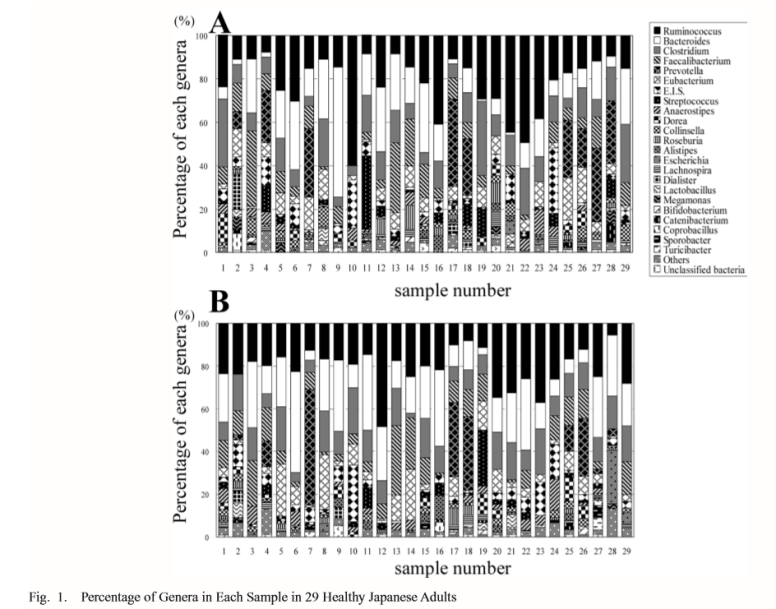
This [2011] article is the basis of this post. The first thing is to note that with these 29 healthy same-ethnic group people, the relative numbers vary greatly!!!!

japan

The is no “normal” microbiome — it is very very individualistic and change over time.

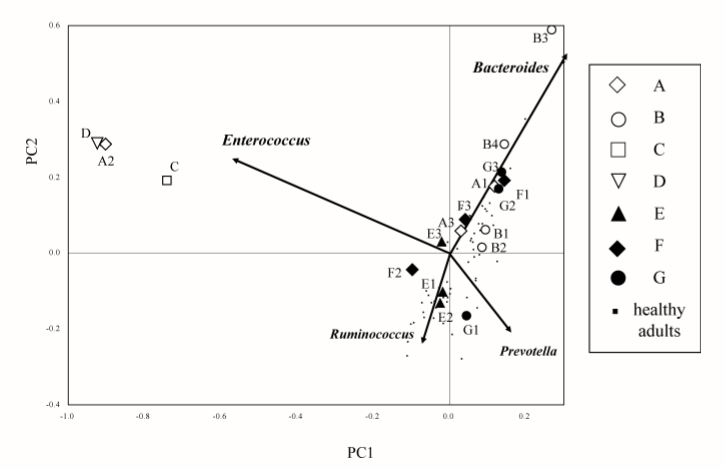
When a macrolide was give, they saw shifts in different directions (the E-G solid colors below)

japan1

” On the other hand, macrolide treatment showed the effects depending on the cases. E and G samples located just within the area which healthy adult samples distribute, despite antibiotic administration. However, F samples were spotted on the left lower of the PCA map.” – In other words, the impact will vary from person to person.

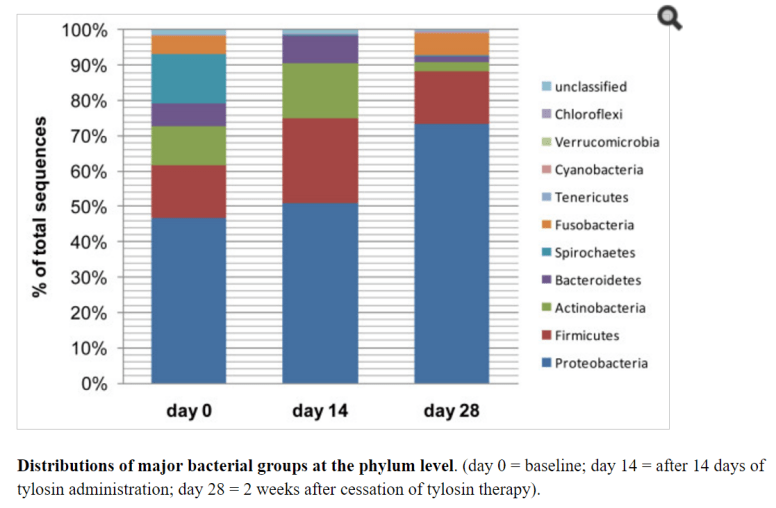
Another study [2009] show the trend over a month – not some phylum disappear completely (Spirochaetes) and other disappeared and re-appeared (Fusobacteria)

trend


Small Intestine Bacterial Overgrowth (SIBO)

This issue often comes up in discussions with CFS/FM/IBS

  • “Recent research shows that patients with CFS have marked alterations in microbial flora, including lowered levels of bifidobacteria and small intestinal bacterial overgrowth (SIBO).” [2003]
  • “a considerable proportion of patients with fibromyalgia experience gastrointestinal symptoms that are commonly overlooked in the studies that are not specifically dedicated to evaluate these manifestations.” [2015]
  • “Recent investigations have shown that bacterial overgrowth of the small intestine is associated with a number of functional somatic disorders, including irritable bowel syndrome (IBS), fibromyalgia, and chronic fatigue syndrome.” [2002]

The model that I use is based on a shift of the microbiome — some overgrowth and some undergrowth. SIBO is a subset of this definition.

According to wikipedia, there are multiple methods of diagnosis — the basis of these methods is abnormal results with “some physicians suggest that if the suspicion of bacterial overgrowth is high enough, the best diagnostic test is a trial of treatment. If the symptoms improve, an empiric diagnosis of bacterial overgrowth can be made.[39]

Under treatment: ” However, if the condition recurs, antibiotics can be given in a cyclical fashion in order to prevent tolerance. For example, antibiotics may be given for a week, followed by three weeks off antibiotics, followed by another week of treatment. Alternatively, the choice of antibiotic used can be cycled.[39]” — the cycling of antibiotic choices is a regular part of Jadin’s protocol for CFS.

Latest from PubMed

  • For rifaximin, “The overall eradication rate according to intention-to-treat analysis was 70.8%…The overall rate of adverse events was 4.6%… improvement or resolution of symptoms in patients with eradicated SIBO was found to be 67.7%”[2017]
    • “Although the rifaximin group showed a greater percentage of global symptom improvement, this was limited to bloating, as scores for abdominal pain, diarrhea, and constipation did not improve significantly.”[2007]
  • “SIBO was found to be associated with deep vein thrombosis (DVT).” [2016] — which implies coagulation may be associated with SIBO (i.e. thick blood).

Bottom Line

SIBO is a common condition with vague diagnosis criteria. Often the treatment and diagnosis is for one particular group of bacteria — for example Hydrogen Sulfide. A MD may tell the patient, your SIBO is resolved and the reality is that only the Hydrogen Sulfide producing bacteria has been reduced, the rest remain active — creating symptoms of FM, CFS, etc.

In short, SIBO — both tests and treatment are a part of the solution to CFS/FM/IBS but is not the full answer and likely, IMHO, not a major part of the answer. False positives and negatives are common with common tests.

On the PLUS SIDE — as with chronic lyme, SIBO can be a justification(defense) for a MD to prescribe antibiotics. Prescribing antibiotics for CFS or FM is not politically acceptable in most countries.


Ciprofloxacin and Clindamycin impact on Microbiome

From Stockholm in 2015, we had this article: “Determining the Long-term Effect of Antibiotic Administration on the Human Normal Intestinal Microbiota Using Culture and Pyrosequencing Methods [2015]”

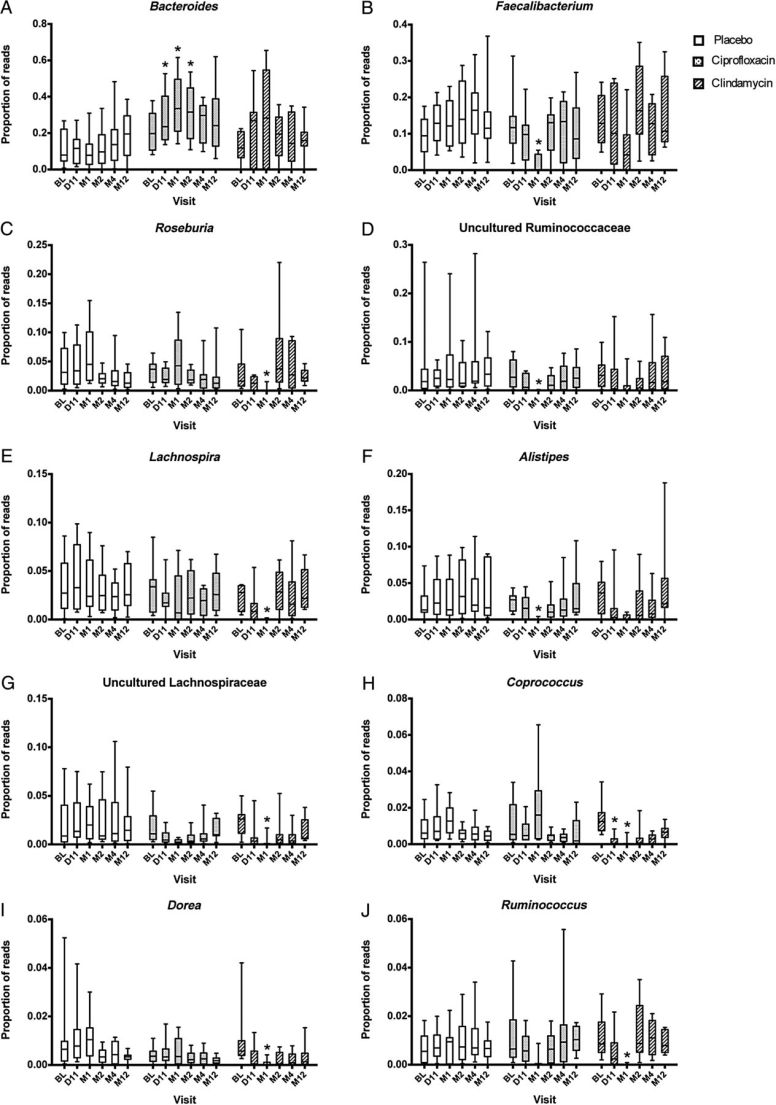
This study is interesting because you can see variation in the population of the control group over the 11 months (possibly due to season food consumption, sun exposure, etc). For some groups like Ruminococcaceae, they appear to survive well for the 10 days that the antibiotic was taken and then collapsed to nothing in the following 20 days and then returned by 2 months.

Abbreviations: BL, baseline; D11, day 11; M1, month 1; M2, month 2; M4, month 4; M12, month 12.

f2-large

“Study Design

Thirty healthy volunteers aged between 18 and 45 years with normal findings in their medical history and physical examination (15 men and 15 women) were included in the study. The volunteers had undergone at least a 3-month washout period following a treatment with any systemic or topical antibiotics. Volunteers who were currently enrolled in another investigational drug or device study or who had participated in such a study in the 3 months prior to the screening visit were excluded. Twenty volunteers were randomly assigned to the treatment groups (ciprofloxacin or clindamycin) and 10 volunteers in the control group. Ten volunteers (5 men and 5 women) were given ciprofloxacin (500 mg twice daily) and 10 volunteers (5 men and 5 women) were given clindamycin (150 mg 4 times daily) for a 10-day period; the remaining 10 volunteers (5 men and 5 women) in the control group were given placebo for 10 days. Fecal samples were collected for analyses at 6 occasions: immediately before antibiotic or placebo administration, day 11 (ie, immediately after treatment), and at 1, 2, 4 and 12 months postdosing”.

Studies on CFS/FM/IBS

  • Clindamycin increases risk ratio of Clostridium difficile by 44 [2008], nothing else found.
  • Fluoroquinolone
    • “After 4-12 months they developed post-Q-fever fatigue syndrome and were treated with intracellular active antibiotics (fluoroquinolones and tetracycline) for 3-12 months. Efficacy of the treatment was observed in two patients, but in one patient the results were not encouraging.” [2007]
    • Used by Prof. Garth L. Nicolson “the recommended treatments for mycoplasmal blood infections require long-term antibiotic therapy, usually multiple 6-week cycles of doxycycline (200-300 mg/d), ciprofloxacin or Cipro (1,500 mg/d), azithromycin or Zithromax (500 mg/d) and clarithromycin or Biaxin (750-1,000 mg/d). Multiple cycles are required,”
  • Used by Cecile Jadin, MD

Tetracyclines impact on Microbiome

Tetracyclines includes minocycline, doxycycline and other brand names. In this post, I am revisiting what we currently know about the shifts of the microbiome as a result.

My last post on Va In this pncomycin had me discovering some lovely graphics on the shift of the microbiome.

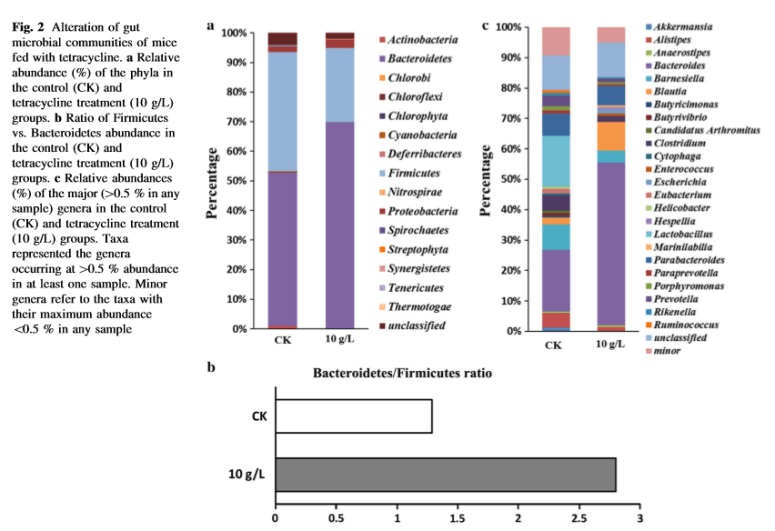
From Metagenomic insights into tetracycline effects on microbial community and antibiotic resistance of mouse gut[2015]. we have the following graphics

tetracycline

Studies of tetracycline on CFS/FM/IBS

  • “After 4-12 months they developed post-Q-fever fatigue syndrome and were treated with intracellular active antibiotics (fluoroquinolones and tetracycline) for 3-12 months. Efficacy of the treatment was observed in two patients, but in one patient the results were not encouraging.” [2007]
  • “Four CFS patients (the CFS group) and 54 controls [the post-Q fever fatigue syndrome (QFS) group] positive for C. burnetii were treated mainly with minocycline or doxycycline (100 mg/day) for 3 months. After treatment, all 58 patients tested negative for C. burnetii infection.” [2005]
  • “These results of an open label study in Japan suggest that minocycline administration is useful for improving chronic nonspecific symptoms considered to be post-Q fever fatigue syndrome caused by C. burnetii infection.” [2004]
  • “post-Q fever chronic fatigue syndrome has been described. … the treatment of choice for acute infection in both diseases is still tetracycline-group antibiotics.” [2007]
  • Used by Prof. Garth L. Nicolson
    • “the recommended treatments for mycoplasmal blood infections require long-term antibiotic therapy, usually multiple 6-week cycles of doxycycline (200-300 mg/d), ciprofloxacin or Cipro (1,500 mg/d), azithromycin or Zithromax (500 mg/d) and clarithromycin or Biaxin (750-1,000 mg/d). Multiple cycles are required,”
  • Used by Dr. Cecile Jadin, MD. Site

Oral Vancomycin Antibiotics -A big reset of the microbiome

A reader wrote with positive results:

“Ever since I developed Sjogren’s,  I started researching a method to get back to normal.  One of the more interesting studies in Pubmed I came across was the use of Vancomycin to manipulate the gut biome for autoimmune recovery, so naturally, I had to try this.
https://www.ncbi.nlm.nih.gov/pubmed/11083284

  Since Vancomycin pretty much stays in the gut similar to Rifaximin, it tends to be safer than most other antibiotics, so I decided to use 250 mg 4 times daily for 14 days, as per a study that was recently run by NYU in another autoimmune related study.”

  • “Vancomycin became available for clinical use >50 years ago but was soon discarded in favor of other antibiotics that were deemed to be more efficacious and less toxic.” [2006 – full text, review of the history of vancomycin]
    • “Prior to its release, vancomycin was used to treat an entity called “postoperative micrococcal colitis” [2]. The response to vancomycin was excellent, and the presence of this disease, also called “acute staphylococcal ileocolitis,” became an indication for the use of vancomycin [29]. Although Clostridium difficile is the primary agent of pseudomembranous enterocolitis, Staphylococcus aureus is clearly an occasional cause of the disorder [30]. Because vancomycin is active against both pathogens and is poorly absorbed from the intestinal tract, it became the drug of choice for treating pseudomembranous enterocolitis [31]”
    • “With the increased use of vancomycin came data suggesting that vancomycin might not be equivalent to β-lactams.”
  • “[In Rats] Vancomycin significantly altered the microbiota, which was restored to control levels by 8 weeks of age. Notably, vancomycin-treated animals displayed visceral hypersensitivity in adulthood without any significant effect on anxiety responses as assessed in the elevated plus maze or open field tests... a temporary disruption of the gut microbiota in early-life results in very specific and long-lasting changes in visceral sensitivity in male rats, a hallmark of stress-related functional disorders of the brain-gut axis such as irritable bowel disorder.” [2014]
    • Visceral hypersensitivity means a general increase in pain sensation experienced in internal organs. It is common in IBS sufferers. [source]
  • “In patients experiencing an acute episode of recurrent Clostridium difficile infection (CDI), a single Fecal transplantation by enema was not significantly different from oral vancomycin taper in reducing recurrent CDI. ” [2017] – in other words, it may be as effective as a fecal transplant… more studies are needed.
    • “To date fecal transplant cures Clostridium difficile infections with more efficacy than vancomycin, and prevents recurrence.” [2015]
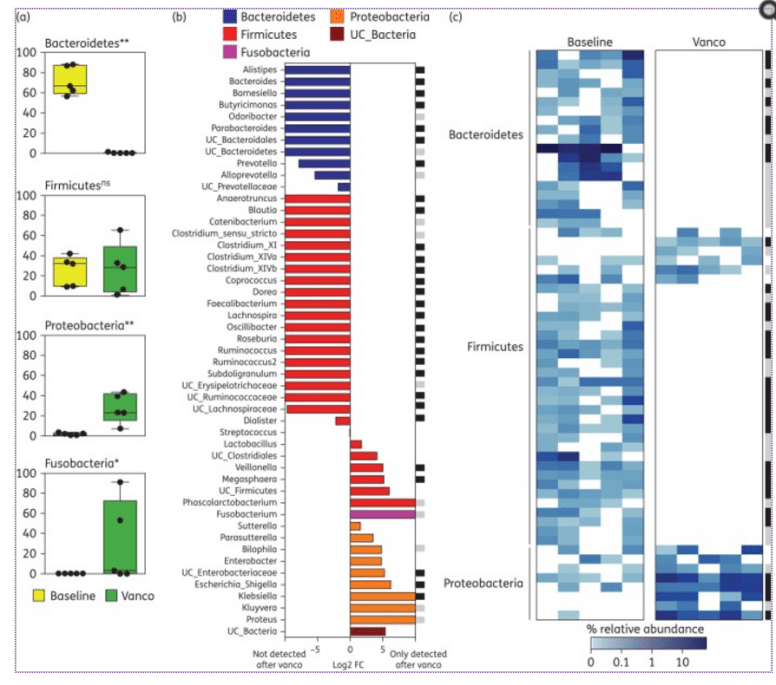
  • Short- and long-term effects of oral vancomycin on the human intestinal microbiota [2017]. FULL TEXT
    • “oral vancomycin remains the treatment of choice for severe C. difficile infection (CDI). Despite its effectiveness against CDI (cure rate of ∼90%),”
    • “microbiota alterations induced by vancomycin may promote intestinal colonization by other pathogens, including VRE, Klebsiella pneumoniae or Escherichia coli.10Moreover, oral vancomycin therapy may predispose to other microbiota-related disorders, including obesity, asthma or diabetes.7,11,12
    • “By contrast, microbiota richness was greatly reduced upon vancomycin administration. Following antibiotic cessation, microbiota richness gradually increased, although it never recovered to baseline levels. A similar result was obtained when the Shannon diversity index was calculated (Figure 1c and Figure S3), which takes into account the number of OTUs and their relative proportion. In this case, however, baseline levels were recovered 22 weeks after antibiotic withdrawal.”

van

Bottom Line

Vancomycin seems close to doing a disk format and re-install of the operating system on a PC. You need to reinstall all of your programs (i.e. populate with probiotics) — unfortunately you no longer have most of the installation disks….

If you do use Vancomycin, I would strongly suggest having as many human-sourced probiotics as possible on hand, and start them 2-6 days after the last dosage, for example:

  • Symbioflor-2
  • Mutaflor
  • Lactobacillus Fermentus ME3
  • Biogaia Lactobacillus Reuteri
  • Enterococcus faecium SF68

As well as these SBO

  • Prescript Assist
  • General Biotics Equilibrium