Decreasing Marvinbryantia Genus

For updated information see Microbiome Prescription

DataPunk.Net Data

INHIBITED BY

ENHANCED BY

PubMed Data

There are 8+ studies on PubMed.

Disease

  • ” The relative abundances of the bacterial genera Marvinbryantia, Corynebacterium, Psychrobacter, Christensenella, Lactobacillus, Peptostreptococcaceae incertae sedis, Anaerovorax, Clostridiales incertae sedis and Coprococcus were significantly decreased, whereas Candidatus Arthromitus and Oscillibacter were markedly increased in model rats compared with normal controls for depresison” [2017]
  • “The total bacterial count of Marvinbryantia genus was significantly lower in upper motor neuron  bowel dysfunction group when compared to the lower motor neuron group. [Spinal Cord Injury]” [2016]

Diet

  • “The relative proportions of Blautia, Bryantella, Collinsella, Lactobacillus, Marvinbryantia, Turicibacter, Barnesiella, and Parabacteroides were significantly correlated with weight loss induced by tea extracts. ” [2017]
  • “dietary resistant starch diet caused significant shifts in microbial composition/diversity, with increases in Parabacteroides, Barnesiella, Ruminococcus, Marvinbryantia and Bifidobacterium as primary contributors to the shift. ” [2016]
  • “raw potato starch ( increased the relative abundance of Turicibacter, Blautia, Ruminococcus, Coprococcus, Marvinbryantia, and Ruminococcus bromii-related OTUs in colonic digesta and mucosa” [2015]

Prebiotics

  • “Fructooligosaccharides …. were identified to be FOS-metabolizing, of which Cronobacter sakazakii, Marvinbryantia formatexigens, Ruminococcus gnavus, and Weissella paramesenteroides are reported here for the first time. ” [2015]

Probiotic

Antibiotic

  • ” the key alteration caused by 2-week low-dose penicillin treatment was a decrease of Enterohadus, Lactobacillus, streptococcus, Candidatus Arthromitus, Allobaculum, and Turicibacter; and an increase in Bacteroides, staphylococcus, Marvinbryantia, Roseburia, Peptococcus, Oscillibacter, Escherichia-Shigella and Stenotrophomonas. ” [2017]
  • “the enrichment of Akkermansia, Bacteroides, Enterorhabdus, and Marvinbryantia in the Ang II+minocycline–treated group.” [2015]

Bottom Line

Avoid

Take

Decreasing Papillibacter Genus

For updated information see Microbiome Prescription

DataPunk.Net Data

INHIBITED BY

ENHANCED BY

PubMed Data

There are 17+ studies on PubMed.

Disease

  • “Parkinson’s disease reduced content of Dorea, Bacteroides, Prevotella, Faecalibacterium, Bacteroides massiliensis, Stoquefichus massiliensis, Bacteroides coprocola, Blautia glucerasea, Dorea longicatena, Bacteroides dorei, Bacteroides plebeus, Prevotella copri, Coprococcus eutactus, and Ruminococcus callidus, and increased content of Christensenella, Catabacter, Lactobacillus, Oscillospira, Bifidobacterium, Christensenella minuta, Catabacter hongkongensis, Lactobacillus mucosae, Ruminococcus bromii, and Papillibactercinnamivorans. ” [2017] [2016]
  • ” two genera belonging to the Clostridium leptum subgroup, Faecalibacteria and Papillibacter, display consistent patterns with respect to disease status and may thus serve as reliable ‘microbiomarkers’ for IBD. [2016]

Diet

Prebiotics

Probiotics

Antibiotics

  • “In general, the community changes induced by the three β-lactam antibiotics showed consistency in inhibiting Papillibacter, Prevotella and Alistipes while inducing massive growth of Clostridium” [2015]

Bottom Line

Avoid

Take

Another enhanced uBiome Analysis

I have been slowly working on this analysis for almost a month because it has a large number of high bacteria genus. Many of which needed deep dive.  When I got to the bottom line, I was delighted that there was few common Avoid/Take items.

Standard Items

The items below follow the high level patterns of all other CFS readers.

Usual major shift of ratios

ah3

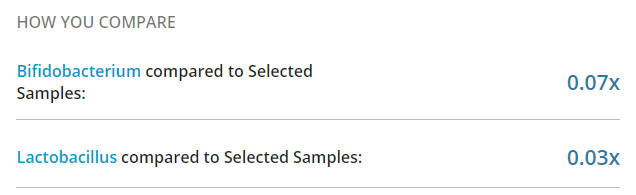
Unlike most CFS readers (where at least one is at 0x, we have both > 0, just very low)

ah2

Enterobacteriaceae (Parent of E.Coli)  0.01X (low or no E.Coli is standard)

Biodiversity:  94%ile (very high — typical for CFS readers using uBiome)

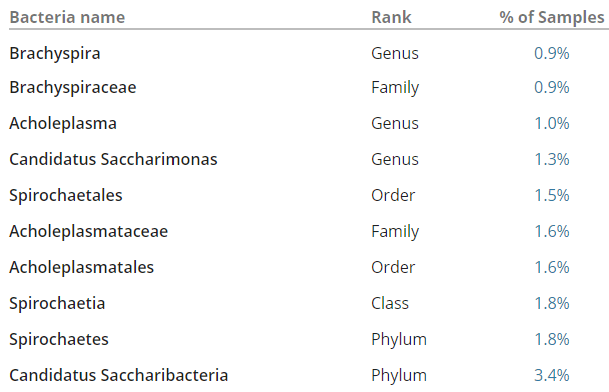
Uncommon Bacteria

ah4

I will do an addendum later for these rate bacteria.

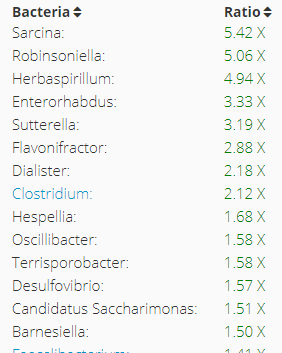
High Bacteria Genus

We have 14 genus >= 1.5, a new record!

ah1

Bacteria “Hit List”

Bottom Line Suggestions

The lists below are done by merging the lists from the deep dives linked above. Some items may encourage one genus and discourage another genus — those are removed (unless it seems that it strongly predominates on one). The impact on Lactobacillus, Bifidobacterium and E.Coli are intentionally ignored [See this post for the logic]. This is all based on applying logic to the results of studies — thus theoretical. This is an addition (not a replacement) to this overview post.

Avoid

  • Aspirin (other NSAID’s are fine)
  • Bacillus subtilis
  • Barley
  • Berberine
  • Bifidobacterium animalis
  • BPA bottles
  • Chemotherapy
  • Gluten
  • High protein diet
  • Iron supplements
  • Kombucha
  • Lactobacillus Fermentum
  • Lactobacillus Reuteri
  • Oligofructose
  • Pomegranate
  • Proton-pump inhibitors (PPI)
  • Resistant starch (type I & III)
  • Saccharomyces boulardii
  • Sodium Butyrate
  • Walnuts
  • β-Glucan

Take

  • Bacillus licheniformis
  • Bifidobacterium Breve
  • Bile supplements
  • Cellobiose
  • Chitosan supplements
  • Chocolate!
  • Coconut Oil, Monolaurin (Lauric Acid)
  • Cranberry bean flour
  • Enterococcus  faecalis probiotics
  • Fennel
  • Flaxseed
  • Gallate – Tea
  • Gluten free diet
  • High Fat diet
  • High resistance starch
  • Inulin
  • Lactobacillus Casei
  • Lactobacillus kefiri LKF01
  • Lactobacillus plantarum probiotics
  • Lactobacillus rhamnosus probiotics
  • Lactobacillus acidophilus
  • L-glutamine
  • lycheerambutanguaranakorlanpitomba, Spanish lime and ackee. [fam-Sapindaceae]
  • Navy bean (Cooked)
  • palm kernel meal
  • Polymannuronic acid
  • Prescript Assist
  • Resistant starch (type II & IV)
  • Smoking (!?!)
  • Streptococcus Probiotics
  • Trametes versicolor
  • Xylitol
  • Xylooligosaccharide

This is an education post to facilitate discussing this approach with your medical professionals. It is not medical advice for the treatment of CFS. Always consult with your medical professional before doing any  changes of diet, supplements or activity. Some items cites may interfere with prescription medicines.

Decreasing Desulfovibrio Genus

For updated information see Microbiome Prescription

DataPunk.Net Data

ENHANCED BY

PubMed Data

There are 3000+ studies on PubMed.

Disease

Diet

  • “a high-fat, very low-carbohydrate normocaloric diet …a statistically significant increase in Desulfovibrio spp. (p = 0.025), a bacterial group supposed to be involved in the exacerbation of the inflammatory condition of the gut mucosa associated to the consumption of fats of animal origin.” [2017]

Prebiotics

Probiotics

  • “the relative abundance of Alistipes, Odoribacter, Ruminococcus, Blautia and Desulfovibrio were higher after Bacillus subtilis, while the potential pathogens such as Staphylococcus and Escherichia-Shigella were lower than those of control.”
  • “Lactobacillus plantarum P-8 …other beneficial bacteria, whereas Desulfovibrio (P < 0.05) and other opportunistic pathogens decreased after taking Lp-8 for 4 wk. ” [2014]

Antibiotics

Bottom Line

Avoid

Take

Reducing Terrisporobacter Genus

For updated information see Microbiome Prescription

DataPunk.Net Data

INHIBITED BY

PubMed Data

There are 6+  studies on PubMed.

Disease

Diet

  • ” Terrisporobacter and Clostridium were decreased in the  palm kernel meal  groups compared to the control. ” [2016]

Prebiotic

Probiotic

Antibiotic

  • “The patient received an 8-week course of moxifloxacin and metronidazole with an excellent clinical response at 12 months’ follow-up.” [2016]

Bottom Line

Avoid

Take