Decreasing Slackia genus

For updated information see Microbiome Prescription

DataPunk.Net

Nothing

PubMed Data

There are 55+ studies on PubMed.

  • Disease:
    • “Rosacea is a chronic inflammatory dermatosis affecting the face and eyes…reduced abundance of Methanobrevibacter (genus), Slackia (genus), ” [2017]
    • Slackia exigua,.. to be a novel case of this bacterium causing thrombosis and haemorrhage.” [2016]
    • “periodontitis Periodontal pathogens were more frequently detected at diseased sites: Gram-positive anaerobes such as Slackia exigua, ” [2016]
    • “Among them, the abundance of the genera Enterorhabdus, Howardella, and Slackia was higher in Pre- Type 2 Diabetes Mellitus.” [2015]
  • Diet:
    • “Genistein reduced …Slackia equolifaciens,” [2017]
  • Prebiotics:
    • ” prebiotic xylooligosaccharide significantly decreased or reversed the increase in abundance of Howardella, Enterorhabdus, and Slackia” [2015]
  • Probiotics:
    • “a fermented dairy product (FDP) fortified with Bifidobacterium animalis subsp. lactis… Increased lactose fermenting taxa included Slackia isoflavoniconvertens and Adlercreutzia equolifaciens; ” [2017]

Bottom Line

Avoid

  • Bifidobacterium animalis  subsp. lactis

Take

  • xylooligosaccharide prebiotic

Decreasing Oscillospira genus

“Oscillospira is an under-studied anaerobic bacterial genus from Clostridial cluster IV that has resisted cultivation for over a century since the first time it was observed… the observation that the presence of this genus is reduced in diseases that involve inflammation.”[2017]

For updated information see Microbiome Prescription

DataPunk.Net Data

Parent means this bacteria parent, Ruminococcaceae  is influenced (this and other siblings may be my inference).

INHIBITED BY

ENHANCED BY

PubMed Data

There are 70+ studies on PubMed

  • Disease:
    • “Inflammatory bowel disease (IBD)..whereas Bacteroides, Flavobacterium, and Oscillospira decreased. “[2017]
    • “Oscillospira … were underrepresented among subjects with food allergy.” [2017]
    • “Parkinson’s disease.. reduced content of Oscillospira, ” [2017]
    • “transient ischemic attack ..
  • Diet:
    • “whereas OscillospiraDesulfovibrio, and Ruminoccaceae, typical hydrogenotrophs equipped with multiple carbohydrate active enzymes, were remarkably enriched with mixture of oat-derived β-glucan and microcrystalline cellulose” [2017]
    • “Oscillospira spp., Dehalobacterium spp., Peptococcaeceae, Corynebacterium spp., Aggregatibacter pneumotropica were reduced in  silver nanoparticles spheres exposed group.”[2017]  – the shape made a difference!
    • “the abundance of pernicious bacteria, Oscillospira (P < 0.001) and Treponema (P = 0.011), was decreased with L-glutamine (Gln) supplementation” [2017]
    • “resistant starch type 4 …  enrichment of three Bacteroides species and one each of Parabacteroides, Oscillospira” [2016]
    • “the Med diet decreased the Prevotella and increased the Roseburia and Oscillospira genera” [2016]
    • “. Leanness is a feature of higher fecal levels of Oscillospira in several animal species “[2017]
  • Probiotics:
    • “Lactobacillus fermentum FTDC 8312 increase in the members of genera Akkermansia and Oscillospira, “[2017]
    • ” L. casei 32G altered the cecal microbiota with the predominance of Lachnospiraceae IS, and Oscillospira decreasing significantly ” [2015]
    • ” B. longum supported populations close to Anaerostipes, Prevotella, and/or Oscillospira.” [2008]

Bottom Line

Avoid:

Take:

Enhanced analysis of an uBiome result

I have just finished doing a bunch of deep dives of some of the bacteria genus that are high in CFS. This makes it faster to do an analysis. Most of the information about probiotics impact was published in 2017, a little in 2016. I expect many more studies in 2018. As new information comes in, recommendations will evolve.

The working hypothesis is that the high genus are causing many symptoms. CFS have many symptoms — so different high genus are expected. This makes effective treatment more difficult for CFS as a group; in theory with uBiome results we can individualize treatment for the person’s uBiome shifts.

Similar uBiomes with high (Butyricimonas, Alistipes, Gordonibacter)

The original analysis was done in June 2017, in this post. The old advise was “Resume with heavy dosages of Bifidobacterium, Consider adding some Lactobacillus (see this post)“. In this post specific strains to take or avoid are derived from these new studies.

Basics:

Bifidobacterium: 0x, Lactobacillus: 0.02x,  Enterobacteriaceae (E.Coli parent) 0x, Akkermansis 2.97x, Firmicutes to Bacteroidetes: 1.4::1 (Normal 2.1::1)
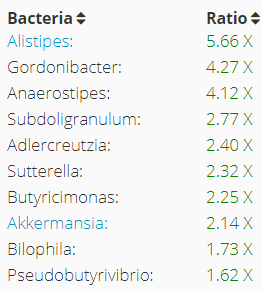
lala

Rare Bacteria ( <5%)

Bottom Line

The following is derived from the research consolidated above. It is a logical inference (theoretical) that have not been tested in human studies on patients with any autoimmune like diseases.

THIS IS NOT A GENERAL RECOMMENDATION FOR ALL CFS PATIENTS.  It is specific to one person with their unique-to-them ubiome. It’s purpose is show that uBiome results may point to specific probiotics.

Food

Inconclusive:

Take

Avoid

  • Pomegranate and walnuts
  • Raspberries
  • Omega 3
  • Berberine 
  • Black tea

Probiotics

Take

Ideally without inulin or other prebiotics

  • E.Coli Nissle –  Mutaflor and Symbioflor-
  • Lactobacillus kefiri
  • Lactobacillus paracasei 
  • Lactobacillus plantarum
  • Lactobacillus rhamnosus GG
  • Streptococcus probiotics

Avoid

  • Bifidobacterium Adolescentis 
  • Bifidobacterium animalis subsp. lactis (B-12®) 
  • Bifidobacterim Breve
  • Bifidobacterium Longum.
  • Clostridium butyricum (i.e. Miyarisan) 
  • Lactobacillus Casei
  • Lactobacillus Salivarius
  • Saccharomyces boulardii

Addendum

From some reader feedback, the lists above can exceed the band width of the CFS fogged brain. My general advice on how to implement the above is based on the concept

“Haste looses information and create uncertainty

CFS patients want to rush to remission and in so doing they overload on supplements and some item makes it worst. They will arbitrary ascribe it to one of the items and often pick the less likely one. The following is how I would proceed for myself.

  1. Step #1 if you have any probiotics on the AVOID list that you are actively taking — keep taking them until you have a week supply left, then stop them. We want to retry them later (remember the above is in theory)
  2. Step #2 As each probiotic goes to the pause state, add in one of the new TAKE probiotic  (no more than 1/week), slowing increase the dosage.  Be aware of costs (work from the cheapest). Ideally 10-30 BCFU of each. CustomProbiotics.com can be as cheap as 5 cents for 10 BCFU to $0.79 for 10 BFCU for align if fresh from the factory (or  $79 BCFU if close to use by date on package)
  3. Stop any supplements on the AVOID list. Give yourself 5 days to wash out — if you crash, then return them and try isolating out the ones you really need.
  4. After a 5 day wash out, start adding in new ones (no more than 1 new one a week). See if you can determine “recommended daily allowance”(Lowest level) and “Highest accepted as safe level”
    1. You want therapeutic levels, which means high levels, slowly worked up
    2. Example: Vitamin K2 cited above:
      1. Search using https://www.ncbi.nlm.nih.gov/pubmed/?term=vitamin+K2+dosage
      2. “Low dosage… up to 200 μg menaquinone-7 daily for 4 wk, ” [2015]
      3. “The tolerable upper intake level (UL) was determined for vitamin A, vitamin D and vitamin E, but not for vitamin K, since no adverse effects have been reported even with its high dosage.” [2010].
      4. When there is no known upper limit, I usually assume that 2-3x a known safe lower limit should be fine.
  5. For food, teas, etc … start shifting your diet away from the AVOID and try to have at least one TAKE every couple of days at least. For teas, a cup with each meal would be a reasonable goal.

This is a personalized addition based on an individual’s ubiome results. It is in addition to the general theoretical guidance provided in this post.

This is an education post showing how ubiome results could lead to specific recommendations to reduce high bacteria genus. Always consult with a medical professional before starting or stopping probiotics, supplements etc.

Decreasing Pseudobutyrivibrio genus

For updated information see Microbiome Prescription

DataPunk.Net Data

Parent means this bacteria parent, Lachnospiraceae is influenced (this and other siblings may be my inference).

INHIBITED BY

ENHANCED BY

INHIBITED BY

PubMed.Data

There are 50+ studies on PubMed.

  • Disease:
    • ” Pseudobutyrivibrio were significantly depleted in Systemic lupus erythematosus (SLE)  patients. ” [2016]
    • Stool from  Sjögren syndrome  subjects had greater relative abundances of Pseudobutyrivibrio, ” [2016]
    • “samples from recent-onset psoriatic arthritis patients were also characterized by a significant reduction in Akkermansia, Ruminococcus, and Pseudobutyrivibrio.” [2015]
  • Food:
    • “black tea (BT) polyphenols i increased the relative proportion of Pseudobutyrivibrio ” [2017]
    • ” barley and oat …showed enrichment in…. Pseudobutyrivibrio. ” [2016]
    • “L-glutamine ..At the genus level, Dialister, Dorea, Pseudobutyrivibrio, and Veillonella, belonging to the Firmicutes phylum, had statistically significant reduction.” [2015]
    • garlic oil no significant impact; peppermint oil increases; origanum oil decreases [2015]
  • Prebiotics:
    • ” The growth of Lactobacillus, Butyrivibrio, Pseudobutyrivibrio, Bifidobacterium and Clostridium butyricum was stimulated … by inulin [2017]
  • Probiotics:
    • ” Lactobacillus paracasei DG  ..a concomitant decrease in the sum of 6 Clostridiales genera, namely Faecalibacterium, Blautia, Anaerostipes, Pseudobutyrivibrio, Clostridium, and Butyrivibrio (P = 0.021), after the probiotic intervention. ” [2014]
    • Pseudobutyrivibrio xylanivorans is being considered as a probiotic. [src]

Bottom Line

Avoid:

Take:

  • Lactobacillus paracasei
  • L-glutamine
  • Flaxseed

Decreasing Caldicoprobacter genus

This is a rare genus that occurs in 2.7% of uBiome results. “Members of the family are found in herbivore feces and terrestrial hot springs.”[2014]

For updated information see Microbiome Prescription

DataPunk.Net Data

No information

PubMed Data

There are just 10+ studies on PubMed

Bottom Line

The only thing that can be inferred to reduce it is to reduce the herbivore aspect of your diet, that is eat more meat.