Another Lab Report to check microbiome: Synlab

Lab is based in Germany but available in other countries (Hungary – $140 according to reader). He gave a nice detailed summary and permission to post, so I quoted it below.

Patient Summary

“26 years old male, lives in Hungary.

Symptoms currently

-High anti-tpo levels(Hashimoto’s disease, autoimmune), level even became more elevated since I tried some probiotics.

-Sleep problems(easy to fall in sleep, but wake up after 3-4 hours and could not fall in sleep again, seems like it is constantly improving since I started to take big dose homemade chocholate (coconut oil+cacao), nettle leaf tea made from fresh leafs, and changed bed since I got to know I have dust mite allergies.

-Blurred vision, brain fog.

-Anxiety, agoraphobia, these improved since I’m under chiropractic care, I found out I had my C1 vertebra out of place, maybe since childhood.

-Sore muscles, often feel like I was doing workout.

-I’m able to do exercises, but next days I will be very fatigued.

-General low energy, but able to live my life, not locked to bed. I would say I have around 50%-60%  energy level, but become fatigued fast.

-Constant craving for chocholate.

-High blood folic acid level, this showed in my newer blood tests, after I started to experiment with different probiotics. Kinda low b12 levels, even my diet b12 rich.

-Coated tongue, especially after fruits.

-Muscle twitches.

-Chest tightness, sometimes breath difficulties.

-Rarely skin rash, dry eyes, but nothing serious.

-Not painful bloating after meals.

-No constipation, or diarrhea.

-Headaches, with not so terrible photophobia.

-Low blood pressure

-Tinnitus

Probiotics I tried:

–Bio Kult, Protexin, even made yoghurt with these. At first they kinda worked, they boosted my mood,energy, but in longterm feel like they hurted slowly especially since they grown on corn, and I found out I got IgG related corn intolerance, I took them for months.

http://www.protexin.com/products/bio-kult-120-capsules/16

http://www.protexin.com/products/balance/3


-Once tried eat carrots, beets, just pulled out, and without washing few times. They worked too good, I had too much energy, but I was worried to continue eat those long enough, so I ordered Prescript-Assist, and AOR3 instead. I had zero effect from those then, but I guess I still had the bugs from raw vegetables then, but they could not make permanent changes.

-Paleo coconut yoghurt with these noname strains Bifidobacterieum lactis,Lactobacillus rhamnosus L.acidophilus,Streptococcus thermophilus, Lactobacillus reuteri(they buy reuteri from Korea, but did not tell me exact strain name), L.casei, L.bulgaricus. At first had similar effect as with Bio Gaia, but not lasted long.

-Bio Gaia L. reuteri ATCC PTA 6475,L. reuteri DSM 17938 . My brain liked these, at first gave me very calmed effect, but maybe it was just placebo, as I felt short time effect only.

-Made yoghurt with these strains and goat milk: Lactobacillus delbrueckii subsp. bulgaricus, Streptococcus salivarius  subsp. thermophilus, Lactobacillus acidophilus LA-5®, Lactobacillus  reuteri, Lactobacillus rhamnosus GG, Bifidobacterium animalis subsp.  lactis BB-12®; 0,9%). No effect.

-Goat milk kefir, homemade with these: Debaryomyces hansenii, Kluyveromyces marxianus subsp. marxianus, Lactococcus lactis subsp. cremoris, Lactococcus lactis subsp. lactis, Lactococcus lactis subsp. lactis biovar diacetylactis, Leuconostoc, Streptococcus thermophilus. My tongue did not like it, kinda burned, but I got IgG intolerance to some yeast strains.

Enterol(s. boulardii): It helped to calm down autoimmune flareup that I got from tea, but did not take long term.

Other interesting observations:

-I tried make tea with turmeric, cinnamon, black pepper, ginger. Gave me horrible autoimmune flareup, thought I will die.

-Months later I made golden paste(turmeric+coconut oil). Same effect as with tea, so I stopped instead after two days, and ordered the microbiome test to know what may happen in my gut.

-Read about chocholate’s effect on microbiome on your blog, taking high dose since few days, early to tell the experience, but so far feels promising. I will email you the result in 3 weeks.

Feel free to post my case.”

Test Results

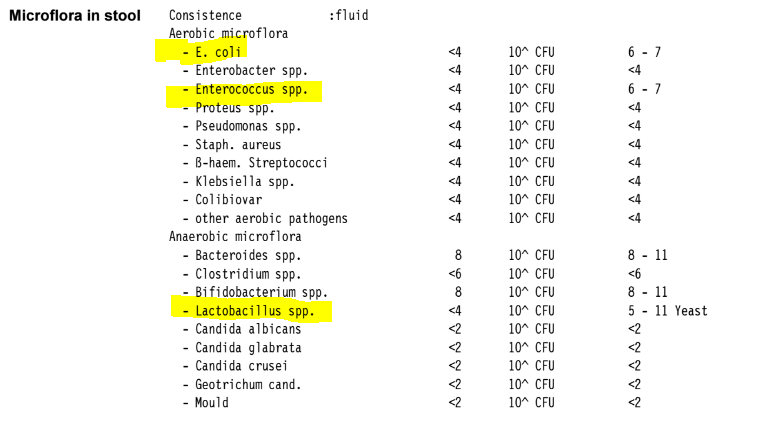
The first part is shown below — I highlighted those that are out of range.
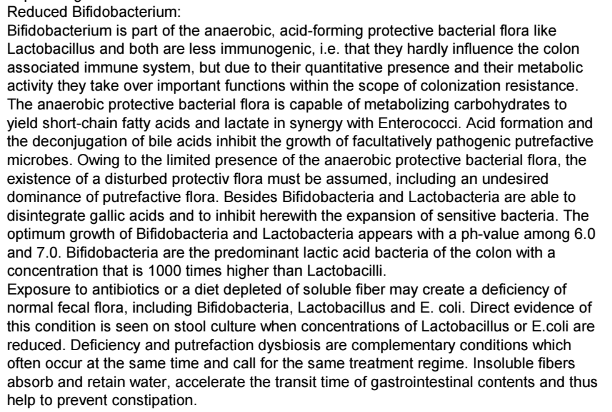
The rest of the report is advice. An example is below
Bottom Line

The Synlab report provides the essential information for confirm a CFS/SIBO/FM microbiome dysfunction pattern. Unlike uBiome, we do not get a detail breakdown at the genus level which would allow custom tuning of diet and supplements (to the degree that we have knowledge – which is very very limited for some bacteria genus). On the plus side, you likely get the results back much sooner (days instead of weeks).

Patient Suggestions

I am pleased to see that many things helped at least temporarily, and thank you for detailing them!

Eating unwashed out of the ground (from known clean environments) is definite a thumbs up from me. The germs on those are more likely good germs. I recall reading that the human biome is closest to ‘underground plant bacteria world’ which likely reflect our ancestral eating habits.

Turmeric(Curcumin) Response

Bactericidal Activity of Curcumin I Is Associated with Damaging of Bacterial Membrane [2015]

states “Our study shows the strong antibacterial potential of curcumin I against all the tested bacteria from Gram-positive(Staphylococcus aureus and Enterococcus faecalis) as well as Gram-negative groups(Escherichia coliand Pseudomonas aeruginosa). ”

  • “It is effective against microbial pathogens like bacteria, virus and fungi.” [2017]

My take is that turmeric is very effective against your pathogens and those are likely dumping massive quantity of toxins. You may wish to retry again starting with very very low dosages and working up. You may wish to review literature on turmeric also.

It worked once and then stopped working

There are two concepts to keep in mind:

  • Corrective — makes things better
  • Prophylactic — keeps things better

When something appears to stop working — but did work for a while, you should move it to your prophylactic list to cycle thru every few weeks originally (every few months eventually). If a prophylactic has a corrective response, you should reduce the cycle time for it.

Many CFSers want the correctiva impact, but do not get prophylactic supplements!

Where to go from here

Suggestions for going forward:

  • Theoretical Supplements at least, it allows a normal healthy microbiome to have food while we get the rest of them established.
  • Licorice may help with the low blood pressure (other readers reported success with this)
  • Discuss with your MD about systematically rotating thru every tetracycline class antibiotics available (I believe different brands of each antibiotics are likely different marginally — so on the 2nd pass, try to get a different brand when practical). See this post for why.
  • Headaches/brain fog: try regular aspirin (325mg/each meal) for a few days and also piracetam. One cause of headaches can be low oxygen delivery to tissue (common in FM). If these help, see this post and attempt to get testing for genetic coagulation defects (so you know what to treat specifically).

As always, consult with a knowledgeable medical professional before any changes of supplements etc.

Theoretical Supplements for CFS etc

With CFS, SIBO etc we see no or low Lactobacillus, Bifidobacteria, E. Coli. This means we have diminished production of their end products. The absence of these end products can cause a variety of symptoms.  Imagine a diet where all citric fruit was removed — you could get scurvy; or for Vitamin D sources, rickets; or Iodine, goiter.

Whether symptoms develop often is dependent on DNA/SNPs.

The table below comes from DataPunk.Net and shows the known end products.

Bifidobacterium Lactobacillus E. Coli

Known Supplementation

Bottom Line

It is interesting to note that various uptake inhibitors have positive effects.  This would be consistent with low levels — the alternative approach would be supplementation to replace the non-production by the missing bacteria.

Several items are toxic in larger amount — I suspect that these items are produced to control other bacteria types (likely the ones that are now overgrown).

What is available as supplements over the counter?

Note: The above shortages will likely have knock-on effects to other chemicals, but they are likely the underpinnings of most of the symptoms seen.

This is strictly informational and no supplementation should be started without first consulting with your knowledgeable medical professionals.

Turning Antibiotics Upside Down

The usual purpose of antibiotics is to kill off one specific infection. CFS Researchers and physicians also
have spent decades looking for one specific infection.

Note: More detail information on the impact of antibiotics is being assembled at our analysis site.
For example: for Vancomycin

This is very much not in agreement with uBiome results and my model. We have at least three specific bacteria genus that have been eliminated and these genus have been replaced by dozens of rare genus.

In this post I want to first look at the three bacteria genus and what antibiotics they are resistant to! Why— because we want to reduce dozens of of bacteria but not to impact those — we want to make space for the three missing bacteria genus to resettle.

Again, my data from from DataPunk.Net (from Peter D’Adamo, a Distinguished Professor of Health Sciences at the University of Bridgeport)

pda-tie

  1. Bifidobacteria:
  2. Lactobacillus (genus) 
  3. Escherichia (genus) 

ANTIBIOTIC RESISTANCE OF THE ABOVE

So if you do not want to kill off the above BUT want to kill off other bacteria… the choice is obvious….

  • Acriflavin 3
  • Amikacin 3
  • Aminoglycoside -3
  • Apramycin -3
  • Astromicin 3
  • Bacitracin -3
  • Beta lactam -3
  • Carbapenem -3
  • Carbenicillin -3
  • Cefoxitin -3
  • Ceftazidime -3
  • Ceftriaxone -3
  • Cephalosporin -3
  • Cephamycin -3
  • Chloramphenicol – 1, 3
    • “Common side effects include bone marrow suppression, nausea, and diarrhoea.[3] The bone marrow suppression may result in death.[3] To reduce the risk of side effects treatment duration should be as short as possible”
  • Cloxacillin -3
  • Deoxycholate -3
  • Dibekacin 3
  • Doxorubicin -3
  • E cephalosproin 3
  • E penicillin -3
  • Enoxacin -3
  • Erythromycin -3
  • Fluoroquinolone 3
  • Fosfomycin -3
  • Gentamicin 3
  • Glycylcycline -3
  • Isepamicin 3
  • Kanamycin 3
  • Kasugamycin 3
  • Lincomycin -2
  • Lincosamide -3
  • Lividomycin 3
  • Macrolide 2, 3
  • Monobactam 3
  • N cephalosproin 3
  • Neomycin 3
  • Netilmicin 3
  • Norfloxacin 3
  • Paromomycin 3
  • Penicillin 3
  • Polymyxin 3
  • Puromycin (mdtn)
  • Ribostamycin (aph3ib)
  • Ribostamycin 3
  • Sisomicin 3
  • Spectinomycin (ant3ia)
  • Streptogramin -2
  • Streptomycin
  • Sulfonamide 3
  • T chloride (mdtn)
  • Tetracycline – 1,2, 3
  • Tobramycin 3
  • Trimethoprim 3

WAIT A MINUTE!

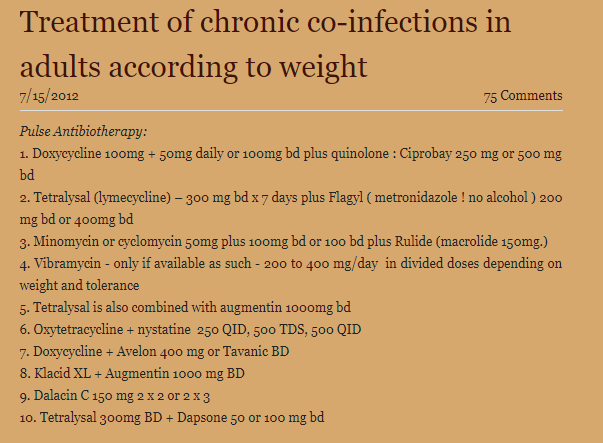
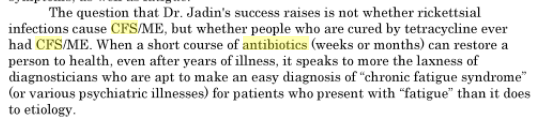
What antibiotics are being used with some success?  I will look at two — one believes that mycoplasma is the cause, the other believes rickettsia infection. I believe the ones above that effects other bacteria BUT NOT Bifidobacteria, Lactobacillus, E.Coli are the ones…

THEY ARE THE SAME ONES

From  Chronic Fatigue Syndrome Treatment Guide, 2nd Edition by Erica Verrillo

cfs

And from http://cecilejadin.info/blog.html

Tetracylines include: Doxycycline, Lymecycline, Minomycin, Vibramycin, Tetralysal.

Older description included macrolides and Fluoroquinolone ( Cipro or Avelox)  [Patient Notes]

cfs6

From Prof Garth Nicholson,

Click to access Treat.considerations.11.1.pdf

“6-week on 2-week off antibiotic cycles (doxycycline[Tetracycline], ciprofloxacin[Fluoroquinolone], azithromycin[Fluoroquinolone], minocycline[Tetracycline], clarithromycin[Macrolide] or others work best as oral capsules without starch fillers).”

What about Metronidazole?

“One hundred and twenty-two strains of Bifidobacterium and Lactobacillus species have been tested against 12 antibiotics and two antibiotic mixtures by a commercial system (Sensititre Anaero3; Treck Diagnostic Systems). … most of the strains were resistant to metronidazole.”  [2005]

“The minimal inhibitory concentration (MIC) of metronidazole was lower for strains of Escherichia coli … The drug-induced decrease in viable numbers of E. coli was followed by an increase. Most cells in this ‘recovery’ population were found to be anaerogenic and were relatively unaffected by subsequent exposure to metronidazole. ” [ 1984]

Bottom Line

All roads lead to the same antibiotics! They do not effect Bifidobacteria, Lactobacillus or E. Coli (after first exposure).

We do not want to use these antibiotics to kill a specific bacteria — the opposite!! We want it to kill many things EXCEPT three bacteria genus. We want to make room for these to repopulate!

This is an educational/information post intended to be discussed by you with your medical professional. Note also that taking probiotics with these antibiotics is fine (and likely a good thing).


What happens with no Lactobacillus, Bifidobacterium and E.Coli?

SIBO and CFS/FM/IBS constantly shows a pattern of low or no Bifidobacterium, Lactobacillus and E.Coli. With these bacteria missing — how does it impact items like amino acids etc…

This is a technical post attempting to illustrate why things go wrong when they are missing — and why their absence leads to various supplements being needed (causation!)

All data is from datapunk.net ( Peter D’Adamo, currently a Distinguished Professor of Health Sciences at the University of Bridgeport, where he direct the Center of Excellence in Generative Medicine.)

ENDPRODUCTS For Bifidobacterium Genus

ENDPRODUCTS for Lactobacillus

ENDPRODUCTS for E.Coli

Involved with the following KEGG Pathways (Escherichia genus used)

Bottom Line

This is likely far above most readers brain-fog levels, but I believe it does illustrate that it is not just some inconsequential bacteria that you are missing. These three groups impact a lot of stuff and missing end products cascade across the body’s system.


American Gut Example Report

A few years ago American Gut and uBiome were both new kids on the block. It seems that uBiome is the dominant one at the moment.  I was delighted when a reader forwarded their gut results because every lab result is interesting in what is there and what is not there.   See this page on what is or is not on various ones.

Both report at the genus level.

Data Visualization Report

agut

Looking at the above we clearly see the over-dominance of Bacteroidetes from the left chart and almost extermination of several others.

There are NO OTHER reports.

Patient History

  • Childhood and pre-CFS days: lots of penicillin and septrin ( trimethoprim and sulfamethoxazole)
    • Comment: Those antibiotics appear to be counter-indicated for CFS.
  • 1979 — flu whose symptoms persisted
    • Severe vertigo attacks
    • Severe anxiety with agoraphobia
  • Started teaching career
    • Picked up infections and more antibiotics
  • 2001 Tested positive for heavy metal poisoning (nickel and mercury).
    • 13 amalgams replaced.
    • Andy Cutler’s protocol
  • 2006 Tested normal for mercury

Current state:

  “I was able to do small amounts of voluntary work for a few hours each week and also walk my dog for around 25 minutes most days.  However I have never been able to walk for longer than 30 minutes maximum at a time before my energy runs out and once my blood sugar drops to say 5 all energy is gone and there is nothing left in my legs.  Using a oxygen concentrator for 30 minutes at a time helps me to feel better and I tend to do this 3 times daily.”

“I guess I have about 60 g carbs daily which are mainly nuts and seeds, a small amount of Sourghan crispbread, lots of vegetables including daily salad, a tiny amount of mixed organic berries from the garden just once daily, a small portion of meat or fish.  I am ok with dairy but not gluten so have a small quantity of whole milk yoghurt most days together with things like flax seed, chia seeds and psyllium.  Have been doing this since the Genova report in late 2015.”

I have taking various Probiotics over the years but none of made a difference to how I feel.  One interesting thing is that I made my own Kefir for a long time this past year but it seemed to make my gut a lot worse which lots of rumbling and rolling and very loose bowel movements so I have stuck with the natural yoghurt which is fine.  I am in the process of trying a small amount of Sauekraut each day to see if that will help me.

My main problem is the severe almost daily migraine, very little dizziness now and bp is fine whereas it used to be so low before treatment.  Still energy runs out and I have to PACE very carefully.  During the winter I can pick up many viruses which always start in my throat.  Echinacea Augustraflora does help this if I drop it frequently down my throat btw.”


Earlier Analysis

Genova Diagnostics 2008

  • High pH: 8.1
  • High Acetate
  • Lactobacillus:  – “in lower than optimal levels”
  • Eschericha coli  4+ (Mucoid E.Coli)
  • Bifidobacterium  – “in lower than optimal levels”

Genova Diagnostics 2015

  • Low Diversity (remember this varies according to test sensitivity)
  • High Verrucomicroba Phylum
  • High Fusobacteria Phylum
  • Low Proteobacteria Phylum

Commensal Bacteria

  • Bacteroides vulgatus – High. see below Bacteroides (genus) 
  • Odoribacter spp. High
  • Pseudoflavonifractor – Spp High
  • Veillonella spp High
  • Bifidobacteria Low
    • B. Longum – None
  • E.Coli – High
  • Akkermansia – None
  • Lactobacillus – None
  • Citrobacter Freundi – High,
    • antibiotics suggested: Ciproflozacin, Tetracycline, Trimethoprom/Sulfa,

Bacteria Genus of interest

  1. Bacteroides (genus) 
  2. Peptococcaceae (family) 
  3. Clostridium (genus)
    1. Part of
  4. Lachnospira (genus) 
  5. Ochrobactrum (genus) 
  6. Rubellimicrobium (genus) 
  7. Rhodospirillum (genus) 
  8. Citrobacter (genus) 
  9. Odoribacter spp
  10. Pseudoflavonifractor –

NUTRIENTS/ SUBSTRATES


INHIBITED BY

ENHANCED BY

INHIBITS

Bottom Line

I would not recommend AmericanGut because the amount of information available to the patient is very little compared to uBiome results (a test that cost less than $100 and does not need a prescription or MD involvement). uBiome has occasionally offered them for free.

Microbiome

Most of the sugar substitutes encourages growth of the above bacteria – bad (Aspartame, Saccharin, Stevia) where as high sugar diet or Sucralose (Splenda) reduces the growth. Sugar substitutes are conceptually nice — but they have major risk for maintaining a bad microbiome.

Citrobacter is still high — there are two paths: Pomegranate ellagitannins or the antibiotics cited above (I would start with minocycline first if you go the antibiotic route — one of the tetracycline family).

There are no apparent clustering of inhibited by or enhanced by, so just try working off the lists.

Regular Breakfast Suggestion: Barley porridge and some walnuts (without Aspartame, Saccharin, Stevia). For a month avoid flax seed, chia seeds and psyllium as an experiment — I was unable to find reliable information on what types of resistant starch these could be.

Occasion Supper: Navy beans with a high fat content meat.

Patient History

It was interesting to read that home-made Kefir made her worst — this is likely because it contains lactic acid producing bacteria (which is why I advocate avoiding most Lactobacillus bacteria — see this post “D-lactic Acidosis -Sauerkraut is not good for you if you have CFS!“). A list of strains in Kefir is here. In general, avoid most yogurts and kefirs — use Activia (bifidus regularis) if you wish to continue having yogurt (See Confusion At The Yogurt Aisle? Time for Probiotics 101).

She also wrote: “I changed my diet to lower carb and higher protein and fats because I had such swings of blood sugar in 2001. This helped and because of the steroid I have to be very careful with the carbs or my blood sugar will stay a bit too high unless I am active which of course I cannot do all the time. “ which are inhibitors of the overgrowth bacteria cited above. ” I feel better on a lower carb diet because otherwise I get extremely high blood sugar readings and feel generally horrible, sluggish, headachy, muzzy and falling asleep.”

It is also interesting that we have a lot of the bacteria associated with sugars and there are challenges maintaining sugar levels.

Probiotics: The patient did not specify what she has tried.  I suspect they are the typical health food stores ones high in lactobacillus species (which can actually make you worst). I would suggest trying at least one from each of the following two groups:

Subject for future post MSG:

“One thing comes to mind is if I ever I eat MSG by mistake in a restaurant it hits my brain almost immediately like a gun going off in my head.  I will pour with sweat, be dizzy and then get a 2 day migraine.  I have often wondered if I produce too much glutamate and some of the meds I have had for migraine prevention do work on the conversion of glutamate to GABA and have been slightly effective until the side effects kick in and I cannot tolerate them.”

As always — this is education information and not intended to treat. Always consult with a knowledgeable medical professional.