A very atypical uBiome

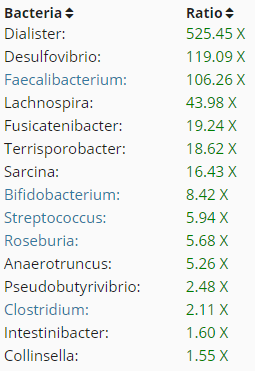
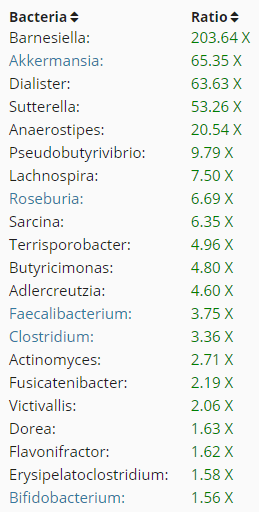
A person who have done their uBiome several times over the last few years was kind enough to share their results. The numbers blew me away!!! If I had gotten a single lab with these numbers, I would suspect a lab error… but clearly that is not the case.

Standard Criteria

  • Lactobacillus is typical very low
  • Bifidobacteria is not — BUT if you look at the overgrowth, it is 1/100 (1%) compare to some overgrowth,,,
  • Low or no E.Coli
    • Not directly reported, but it parent is: Enterobacteriaceae  which is 12% of the reference group
  • High Akkermansia (parent is Verrucomicrobiaceae) 525% – 6500% of the reference group

Patient History

  • Onset was in 2009 while living in a moldy apartment
    • Trigger may have been wither H1N1 Flu or stomach bug overseas
    • POTS, brain fog, PEM, Sinus, histamine issues
  • Hypersensitive to mold
  • Reacts mildly to fragrances
  • No longer living in a mold environment

2013 uBiome

  • Bifido: 2.27
  • Lacto: 0.02
9/13/15 6/23/16 10/18/2016 6/13/2017
15 16 1016 17
  • Bifido: 0.27
  • Lacto: 0.07
  • Bifido: 1.23
  • Lacto: 0.0
  • Bifido: 1.45
  • Lacto: 0.06
  • Bifido: 0.71
  • Lacto: <0.01
This is using the latest results (6/13/2017). The number indicates the order in the results above. The data is from DataPunk.net

NUTRIENTS/ SUBSTRATES

INHIBITED BY

ENHANCED BY

NOTE: the comparison for Bifido and Lacto were against different references above.

Analysis

The above is a challenge. Please note that Lactibacillus  (Genus) includes both Lactobacillus and Bifidobacteria. So the high number above is due to bifidobacteria.

I have worked only the current state — and included the known nutrients for these bacteria. My initial inclination is to starve them of the nutrients they need.  D-Glucose which is blood sugar. This means going to NutritionData.Self.com listing high glucose foods and avoiding them. Some possible surprises for food to avoid:

  • Apricots, Pineapples, Dates, Honey, Pomegranate juice, Grape juice… i.e. most fruits
  • Pop, Melons, Squash, dill pickles, Cabbage, tomato products, radishes etc.

The person may wish to work with a nutritionist (if they can get their head around working on a low glucose diet — which is different from a low sugar diet. glucose is a specific type of sugar).

As shown above — walnuts, Saccharomyces boulardii and Proton-pump inhibitors (PPI) – are clearly to be avoided. While Flaxseed is on both inhibits and enhanced, it appears that it will inhibits a lot more than it enhances, and should be part of the daily diet. Flaxseed porridge with brown sugar for breakfast? (Brown sugar is sucrose, not glucose)

Bottom Line

The problem with many bacteria genus overgrowth is when to stop searching for a magical super set of supplements and food changes. My suggestion here is not to go on a low sugar diet (which will impact all bacteria), but a low glucose diet because the two biggest over growths feeds on this. This is some ways may be contrary to common sense health advice such as eating lots of fruits. You may wish to read wikipedia on glucose syrup (something to avoid)

As always consult with a knowledgeable medical professional (which may include a nutritionist) before any changes of supplements or diet. Keyword is knowledgeable

Addendum

Q: You say sugar is sucrose and not glucose, but isn’t sucrose broken down into 50/50 glucose and fructose?
CFS Remission Correct — since we are talking about gut bacteria… the glucose would be delayed and more important — the bacteria favoring sucrose and fructose would be increased. Glucose based bacteria will be dependent on other bacteria processing first, not the direct food intake.

Gulf War Illness – Same condition, different Trigger

The core of my model is a significant shift of the microbiome due to some event that does not return to normal after the event. Details include the same general pattern of shift (no bifidobacteria, lactobacillus, E.Coli coupled with overgrowth of bacteria hostile to them).

Research Suggesting They were the same

Coagulation Pattern

“Most symptoms of Gulf War Illness (GWI) are similar to Chronic Fatigue Syndrome (CFS) and/or Fibromyalgia (FM). We investigated whether these symptoms are associated with an activated coagulation system as has been reported in some cases of CFS/FM. The coagulation assays include activation markers of the cascade, platelet activation and hereditary risk factors. Our findings show activation of the coagulation system in GWI. This evidence of a hypercoagulable state suggests that symptoms may be due to poor blood flow and, therefore, a basis for the potential utility of anticoagulant therapy.” [2000]

  • “There appears to be significant overlap, in the symptoms of Gulf War Illness, CFS and Fibromyalgia “
  • “The symptoms of CFS/FM and GWI are very similar. The positive ISAC testing of the GWI patients parallels the results seen in CFS/FM patients. The hereditary risk profile is also positive in both. GWI may be a unique subset of CFS/FM.”

NOTE: my model has the metabolites (chemicals) produced by bacteria overgrowth triggering coagulation in those susceptible due to DNA.

Mycoplasma Model of Prof. Garth Nicholson

“They identified the causal pathogen for Gulf War syndrome as Mycoplasma fermentans, which was a different strain from the natural pathogen, raising the possibility that it was man-made biological weapon. They successfully treated patients with multiple courses of specific antibiotics, such as doxycyclineciprofloxacinazithromycinclarithromycin or minocycline.” [Wikipedia]

Note: The antibiotics (treatment) are the same ones that I advocate for correcting the microbiome.

GWI Microbiome

“upper GI section samples revealed a significant increase in the Bacteroidetes  and a significant reduction in Bifidobacterium  No significant changes were detected in
the load of Firmicutes and Desulfovibrio. In lower GI section samples, Bacteroidetes were dominant in both control and GWI groups (control: 19.50 +/- 0.62, GWI: 19.60 +/- 0.46) compared to other phyla. MiSeq-derived results also showed that in samples from the upper GI section, the contribution of Bacteroidetes was more pronounced in GWI patients compared to controls. ….Conclusion: The composition of the microbial community in the small intestine is different in patients with GWI than controls supporting the idea of shift in the microbiome in GWI.” [2014]

A 2017 study states “With sufficient evidence from GW veteran studies about the existence of chronic fatigue and GI disturbances coupled with neuronal inflammation, it is all the more important that we explore newer and novel mechanistic pathways, especially the role of the gut microbiome in modulating adverse outcomes in GWI such as neuroinflammation and intestinal injury”

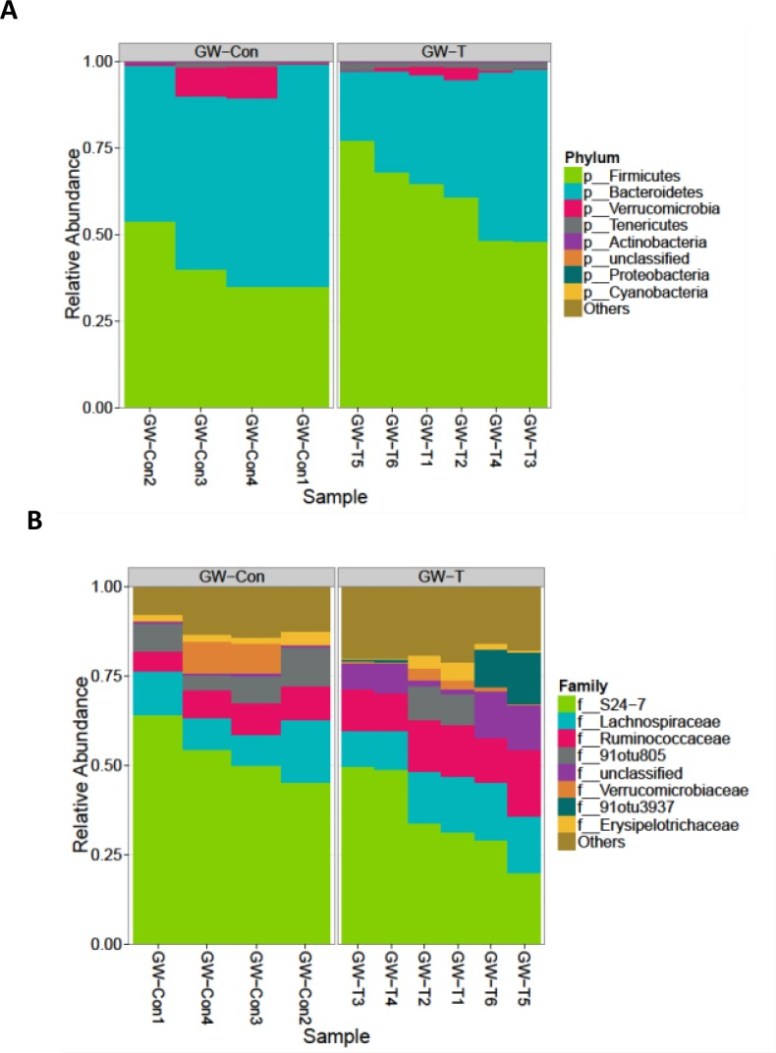
The diagrams below showed the changes of  gulf war chemical exposed group (GW-T) versus  control group fed with vehicle (GW-Con). Increase of firmicutes and decrease of bacteroidetes.

pone-0172914-g001

Bottom Line

Studies of GWS have dropped off, but it appears that the microbiome is now being considered. My expectation is that it will overlap with CFS, possibly with less divergence than that seen in CFS.


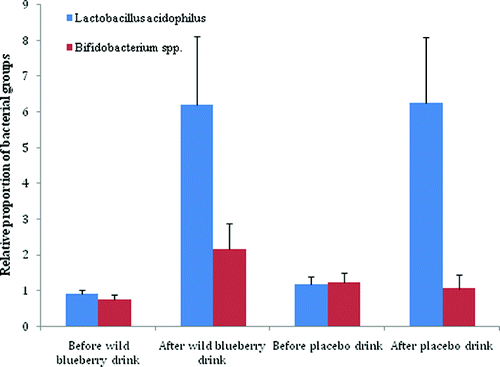
Chocolate & Blueberries– Good Medicine for Bifidobacteria

I have written in the past about the benefits of chocolate [2012], [2014], and it’s time to update with a deeper summary of the benefits.

  • High cocoa polyphenol rich chocolate may reduce the burden of the symptoms in chronic fatigue syndrome [2010]

  • From Chocolate, gut microbiota, and human health (2013)
    • In all these studies, IBS subjects had lower numbers of Bifidobacteria, Lactobacilli, and a higher number of Clostridia. The potential effect of chocolate, therefore, as shown in Tzounis et al. could be evident in this case since it led to the increase in the Bifidobacteria and Lactobacilli population and a reduction in Clostridia. Roberfroid et al. (2010)”
    • “This result supports the findings of the previous study in which an increase in the Bifidobacteria and Lactobacilli was observed due to consuming a drink that is rich in cocoa. (Duda-Chodak, 2012).”
    • “In animals, the effect of cocoa was investigated on rat gut microbiota and the results were similar to that on human gut microbiota (Massot-Cladera et al., 2012)…As in the study that was conducted by Tzounis et al., this group found a significant decrease in Bacteroides, Clostridium, and Staphylococcus species in the faeces of rats that were on a cocoa diet.   “
  • “In humans, whole grain cereals can modify fecal bacterial profiles, increasing relative numbers of bifidobacteria and lactobacilli. Polyphenol-rich chocolate and certain fruits have also been shown to increase fecal bifidobacteria. ” [2012]
  • ” Chocolate containing the polydextrose (PDX) blend also significantly increased faecal lactobacilli (P = 0.00 001) after the 6 weeks. The PDX blend also showed significant increases in faecal propionate and butyrate (P = 0.002 and 0.006, respectively).” [2010]
    • BUT polydextrose alone resulted in a “decreases in the faecal Lactobacillus-Enterococcus group were demonstrated.” [2012]
  • “Colonic Bifidobacterium spp. and/or Lactobacillus spp. were higher in potato fiber and potato-resistant starch diets than in the cellulose diet” [2012]
  • “Enterobacteriaceae or lactobacilli during the study period in subjects consuming 0:10 sucrose:lactitol but there was a significant increase (P = 0.017) in bifidobacteria…Subjects consumed 25 g tablets of milk chocolate containing 10 g sweetener as sucrose:lactitol in ratios of 10:0, 5:5 or 0:10 daily for 7 d.” [2007]
  • “Bifidobacterial levels increased significantly upon ingestion of both the low (9.78+/-0.29 log(10) cells/g faeces, P<0.05) and the high inulin dose (9.79+/-0.38 log(10) cells/g faeces, P=0.05) compared to placebo (9.64+/-0.23 log(10) cells/g faeces)….a chocolate drink containing placebo (maltodextrin, 8 g/day), 5 g/day inulin and 8 g/day inulin for a 2-week treatment period.” [2007]
  • “Dark chocolate reduced the urinary excretion of the stress hormone cortisol and catecholamines and partially normalized stress-related differences in energy metabolism (glycine, citrate, trans-aconitate, proline, beta-alanine) and gut microbial activities (hippurate and p-cresol sulfate). The study provides strong evidence that a daily consumption of 40 g of dark chocolate during a period of 2 weeks is sufficient to modify the metabolism of free living and healthy human subjects, as per variation of both host and gut microbial metabolism.” [2009]


Blueberries

Bottom Line

Dosages is simple 2-3 oz per day of 85% dark chocolate. A glass of blueberry juice (instead of orange juice???).

Expectation: slow gradual reduction of symptoms over 6 weeks (not an overnight change).

Caution: Because the change is slow and gradual, you may forget how you were 6 weeks ago and conclude that it did nothing….  Take notes and measurements of where you are at the start…. so you don’t stop a good things because of memory challenges.

See also: Food to Increase Bifidobacteria and Lactobacillus


Does a Ketogenic diet alters the microbiome in a good way for CFS?

A reader asked this question, and a summary of what we find in the literature is likely good. Whether it applies to you depends on what bacteria genus you are high in.

What is a [proper] ketogenic diet – The ketogenic diet is a high-fat, adequate-proteinlow-carbohydrate diet [Wikipedia]. It was first used in the 1920s, “outside of paediatric epilepsy, use of the ketogenic diet remains at the research stage“.

  • “A recent study by our group has demonstrated that a brief ketogenic period, if followed by a longer period of correct Mediterranean diet could avoid this yo-yo effect” (Paoli et al., 2013)
  • “This rapid and marked expansion in the representation of the Bacteroidetes, achieved after a 24-h fast,” [2009]
    • “fasting was associated with a significant increase in the proportional representation of the Bacteroidetes [from 20.6% (fed) to 42.3%”
    • “A ketogenic diet did not produce a notable change in the ratio of Bacteroidetes to Firmicutes in the cecal microbiota compared with CARB-fed, untrained (or trained) controls (Fig. S2C). However, unlike fasting, a ketogenic diet was associated with a significant decrease in bacterial diversity (P < 0.001; Fig. S2A). “
  • “KD reversed the elevated Akkermansia muciniphila content in the cecal and fecal matter of BTBR animals.” [2016]  – only a subset of CFS patients have high Akkermansia, most are low. [2016]

    • According to the above chart — Bifidobacteria is lowest on K.D.
  • Lactobacillus and Bifidobacteria decreases over time on a low-carbohydrate high fat diet. [2009]
    • Lactobacillus and Bifidobacteria increase over time with high carbohydrate, low fat diet.
  • “In contrast, the Roseburia spp. and Eubacterium rectalesubgroup of cluster XIVa and bifidobacteria decreased as carbohydrate intake decreased. ” [2006]

Bottom Line

With repeated studies finding a decrease of bifidobacteria and lactobacillus with a Ketogenic diet, I do not believe it has any clear benefit and may encourage further negative shifts with some CFS/IBS/FM patients.

CFS Patients appear to universally have very low or zero bifidobacteria, lactobacillus.


There are no official tests for CFS — but there are a ton of markers!

I often have read on the web that there is no test for CFS. This is very incorrect — there is no official test for CFS nicely bundled up.  “No current diagnostic tool or method has been adequately tested to identify patients when diagnostic uncertainty exists.”[2014]  What we find in the literature are many tests available to confirm CFS/ME when symptoms presents.

This post reviews where there have been a strong association of abnormal laboratory results to CFS/ME patients. These tests can often be used to confirm that the diagnosis is correct. For example: is TGF-β elevated and resistin lower?  etc.  In terms of microbiome results from uBiome.com: low or no lactobacillus, low or no bifidobacteria, low or no akkermansia muciniphila, low or no E.Coli.

My Own Favorite Ad-Hoc Markers

From uBiome:

  • Low or no Lactobacillus
  • Low or no Bifidobacteria
  • Low or no E.Coli
    • Not directly reported, but it parent is: Enterobacteriaceae which will be NOT listed in results, or at something like 2% of the reference group
  • Low or High Akkermansia (parent is Verrucomicrobiaceae)

Bottom Line

Yes, there is testing that can be used to increase the certainty of a CFS/ME diagnosis (or exclude it — which should lead to further testing).