Tulsi – Holy Basil – Ocimum sanctum

Although I have often reference this, I just realized that I have not done up a post on it. From PubMed, we have the following information:

  • “The oils [of Tulsi], at concentrations of 4.5 and 2.25% completely inhibited the growth of Staphylococcus aureus(including MRSA) and Escherichia coli, while the same concentrations only partly inhibited the growth of Pseudomonas aeruginosa…Tulsi essential oil could be a valuable topical antimicrobial agent for management of skin infections caused by these organisms.” [2016]
  • “At 3mg. concentration, O.sanctum was the most effective against S. mutans,” [2014]
  • “Moreover, water extracts did not restrain the growth of any tested bacteria. Ethanol and methanol extracts were found to be more potent being capable of exerting significant inhibitory activities against majority of the bacteria investigated. Staphylococcus aureus 1 was the most inhibited bacterial isolate with 24 extracts (60%) inhibiting its growth whereas Escherichia coli 2 exhibited strong resistance being inhibited by only 11 extracts (28%).” [2012]
  • Amelioration of inflammation by phenolic rich methanolic extract of Ocimum sanctum Linn. leaves in isoproterenol induced myocardial infarction[2015].
  • Therapeutic Potential of Ocimum tenuiflorum as MPO Inhibitor with Implications for Atherosclerosis Prevention [2015].
  • Anti-Inflammatory, gastrointestinal and hepatoprotective effects of Ocimum sanctum Linn: an ancient remedy with new application [2013]. “In modern era, it has been shown to be effective against diabetes mellitus, hypertension, cancers, bronchitis, and found to have anti-microbial properties. Several experimental studies have confirmed its anti-inflammatory properties and its role in modulation of both cellular and humeral immunity. Recently its efficacy against inflammatory response, hepatic injury and gastric ulcer has been elucidated in animal studies. In liver, essential oils and extracts of Ocimum sanctum could prevent oxidative stress by increasing glutathione peroxidae and catalase and were also effective in prevention of hepatic steatosis. In gastric epithelial tissue different derivatives of Ocimum sanctum had anti-ulcer and anti-secretory characteristics and could heal gastric ulceration.”
  • “antimicrobial activity of herbal medicines (neem extract, tulsi extract) and chlorhexidine against Enterococcus faecalis in Endodontics…Herbal medicines seemed to be effective against E. faecalis compared to 2% chlorhexidine gluconate.” [2015]
  • “For tulsi oil-fed mice, the decrease in bacterial load was significant with long-term feeding (p < 0.01).” [2009]
  • Ocimum sanctum essential oil inhibits virulence attributes in Candida albicans [2014].
  • “The results obtained were compared with standard drugs Amoxicillin (10μg) and Amphotericin B(10μg).” [2007]
  • Activity of Ocimum sanctum (the traditional Indian medicinal plant) against the enteric pathogens [2001]. “Aqueous extract showed wider zones of inhibition for Klebisella, E. Coil, Proteus & Staphylococcus aureus.”
  • “The extracts from the leaves of Ocimum sanctum showed better activity against the three MRSA strains.” [2005]
  • “Ocimum sanctum fixed oil showed good antibacterial activity against Staphylococcus aureus, Bacillus pumilus and Pseudomonas aeruginosa, where S. aureus was the most sensitive organism.” [2005]
  • “This finding reflects that supplementation of O.sanctum intuitively by reasonable and understandable treatment effectively ameliorates the cerebral ischemia-induced oxidative damage.” [2012]
  • “The results of the study indicate an immunostimulant capability for Ocimum sanctum which may be contributory in explaining the adaptogenic action of the plant.” [1988]

Bottom Line

It is an effective antibiotic especially against S. Aureus. While it does inhibit E.Coli, I believe the trade off is a net beneficial one.


Kisses, Sex and FM/CFS/IBS

I have suggested to a few people that they should start hanging out at bars etc. The goal is to get bacteria transplants by deep french kisses with as many healthy strong young people as possible. According to the microbiome model this may result in two things happening:

  • You get cure
  • Another FM/CFS/IBS patient is created
    • Since most patients are females, the odds of a male getting it is very low…

Now for the science!

A 10 second “intimate kiss” transfers transfers 80 million bacteria, according to this recent research [LA Times] [Article]. So to get 1 BFCU, we need 12 of them (2 minutes of intense kissing!). If it does not cure you, at least you will have some fun! 😉

  • “it has been estimated that the oral cavity of western adults harbors approximately 700 different, mostly anaerobic, species of bacteria”[2014].

Interesting questions have been asked in recent literature….

  • “In India, there is a tradition since time immemorial that immediately after birth, the newborn is not allowed to suck the mother’s breast or any other hospital beverage, but the family will choose a most respected and legendary woman to put honey on her index finger and put in the mouth of the newborn, so that the baby can suck the sweetened finger. Only after this tradition, baby can take any other fluid or mother’s milk. It is believed that the baby will develop the same personality and health parameters as of this woman. It is also believed that this tradition was used as blessing to the baby. No validation studies have been done, but in the present era of the microbiome, with advances in gene sequencing and associated bioinformatics, a lot of data are being generated….However, there is no study in the literature which shows that using the same spoon or glass, how many bacteria or viruses can transmit from one partner to another in one act, and how much time it will take to equalize the microbiota in the mouth cavity of both husband and wife, if at all, it equalizes. Furthermore, it remains to be studied; that equalization of microbiota in the mouth cavity has any association with the longevity of marriages. ” [2015]
  • “Connubial ecthyma gangrenosum in a healthy couple: a consort counterpart of a “kissing ulcer”[2015].
  • “Sex and intimate behavior seem to be increasingly described as triggers of allergic reactions, although the pertaining literature is represented mostly by case reports. Kissing has been described as a risk factor for food- and drug-induced severe reactions.” [2007]
  • “Following primary infection, the virus is found in saliva for weeks and chronic shedding participates in transmitting the infection from person to person through intimate kissing contact. EBV causes infectious mononucleosis, l” [1999]

Sexual Contact?

The reason that I started this post was reading  “Is Lyme Disease Contagious? Clues Hint That It May Be A Sexually Transmitted Disease“. The result does not surprise me, that CFS/FM/IBS are communicable diseases have long been suspected — just at a low rate requiring prolonged exposure. Specialists dealing with these conditions appear to have a statistically significant higher rate of getting these conditions than would be expected.

Was it sex or was it an intimate kiss before sex? The above study failed to control for that difference.

  • “There also is evidence linking several infectious agents with CFS, although no [single] agent has been proven to be a cause of the illness. Most of the infectious agents that have been linked to CFS are able to produce a persistent, often life-long, infection and thus are a constant incitement to the immune system.” [2011]

The problem is that there have been no studies on the incidence of husbands of CFS wives coming down with one of these conditions. The incidence will be low, because males have a low incidence compared to females for all of these conditions, thus it will not jump out in a clinical setting but requires statistical analysis.

The official view is that none of these are communicable — yet I have yet to see a single study validating this official belief. Husband-wife statistical analysis is required for a low communicable  disease  which is what I believe that these conditions are. This is almost illogical because chronic EBV is one suspected cause and it is communicable.

Bottom Line

I suspect we will not see MDs writing prescriptions to “Snog 4 times a day with different people”. IMHO, these are low communicable conditions with a strong bias for the female sex.


Histamine Intolerance – my best suggestions

A European 30 y.o. reader wrote for some help. She has been treated by at least one of the top CFS physician in the world (I have actually met him at a conference), but with little joy.

Her stool revealed elevated IgA, too little bile acids, elevated PH, sugar. Bifido and Lactobacillus species were low. — so the typical CFS profile.

She has severe histamine intolerance and had tried some probiotics (they were not named).

When the gut bacteria shifted into the histamine intolerance zone, it is currently a treatment nightmare —  mainly because there is so little useful information!

With that said, I am going to research  a draft model and then find as much information that may be helpful with the model for treatment. This is speculation.

Model

Assumptions:

  1. Histamine intolerance is the result of a shift of bacteria.
    1. It may be either a decrease of DAO bacteria or their helpers/suppliers or an increase of histamine producing bacteria.
      1. “These results show that some Gram negative bacteria, associated with acute exacerbations in respiratory infections, produce histamine and possibly other inflammatory mediators,” [1989]
      2. “A diminished histamine degradation based on a reduced diaminoxidase activity is suspected as a reason for non-IgE-mediated food intolerance caused by histamine.” [2006]
      3. “Bacteria induced basophil histamine release through two ways: immunological (IgE-mediated) and non-immunological (sugar-lectin interactions).” [1998]
      4. “Staphylococcus aureus produces numerous bi-component toxins,..and histamine release” [1997]
      5. “Influenza A virus, S. aureus and lipopolysaccharide from S. typhimurium increased the maximum release of histamine and caused a shift to the left of the dose-response curves showing increased cell sensitivity and lowering of the threshold to these stimuli.” [1991]
      6. “Histamine release induced by Staphylococcus aureus was examined in cells obtained by bronchoalveolar lavage (BAL) in non-atopic individuals. Approximately half of the individuals responded with mediator release to the bacterium, and the release was found to be time- and concentration dependent.” [1991]
      7. Staphylococcus aureus and influenza A virus stimulate human bronchoalveolar cells to releasehistamine and leukotrienes [1989].
      8. “Staphylococcus aureus, lipopolysaccharide (LPS) from Salmonella typhimurium and influenza A virus were found to enhance the histaminerelease but did not release histamine per se….These findings indicate that the enhancement of mediator release by bacteria, endotoxin, and virus depends on a sugar-mediated reaction.” [1990] – i.e. cut all sugars!
    2. If practical, this can be tested. Low serum DAO activity, i.e. <10 U/mL would be expected (see my DAO post). Other studies cites < 40 U/ml

Background Literature

  • “Histamine was first thought only to be present in mast cells, but modern research has proven that many other cells also produce histamine to varying degrees. These include white blood cells such as basophiles, platelets, certain types of gastric cells and neurons.[ 2] Furthermore, histamine has been found to be present in all tissues of the body.[ 3]” [e]
  • “Reduced diaminoxidase serum levels leading to occurrence of HIT symptoms like chronic headache, dysmenorrhea, flushing, gastrointestinal symptoms, and intolerance of histamine-rich food and alcohol were significantly more common in patients with Atopic eczema than in controls.” [2006]
  • “The significance of HIT in patients with atopic dermatitis in whom the benefit of a low histamine diet has been proven is becoming increasingly understood recently.” [2012]
  • “Twenty patients with histamine intolerance and highly reduced initial activity of serum DAO (<40 HDU/ml) went to a histamine-free diet and after 6 to 12 months of histamine-free diet all clinical parameters and serum for determination of DAO activity were taken again….all 20 patients after the histamine-free diet the main clinical symptoms typical for histamine intolerance have disappeared. Furthermore, the measured values for activity of serum DAO have increased significantly (p<0.0001)….We can conclude that determination of DAO activity in serum is a useful diagnostic tool, together with detailed history to differentiate between food allergy and histamine intolerance. “. [2011] [2013]
    • Comment: The report did not indicate that the serum DAO went to normal, only that they changed (in a positive direction was implied but not stated). Neither was it stated if the patient could stop being on a histamine-free diet.
  • DNA SNPs:
    • “The minor allele at rs2052129, rs2268999, rs10156191 and rs1049742 increased the risk for a reduced DAO activity…

      CONCLUSIONS: DAO gene variants strongly influence DAO expression and activity but alone are not sufficient to fully effectuate the potentially associated disease state of HIT, suggesting an interplay of genetic and environmental factors.” [2011]

      • So, it appears that the microbiome may be a very significant player

Hunting the elusive Probiotics

Conjecture: Probiotics that help Atopic eczema or atopic dermatitis[AD] are likely to help histamine intolerance.

  • “The effects of probiotics in the prevention and treatment of AD remain elusive. However, evidence from different research groups show that probiotics could have positive effect on AD treatment, if any, that depend on multiple factors, such as specific probiotic strains, time of administration (onset time), duration of exposure, and dosage.” [2016]
  • “Alterations in the skin microbiome may lead to increased Staphylococcus aureus colonization and atopic dermatitis progression. Despite the evidence for their important role, probiotics have not been deemed efficacious for the treatment of atopic dermatitis, although studies suggest that probiotics may be effective at preventing the development of atopic dermatitis when given to young infants.” [2015]
  • “In this study, administration of the probiotic strain Lactobacillus sakei probio-65 for 2 months significantly reduced the disease severity index in experimental dogs diagnosed with Canine atopic dermatitis.” [2015]
  • “the negative impact of specific TLR genotypes[DNA/SNPs] may be positively affected by probiotic supplementation. Lactobacillus rhamnosus HN001 (HN001) exhibits a much stronger effect than HN019 in this respect.” [2015]
  • “the association of S. thermophilus ST10 and tara gum could improve the activity of L. salivarius LS01 administered at high doses to adults with AD….A significant improvement in SCORAD index was observed in the probiotic group after 1 month of treatment, whereas no significant changes occurred in placebo patients. A slight decrease in fecal S. aureus count was observed in probiotic-treated patients.” [2014]
    • ” Most of the S. thermophilus isolates formed low amounts of histamine (1-50 mg/L) from histidine.” [2013]
    • “In each case, the production of histamine [from S. thermophilus] increased concomitantly with the cell number with a relatively small further rise during the stationary phase.” [2012]
  • A few antihistamines appear to be effective against S.Aureus “Chlorophenoxamine hydrochloride-topical and chlorophenoxamine hydrochloride-systemic were the most effective (P < 0.05).” [2009]
  • ” The stimulation of rat mast cells with Staphylococccus cohnii, Staphylococcus coagulase(-) (two strains), Ureaplasma urealyticum, Peptostreptococcus spp., Bacteroides capillosus, Staphylococcus aureus and Streptococcus agalactiae resulted in lower but significant histamine secretion (11.2%-17.5%). Other bacteria strains (Staphylococcus epidermidids, Enterococcus faecalis, Escherichia coli, Actinomyces naeslundii (two strains) and Lactobacillus fermentum (two strains) caused very low (4.2% – 8.8%) histamine release.” [2002]
    • So SymbioFlor-2 (E.Coli) and Symbioflor-1  (Enterococcus faecalis) are suggested  in the hope they will displace the higher producing histamine bacteria. [A few E. faecalis strains rduces S. Aureus [2014] ..

No or Low Histamine Probiotics

These are also candidates against S. Aureus.

L. Reuteri is NOT on the list

  • L. Reuteri  (certain strains only)= “: Lactobacillus salivarius, Lactobacillus reuteri, Lactobacillus johnsonii, Pediococcus acidilactici, and Lactobacillus paralimentarius. None of the isolates [from poultry] produced tyramine or histamine.” [2012] “hdc(+) L. reuteri, which can convert l-histidine to histamine in the gut,” [2015]

Almost all human L.Reuteri are histamine producers. See chart below from From prediction to function using evolutionary genomics: human-specific ecotypes of Lactobacillusreuteri have diverse probiotic functions[2014].
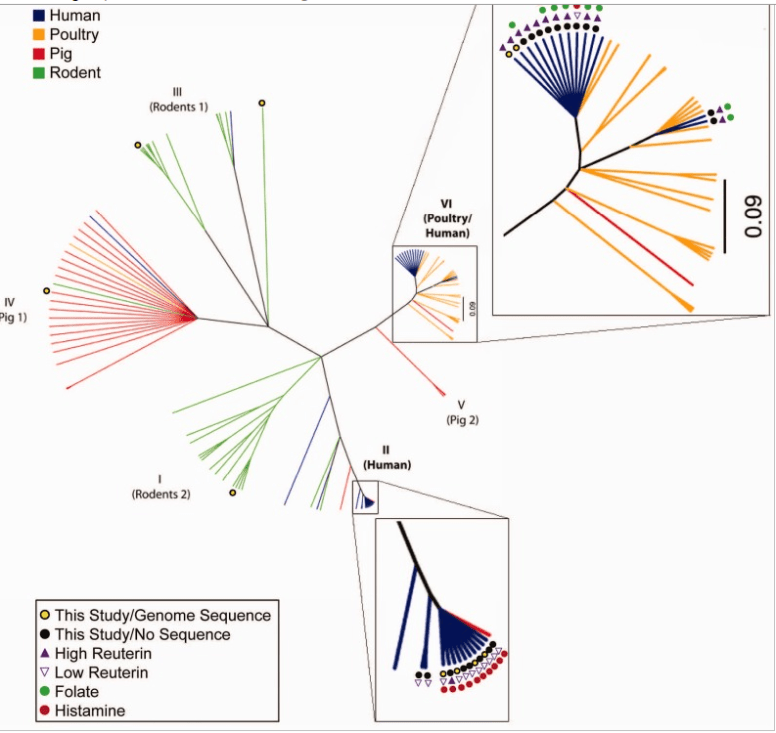
Reuteri.PNG

Proposed Model

It seems that some strains of Staphylococcus aureus are likely involved. See my earlier post on S. Aureus where I cite 4 specific probiotics (Propionibacterium freudenreichii,  Lactobacillus reuteri,Bacillus clausii, Lb. plantarum WLPL04) as well as a list of herbs.

  • Staphylococcus aureus enterotoxins induce histamine and leukotriene release in patients with atopic eczema.[2001]
  • “The mechanism needs to be further understood. Staphylococcus aureus infection has a close relation with diarrhea; its cell wall component peptidoglycan (PGN) has strong biological activity on immune cells and possibly plays a role in S. aureus-induced diarrhea. The present study showed that oral PGN-induced diarrhea in mice in a dose-dependent manner. Intestinal epithelial cells absorbed PGN via the intracellular pathway. Intestinal mast cells[Histamine release] were activated after PGN gavage.” [2007]
  • ” Experimental colds do not alter bacterial dispersal, but respiratory allergies multiply the effect of dispersing S. aureus.” [2006] i.e. S.aureus may have adapted to create histamines as a way of spreading..

Herbal Attack

In an earlier post I listed some herbs reported effective against S. Aureus. I am working off the assumption that some of these strains are significant players and thus need to be reduced.  The problem is determining if these herbs are also histamine releasers (not good).

Information on PubMed tend to be parse, so I am relying on some histamine intolerance web sites also


The list below is not comprehensive, but a good start. Each and every herb or spices should be documented to be:

  • Effective against S.Aureus
  • Inhibits histamine release

A third desired characteristic is that it is not in the usual herbs and supplements. Why? Because S. Aureus will have developed mutations to deal with the supplements and herbs usually taken — hence we want chemicals that have not been seen prior by the S. Aureus strains.

L – Low  A- Avoid T – Take/ Inhibits
 
Herb Histamine Note
Salvia officinalis (common sage) L[a] http://www.ncbi.nlm.nih.gov/pubmed/6485822
Eucalyptus globulus, Tasmanian bluegum  T http://www.ncbi.nlm.nih.gov/pubmed/11297859
Coleus forskohlii, Plectranthus barbatus, Indian Coleus  T http://www.herbal-supplement-resource.com/coleus-forskohlii.html
Forsythia suspensa (連翹 Lián Qiào) T http://www.ncbi.nlm.nih.gov/pmc/articles/PMC4003708/
Turnera diffusa, L http://www.tropilab.com/damianatea.html
Larrea tridentata T http://herbup.com/larrea.htm
Fresh Garlic T[b] Must be fresh
Cinnamon A https://migraine.com/blog/elimination-diet-foods-to-eat-foods-to-avoid/
Black Cummin Seed T[b]
Milk Thistle A http://www.livestrong.com/article/333974-can-milk-thistle-cause-skin-rashes/
Withania somnifera (Ashwangdha) A http://www.daburmediclub.com/clinicalreport/stresscom.pdf
Bacopa monnieri T https://healingherbalsnewzealand.com/bacopa/
sulphoxide extracts of green chamomile tea T[b]
Turmeric T[b]

My suggested short list would be:

  • Eucalyptus globulus, Tasmanian bluegum
  • Coleus forskohlii, Plectranthus barbatus, Indian Coleus
  • Forsythia suspensa (連翹 Lián Qiào)
  • Larrea tridentata

Start with one for 1 week, then add the next one a week later (stopping each after 2 weeks) and keep rotating. As you see in my earlier post, all of these unusual herbs are available (typically via Swanson or Amazon).


Sudden Pain Appearing

A reader wrote me yesterday because while she has gone from 0-1 to 7-8 on a 10 point scale applying my model. She suddenly had severe pain appearing a couple of days ago.

The pain started in the shoulder blades and then spread to the arms and the legs. The pain was quite severe. She has started taking pain killers, and ask me for alternative suggestions.

Most common source of pain in CFS/FM/IBS

It has been found in many study of FM that low oxygen delivery to the tissues is the apparent cause of pain. A blood oxygen meter may show normal levels – so it is not low oxygen in the blood. It is delivery of oxygen.

My suggestion was Neem, Tulsi and an aspirin (instead of other pain killers). Aspirin is a blood thinner and anti-inflammatory. Neem and Tulsi are anti-inflammatory and also know to reduce pain. I suspected toxins from dying bacteria was triggering the pain by causing inflammation or vascular constriction.

It worked. Her pain level went down greatly.

So the model of the pain coming from low oxygen to the tissue seem to be correct in her case.

  • Causes can be:
    • inflammation
    • thicker blood
    • constricted blood vessels –
      • Vasodilators: Flushing Niacin, Turmeric, Ginger, Cayenne Pepper, Danshen, etc. Warm baths, infrared saunas

Supplements that help those would be the right direction to investigate.

Care need to be taken if you are taking antibiotics because some very helpful supplements for the pain will result in antibiotics being more effective (up to 10x higher concentration in tissues according to some pubmed studies). This may result in MORE toxins being released and greater pain

  • Bromelain
  • Serrapetase
  • Lumbrokinease
  • Nattokinease


Honey, I shrunk my wallet!

A reader asked about  honey and I said I would  see what we know on PubMed. Honey — with special ones being claimed to have magical healing power has been around for many decades.  This always causes me to ask “Show me the beef!”(i.e. evidence).

First, honey has been used medically for thousands of years (see WebMd.com) “But outside of the laboratory, claims for honey’s healthfulness are unproven — except in the area of wound care and, to a lesser extent, cough suppression.”

“In the laboratory, honey has been shown to hamper the growth of food-borne pathogens such as E. coli and salmonella, and to fight certain bacteria, including Staphylococcus aureusand Pseudomonas aeruginosa,” – which immediately raises a red flag because CFS is extremely low in E.Coli and that is what we are wishing to correct!

How does Honey Work?

“The healing property of honey is due to the fact that it offers antibacterial activity, maintains a moist wound condition, and its high viscosity helps to provide a protective barrier to prevent infection. Its immunomodulatory property is relevant to wound repair too. The antimicrobial activity in most honeys is due to the enzymatic production of hydrogen peroxide. However, another kind of honey, called non-peroxide honey (viz., manuka honey), displays significant antibacterial effects even when the hydrogen peroxide activity is blocked. Its mechanism may be related to the low pH level of honey and its high sugar content (high osmolarity) that is enough to hinder the growth of microbes” [2011 – a detail history]

” Research has been conducted on manuka (L. scoparium) honey[27], which has been demonstrated to be effective against several human pathogens, including Escherichia coli (E. coli), Enterobacter aerogenes, Salmonella typhimurium, S. aureus[6],[27]. Laboratory studies have revealed that the honey is effective against methicillin-resistant S. aureus (MRSA), β-haemolytic streptococci and vancomycin-resistant Enterococci(VRE)[28],[29]. However, the newly identified honeys may have advantages over or similarities with manuka honey due to enhanced antimicrobial activity, local production (thus availability), and greater selectivity against medically important organisms[6]. The coagulase-negative staphylococci are very similar to S. aureus[14],[30] in their susceptibility to honey of similar antibacterial potency and more susceptible thanPseudomonas aeruginosa (P. aeruginosa) and Enterococcus species[14].” [2011]

Studies on the conditions of interest:

Honey and the Humane Microbiome

Nothing – lots of articles on the bee’s microbiome.

State of research is described in this 2016 PubMed full text article (supported by the New Zealand Honey Industry — reader beware).

Bottom LineT

here have been no demonstrated benefits for any form of honey for CFS/FM/IBS. It’s effectiveness against E.Coli raises major concerns.

Paying premium prices for honey with no known benefits is not recommended.