Dicyclomine

A reader commented that they are using high dosages of Dicyclomine, a prescription drug for IBS. Being unfamiliar with this, I thought that I should inform myself and my readers.

“Recent evidence on the use of dicyclomine for GI tract conditions involving smooth muscle spasm is lacking. A limited amount of evidence published before 2005, identified in selected guidelines, has shown that dicyclomine is superior to placebo in improving IBS global assessment, and leads to more adverse events. Guidelines based on this evidence have recommended dicyclomine as a pharmacological treatment of IBS, as well as other antispasmodics such as mebeverine and alverine citrate. The recommendation was considered by the authors to be “definitive” based on low-quality evidence with uncertain trade-offs between benefits and harms.” 03 December 2015 Health Canada on National Institute of Health site, a review of all publications were done by them.


.. and the Microbiome

There is very little, but it appears effective against the species that I keep finding in research that appears to be significant for CFS, Staphylococcus aureus . See my prior post.

Bottom Line

I feel uncomfortable about this because of the literature review above. I am wondering if it’s positive effect is due to the antibiotic dimension, if so, rotate-rotate-rotate with other antibiotics is recommended.

These are questions to be raised and discussed with your MD.
 

Best two probiotics to start probiotic approach

Most CFSers have challenges with money as well as being hyper-sensitive to many things. When we come to probiotics — there is always the risk of a herx.

There are two items that are likely best — in terms of impact, low herx risk and the cost.

Both allow a very slow ram up. An easy ramp up because you can easily start at 1/15 th of the normal dosage without having to cut pills or break apart capsules.

  • A normal dosage of Symbioflor-2 is 15 drop.
  • For Miyarisan it is 15 small tablets.

So you can start at just one of each. They are also relative to others cheap,

  • Miyarisan:  $17.16  £20.10
  • Symbioflor-2 EUR 19.46 (delivers to US) for 2 x 50ml bottles each bottle has 50 dosages of 15 drops)


Review of Recent Probiotic News

  • “A recent study by Forslund et al. (1) adds another dimension for consideration by illustrating how medications may adversely affect the microbiome—an interaction often overlooked in post hoc analyses of disease-microbe relationships.” [2015]
  • “Early-life antibiotic use is associated with increased risk for metabolic and immunological diseases, and mouse studies indicate a causal role of the disrupted microbiome. However, little is known about the impacts of antibiotics on the developing microbiome of children. Here we use phylogenetics, metagenomics and individual antibiotic purchase records to show that macrolide use in 2-7 year-old Finnish children (N=142; sampled at two time points) is associated with a long-lasting shift in microbiota composition and metabolism. The shift includes depletion of Actinobacteria, increase in Bacteroidetes and Proteobacteria, decrease in bile-salt hydrolase and increase in macrolide resistance. Furthermore, macrolide use in early life is associated with increased risk of asthma and predisposes to antibiotic-associated weight gain. Overweight and asthmatic children have distinct microbiota compositions. Penicillins leave a weaker mark on the microbiota than macrolides. Our results support the idea that, without compromising clinical practice, the impact on the intestinal microbiota should be considered when prescribing antibiotics.” [2016]
  • Mother’s Microbiome Shapes Offspring’s Immunity [2016]
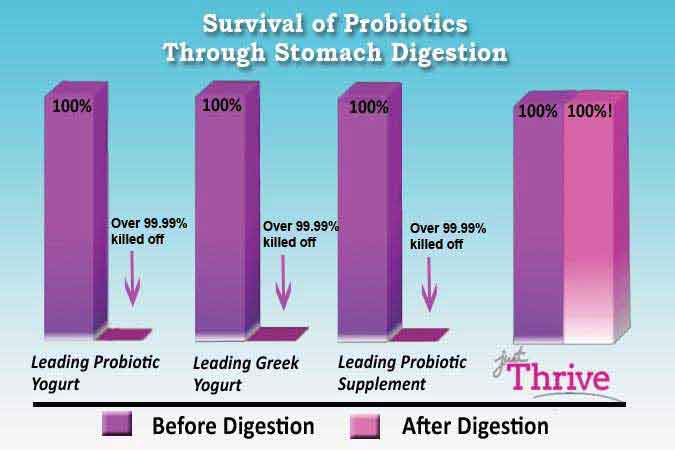
  • Thrive Probiotics – Claims that the bacteria produce antioxidants as well as that 100% survives (which  is because they are all bacillus).  Contains:

    • Bacillus Subtilis HU58 ” Two isolates of B. subtilis examined here were HU58, a human isolate and PXN21, a strain used in an existing commercial product. Compared to a domesticated laboratory strain of B. subtilis both isolates carried traits that could prove advantageous in the human gastro-intestinal tract. This included full resistance to gastric fluids, rapid sporulation and the formation of robust biofilms.” [2012]
    • Bacillus Indicus HU36 “Recently isolated spore-forming pigmented marine bacteria Bacillus indicus HU36 are sources of oxygenated carotenoids with original structures (about fifteen distinct yellow and orange pigments with acylated d-glucosyl groups)” [2015] ” Overall, carotenoids from Bacillus indicus HU36 and Bacillusfirmus GB1 were found to be interesting antioxidants to fight postprandial oxidative stress in the stomach” [2013]
    • Bacillus Clausii – strain is not identified, another probiotic does: Enterogermina
    • Bacillus Coagulans


    graph-slider-page-low

    • Note: Expensive and no studies for FM/IBS/CFS for the species or strains.
  • “Increased proportions of the Fusobacteriaceae family correlated with increased disease activity and levels of C-reactive protein in patients with UC who underwent pouch surgery. In contrast, proportions of Faecalibacterium were reduced in patients with pouchitis vs controls; there was a negative correlation between proportion of Faecalibacterium and level of C-reactive protein. There was an association between antibiotic treatment, but not biologic or immunomodulatory therapy, with reduced proportions of 11 genera and with increased proportions of Enterococcus and Enterobacteriaceae.” [2016]
  • “Gut microbes produce a chemical that enhances clotting in the arteries, increasing the risk of heart attack and stroke.” [2016] … i.e. hypercoagulation!
  • ” But with hundreds of microbial species crammed together in tight quarters, new research suggests that our intestinal innards might resemble a battlefield more than a conference room. Researchers have found that gut bacteria continually wage war on their neighbors, perhaps as a way to stake out space. The team injected different strains of Bacteroides fragilis, the species of gut-dwelling bacteria (pictured here), into mice that lacked their own microbes. When they analyzed the rodents’ stools over time, they found evidence that the strains were attacking each other. Different strains of B. fragilis inject different combinations of toxins into neighboring bacteria. Bacteria within the same strain fight back: They’re immune to the toxins secreted by their strain-mates. But different species or strains of bacteria can succumb to the assault, giving the attacking strain more room to spread out.” [2016]
  • Pylopass, a non-viable L.Reuteri probiotic  (i.e. killed) [2013] was found effective against H. Pylori.
  • “Iron replacement therapy in patients with inflammatory bowel disease alters gut microbiota depending on how it is administered, suggest scientists… oral treatment (instead of IV) was associated with decreased abundances of operational taxonomic units assigned to the species Faecalibacterium prausnitzii, Ruminococcus bromii, Dorea sp. and Collinsella aerofaciens.” [2016]
  • “A chronic lack of dietary fibre has been found to reduce the diversity of bacteria in the guts of mice. This effect is not fully reversed when fibre is reintroduced, and increases in severity over multiple generations” [2016]
  • “Smart gas sensing pills developed at RMIT University can measure intestinal gases inside the gut and send the data directly to a mobile phone.” [2016]

“In the United States, the described benefit of a substance impacts how it is regulated. In the case of beneficial bacteria (i.e., probiotics),

  • if the probiotic is added to food “primarily for taste, aroma or nutritive value” but also providing an added beneficial effect to a healthy individual, the probiotic will be regulated as a food.4
  • If the probiotic is marketed to help maintain the structure or function of the body and to “supplement” the diet, the probiotic will generally be considered a dietary supplement (when labeled according to dietary supplement labeling regulations) and the associated claim is termed a “structure/function” claim. A structure/function claim does not need pre-market approval, but does need to be substantiated with “competent and reliable” scientific evidence proving the claim is “truthful and not misleading.”5 Recent claims indicate a wide variety of effects of consumed probiotics on the body, including effects on the skin that consumers regard as a “cosmetic” effect.6 Probiotics have also been added directly to cosmetic products to modulate the cutaneous microbiota.7 However, cosmetic manufacturers must keep in mind that any product that affects the structure or function of the body when applied to the skin is considered a drug, and therefore claims for cosmetics must be limited to the beautifying or attractiveness effects.8
  • In general, claims for foods and dietary supplements that discuss the nutritive value or maintenance of the body do not need pre-market approval, but claims that relate a food or dietary supplement ingredient to the reduction in risk of a disease, termed “health claims,” do require pre-market approval by FDA, which regulates claims stated on food and dietary supplement labels.
  • However, if a probiotic is claimed to “prevent, treat, cure or mitigate” disease, the probiotic will be regulated as a drug and the associated claim is a drug claim. Even if a probiotic is added to a food product or dietary supplement, but the claims on the packaging (or other media such as websites or social media) state the probiotic prevents or treats disease or symptoms characteristic of a disease, then FDA or FTC, the latter of which has jurisdiction over advertisements for food, drugs and medical devices, would consider the probiotic a “biologic” drug, and therefore misbranded as a food or dietary supplement.” [2016] This is why Mutaflor is deemed a drug in the US. It also means any effective probiotic for CFS/IBS/FM may end up being deemed a (prescription) drug in the US.

The Care and Feeding of E. Coli Probiotics

This last weekend our shipment of Symbioflor-2 (6 strain E.Coli probiotic) arrived. As was the case with Mutaflor (E.Coli Nissle 1917) there was a package insert warning of some side effects. This does not happen with most probiotics — inserts with warnings! A local friend also message me, she has started Mutaflor and had a massive herx for three days and with it passed, she is feeling significantly better. Side effects include:

  • ” At commencement of treatment distension of the abdomen, release of wind or upper abdominal pain may occur occasionally.”
  • “After the beginning of administration, flatulence is common. Very rarely, undesired effects of the gastrointestinal tract such as abdominal pain, gut noises, meteorism, loose stools or diarrhea, nausea and vomitting may occur. Again very rarely, cases of headache may occur.”

Typically studies start with low dosages and work up

“Symbioflor 2 was administered in standard dosage starting with two times five drops daily and a daily increase by two times one drop until 15 drops daily were reached. Fourteen drops are 1 ml containing 1.5–4.5times107 viable bacterial counts. The total duration of treatment was 21 days.” [2009]

And yes this probiotic does not come in capsules, but in a droplet bottle! Symbioflor 2 is preferred over Mutaflor (2 capsules = 1 day vs 15 drop = 1 day) because it is easier to slowly increase the dosage.

Why E.Coli Probiotics?

The first question is always why go thru the side effects!!!! The answers are:

  • Escherichia coli (E. coli) bacteria normally live in the intestines of people and animals. Most E. coli are harmless and actually are an important part of a healthy human intestinal tract.” [cdc]
  • ” The harmless strains of E.Coli are part of the normal flora of the gut, and can benefit their hosts by producing vitamin K2,[5] and preventing colonization of the intestine with pathogenic bacteria.[6][7]” [Wikipedia]
  • “In 1885, the German-Austrian pediatrician Theodor Escherich discovered this organism in the feces of healthy individuals.” [Wikipedia]
  • Often CFS patients will have ZERO E.Coli in their system
  • It is suspected that the bacteria replacing E.Coli are heavy d-lactate acid producers, thus E. Coli probiotics will lower d-lactate levels
  • E. coli can synthesize all 20 amino acids, all vitamins, all nucleotides, and all fatty acids that it uses during growth and metabolism.” [Course]
  • “We pretty much depend upon E. coli in our intestines for our source of Vitamin K and B-complex vitamins.” [Kansas University]
    • Niacin [1954] and NADH – which may be why CFS responds to NADH.

So, the absence of E.Coli result in low levels of Vitamin B (B12, Niacin, etc) and Vitamin K. More important, it has a major role of keeping pathogenic bacteria controlled.

If you stop and think about it — a lot of the abnormal lab results could be caused by the lack of E.Coli…. (speculation!)

Feeding of E.Coli

In earlier posts we saw that sulphur in food (dark green vegetables) encourages the growth of E.Coli or / and MSM. Also d-ribose sugar encourages  the growth of E.Coli (which may be why it helps CFS patients). E.Coli grows best at…. 98.6F (37C)… [Course]

Per earlier posts, it should be taken before meals with some fat. My wife is trying drops of Symbioflor-2 into warm 2% milk (i.e. close to 37C) with a little d-ribose in it.

Do NOT take with C. butyricum MIYAIRISAN Probiotics

“1.1 C. butyricum MIYAIRI antagonistic effects on toxinogenic Escherichia coli and 20 E. coli strains isolated from live stocks (cows, pigs and chickens) were evaluated by the plating method. C. butyricum MIYAIRI inhibited the growth of all E. coli strains tested” [Source]

See also this post on feeding E.Coli with baking soda.

Yoga, Meditation et al for CFS

CFS is a disease that is stress sensitive. Stress produces chemicals that appear to increase the population of disruptive bacteria in the gut.

There are potential attitude problems because it implies (to some) that CFS is a psychological condition

So for symptom mitigation, it can definitely help — exactly what would be expected from the model. Meditative movement reduces stress and thus the production of chemicals produced by stress.

For remission, zero indication that it would result in any remissions.

Stress Impact

Bottom Line

Most CFS patients need to lower their stress levels, especially those who onset were connected to stressful jobs.  This may be done by adaptogens (Ashwagandha, etc) [See Mother Earth News], adjusting self-expectations and/or ignoring other expectations on you, or by some form of meditative movement. This will not, by itself, cause remission but it should lessen the time to remission and reduce the risk of future relapse once remission is obtained.  If you were an adrenaline junkie, you have a LOT of behavior modification to do.

On the flip side, disability issues, financial issues, non-supportive spouses and families represent severe challenges of sources of stress that can keep a person locked into the CFS cycle — especially with brain fog.

Of course, one of my favorite “medicines” shows up… see my earlier post on this special medicine (which also encourages the growth of bifidobacterium probiotics)

  • Dark chocolate reduced the urinary excretion of the stress hormone cortisol and catecholamines and partially normalized stress-related differences in energy metabolism (glycine, citrate, trans-aconitate, proline, beta-alanine) and gut microbial activities (hippurate and p-cresol sulfate).” [2009]
    • Specific dietary preferences are linked to differing gut microbial metabolic activity in response to dark chocolate intake. [2012]
    • “The milk chocolate snack resulted in the decrease of anxiety in high anxiety trait subjects, whereas dark chocolate and cheese and crackers respectively improved the anxiety level and the energetic state of low anxiety trait participants.” [2012]