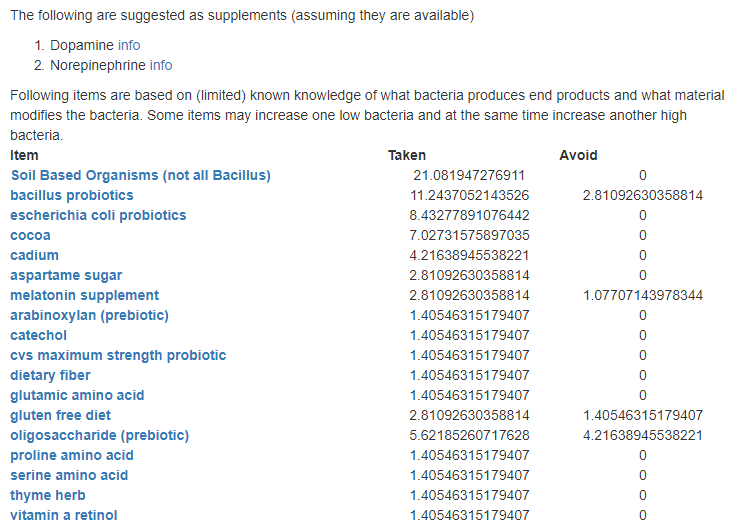
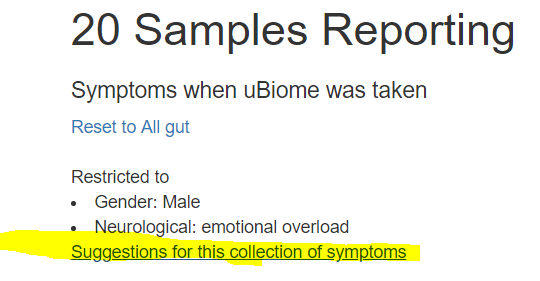
Suggestions based on Symptoms Alone

The strong associations found with the End Products resulted in a reader asking “Can’t you create a page of recommendations based on symptoms alone?”

This took me back a little – what!!!  Then I realized that it was possible.  The process is simple:

  • From the symptoms, determine the End Products with a rough t-score of 3 or more
    • THIS IS BASED ON CONTRIBUTED UBIOMES with SYMPTOMS
  • Get all of the bacterias associated with those End Products
  • Assume that the t-score is a proxy on how short or high that these bacteria are
  • Send this collection of bacteria and shifts off to the recommendation engine…

Voila you have suggestions!  What they are worth is another question — the End Product is still a beta concept, this page would be pre-beta, i.e. an alpha concept.

With the above disclaimers, let us go to show how you can play around with it.

Pick your symptoms

I would suggest working from most frustrating to least frustrating. Add them one at a time.

Go to  http://microbiomeprescription.com/Data/SymptomEndProductExplorer 

I picked

sample4

A new page opened

sample5

I add another symptom

sample6

and Repeat

sample7

Bottom Line

This was an interesting challenge — it has logic and science behind. It does not have any clinical experience yet.  I suspect that I will keep adding data… and more important, users will keeping adding ubiome WITH SYMPTOMS.

The above depends on those ubiomes with symptoms. 

BIG DISCLAIMER

This is an education post to facilitate discussing this approach with your medical professionals. It is not medical advice for the treatment of any medical condition. Always consult with your medical professional before doing any  changes of diet, supplements or activity. Some items cites may interfere with prescription medicines.


End Product Predictions vs New CFS Study

A reader sent me a link to a new study, July 3rd, 2018 “Insights into myalgic encephalomyelitis/chronic fatigue syndrome phenotypes through comprehensive metabolomics“. Authors include some well known CFS researchers: Nagy-Szakal D1Barupal DK2Lee B1Che X1Williams BL1Kahn EJR1Ukaigwe JE1Bateman L3Klimas NG4,5Komaroff AL6Levine S7Montoya JG8Peterson DL9Levin B10Hornig M1Fiehn O11Lipkin WI12.

Full text is here. WARNING: Heavy data science language used.

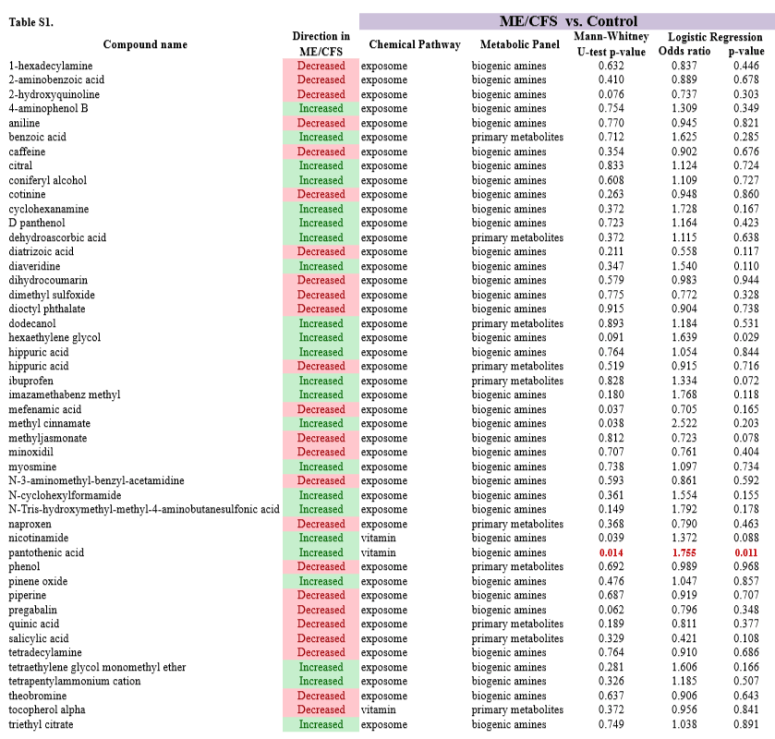
In the supplemental material was a table of compound names and shifts in CFS patients:

Study2

I was curious to see how that compared to predictions from the ubiomes of people with a CFS diagnosis. That table is at http://microbiomeprescription.com/Data/SymptomEndProductExplorer?site=gut&filter=266.

The only items on both lists were:

  • pantothenic acid — both were high
  • Nicotinamide versus niacin were opposite. They are different forms of the same chemical group

Their studies excluded looking at most B vitamins (which raise question on why some B vitamins were included – patients may be taking B-100 supplements).

In terms of B vitamins, the end products predicted from the ubiome results for CFS diagnosis are:

  • LOW Norepinephrine Info 37.79 for significance
    • ” CFS patients had significantly higher levels of plasma norepinephrine” [2016]
  • LOW Dopamine Info 34.41  for significance
    • “Pro-inflammatory cytokines can alter the metabolism of serotonin (5-HT) and dopamine (Felger and Miller, 2012),* effecting dysregulation of associated neurotransmitters, including glutamate, norepinephrine (NE, noradrenalin), and corticosteroids. 5-HT and NE are the major neurotransmitters ” [2017]
  • LOW Tyrosine Info 29.33 for significance
    • ” levels of tyrosine, the rate-limiting dopaminergic precursor, were significantly lower at all time points in the CFS patients.” [2003]
  • LOW Niacin (Vitamin B3) Info  12.41 for significance
  • LOW Succinate Info 5.59 for significance
  • LOW Thiamine (Vitamin B1) Info 4.17 for significance
  • HIGH Folate (Vitamin B9) Info  3.02 for significance
  • LOW Phenylacetic acid Info 2.32
  • HIGH Biotin (Vitamin B7) Info 2.99
  • HIGH Riboflavin (Vitamin B2) Info 2.26
  • LOW Pantothenate (Vitamin B5) Info 2.22
  • LOW Isovaleric acid Info 2.19
  • LOW Cobalamin (Vitamin B12) Info 1.93

Some of these agree with studies and some do not appear to. We need to remember some complicating factors:

  • We are looking at production in the gut, other things may have a hearty appetite there and the production may not make it to the circulating blood.
  • There is the rationing hypothesis — if the body is low in a metabolite, signal are sent out to shut down other consumers, and only essential functions consume it.

Depression

In an earlier post, “Additionally, Isovaleric acid in stool correlates with human depression.[2016] hence isovaleric acid producing bacteria appear to be another facet.”

Looking at those that report depression, http://microbiomeprescription.com/Data/SymptomEndProductExplorer?site=gut&filter=,287

we found isovaleric acid (LOW), dopamine (LOW) etc. with similar to the above. The problem is that we have depression associated with CFS and true depression mixed in our data.

Bottom Line

This beta-forecast of end-products is interesting because of the number of strong associations found. In many cases, they agree with common accepted knowledge — in most other cases, we find the end product is significant according to the literature but the predicted shift is opposite to what is reported in the literature.

As a data scientist, getting the association is key. The sign of the association is less significant and ceases being an issue if random forest or tensor flow is applied to the data.


End Product Explorer is up

I have the three symptom explorers under the same item on the menu now. There is no need to login to use them. Site: http://microbiomeprescription.com/

explorer

All of these follow the same pattern — select a symptom and the data at the bottom of the page is updated to report on the subset with this symptom.

For example,  I clicked on:

And see this result:

Throat

Looking only at values over 2.0 we see:

  • Very low biogenic amines bacteria
  • High Co-enzyme A bacteria
  • High Acetate bacteria
  • High Folate bacteria
  • High Formic acid bacteria
  • High Panthothenate  bacteria
  • High Riboflavin bacteria.

I must admit — this was a surprise!

Changing to

We have:

  • Extremely low Polyhydroxyalkanoic acids bacteria
  • Low Norepinephrine bacteria
  • Low Formic acid bacteria
  • High Folate acid bacteria

Changing to

We have

  • Low Dopamine bacteria
  • High Folate bacteria
  • Low Norepinephrine bacteria
  • Extremely low Polyhydroxyalkanoic acids bacteria
  • etc

I will leave people to explore their own symptoms.


Some answers to a reader’s questions on EndProducts Beta

First, I am NOT a medical professional. I am best described as a mathematician, a librarian and statistician.  I know how to shove numbers around, I know how to research, I know how to painfully logical. Anything on this site should be discussed with a medical professional before doing.

On my last post, a reader asked a stack of questions — these are my  thoughts on them.

Holy moly, I have so many questions! I have diagnosed RA and AS but none of the prescriptions they have ever given me over the years have done anything. This site has been much better at reducing symptoms and pain with suggestions.

Thank you for sharing that this site has benefited you.

Anyway, I’m currently taking Biotin, Kelp, Choline w Inositol (and two eggs and almonds everyday), 5HTP, Selenium, Zinc, GABA, Whey, Magnesium w B6, Quercetin w Resveratrol, Ashwaganda, Spezzata, COQ10, flaxseed… have been since March before this Ubiome in April. It’s now July. I’m wondering if I should stop taking some things? So many things here are extremely high! I just ordered N-Acetyl-D-glucosamine, now I’m thinking I better not take it?

The endProducts is just 1/2 of a balance: there are consumers and there are producers.  Low B12 production combined with Low B12 consumption may result in normal B12 levels. Think of a married couple with low earning but a frugal life style — they may have an excellent credit rating! Attempting to work on consumers is on my to-do list.

Perhaps I should add b-12 and pomegranate to the regimen? I’m not sure what 2,3-Butanediol and Formic acid is, or Phenylacetic acid. How would I or should I bother to try and raise those levels?

My thoughts comes from being the son of a farmer, you can have a good looking crop driving by in a car. You get the best crop when the soil has all of the nutrients needed by the crops. I view that having adequate levels of these end products will help to rebalance the microbiome — after all, how can some of the weak healthy bacteria retake your gut when it is starving or on low-rations?

Next, Wikipedia is your friend.

A second friend can be Cambridge University Botanic Garden. Doing a site search with google:
site:www.botanic.cam.ac.uk formic acid

find that Formic Acid is in Urtica dioica (stinging nettle). This may be purchased as a supplement.

Not being a medical professional, I cannot answer the question “Perhaps I should add b-12 and pomegranate to the regimen?“.  I can suggest that experiments are good if you keep good records. Experiments are better, when you share the results.

Is it good to have low Trimethylamine?

Again over to wikipedia as a starting point, Trimethylamine” In humans, it is synthesized exclusively by gut microbiota from dietary nutrients such as choline and carnitine” I could find no literature dealing with low levels, very high levels (usually associated with a DNA defect) is associated with fish odor syndrome.

What the heck is Propionate and Phloroglucinol and how would I ever lower that if that’s even needed to be lowered? A quick search shows some studies that say it’s beneficial to have high.

Again, to wikipedia: https://en.wikipedia.org/wiki/Propionate “Propionate is observed to be among the most common short-chain fatty acids produced by human gut microbiota in response to indigestible carbohydrates (fiber) in the diet.[2]” so to reduce, cut back carbohydrates seems reasonable.

https://en.wikipedia.org/wiki/Phloroglucinol  “The bacterium Pseudomonas fluorescens produces phloroglucinol, phloroglucinol carboxylic acid and diacetylphloroglucinol.[14]… It is also used as a treatment for gallstones, spasmodic pain and other related gastrointestinal disorders.[15][16]

So, the question arises, do you want to reduce it? If you  do, see this page on modifiers of pseudomonas.

My worst symptoms are brain fog of doom, lack of focus, concentration, and understanding words when spoken. Weird anger. Horrible fatigue. Bad depression. Swollen joints are the worst pain in my hands. Those are the main concerns and are a bit better than without these things but still debilitating.

My initial impression is that a SPECT scan has a 80% probability of showing hypoperfusion in the brain (i.e. low/slow penetration of blood into the brain tissue). There are multiple possible causes:

  • Build up of fibrin fragments — there are fibinolytics (fibrin disolvers)
  • Vascular constrictions — there are vascular dilators (my own usual is flushing niacin)
  • High blood viscosity — slow moving blood, think of oil versus water, I recall Alpha Lipoic Acid is one non-prescription supplement that can help with this.
  • Inflammation
  • etc

Again, by law, I can only suggestions/topics to discuss with your licensed medical professional.

Sorry about all the questions!! But I would love some answers!

This is an education post to facilitate discussing this approach with your medical professionals. It is not medical advice for the treatment of any medical condition. Always consult with your medical professional before doing any  changes of diet, supplements or activity. Some items cites may interfere with prescription medicines.
End Products Analysis is now in Beta

Bacteria produce end-products such as B12, Biotin, Butyrate etc. I have done a naive count of the number of bacteria in your ubiome that produces each and create a report from it. This is not perfect:

  • different bacteria are more or less efficient in production
  • this is based on available data. Some bacteria are hard to cultured and remain mysteries.
  • This is one side of the equation — if your are a low B12 producer AND low in bacteria consuming B12 then you may have normal B12 in lab results

This will work for uBiome and Thryve uploads. It is strictly experimental.

Some answers to readers questions are in this followup post.

Then you logon, you will see a new column on the sample page.

ep1

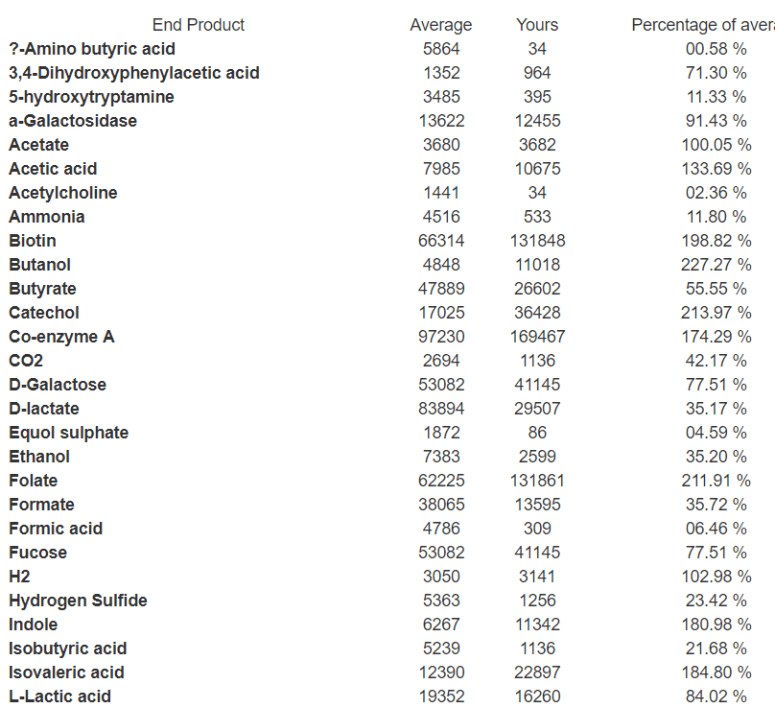
Clicking on this will take you to the new report. The Average was calculated from the 45 people that uploaded and reported no health issues. I will periodically recalculate these.

ep2

p3

Purely experimental

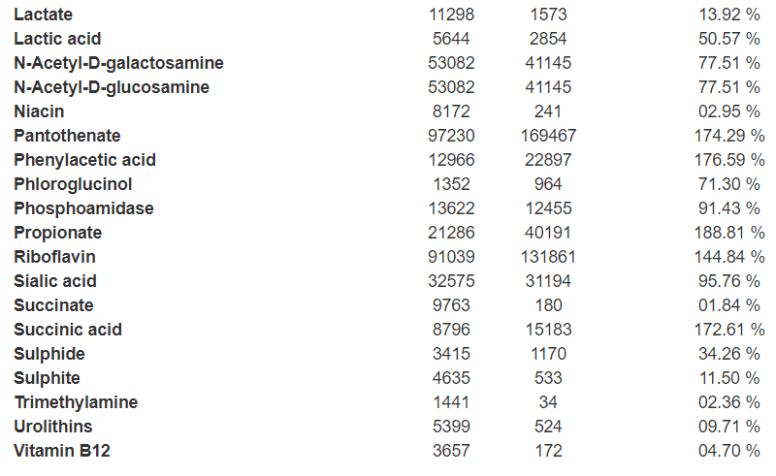
We see that this person may benefit from Vitamin B12 and Niacin, but does not need Riboflavin or Folate — A B-100 supplement may be a poor choice for them.

They are low in Acetylcholine — a neurotransmitter. This may account for some cognitive issues.

I will leave people to explore and add comments of any discoveries they make on this page! I would suggest focusing on the EXTREME values — there is a lot of natural variations.

Site again is: https://microbiomeprescription.azurewebsites.net