Brain Fog – Hypoperfusion of the brain in ME/CFS and Long Covid

A reader followed a new article that seems to bear strong echoes from research done 23 years ago by David Berg at Hemex Labs. The article is “CFS/ME, FM: THERAPEUTIC TEST AND FIRST TREATMENT SCHEME FOR PATIENTS WITH CHRONIC FATIGUE AND BRAIN FOG TO ASSIST THE DIAGNOSIS OF PERSISTENT CLOTS AND HYPOPERFUSION.” Oct 2021

 Our approach is that Chronic Fatigue Syndrome and Myalgic Encephalomyelitis (CFS/ME) include several Subgroups according to their pathophysiology and the causes that originate the symptoms, and most of the cases of CFS/ME correspond to a Subgroup in which there is an inadequate functioning of the blood vessels, more specifically a dysfunction of the endothelial cells, which in a high percentage is accompanied by a lower blood flow and a state of long-term hypercoagulability, with the presence of persistent clots that are attached to the vascular walls and also circulating intravascularly.  

There are other Subgroups within CFS/ME, such as that associated with Dysbiosis, SIBO or alteration of the Intestinal Microbiota, a situation in which D-Lactate is increased.

There are also Subgroups associated with Vitamin depletion (especially B complex) and Subgroups associated with decreased hormones (especially thyroid and adrenal).

It should be taken into account that patients with CFS/ME can frequently present symptoms associated with several of the Subgroups of CFS/ME, being frequent that they present at the same time Endothelial Dysfunction, Dysbiosis or SIBO, and vitamin B complex depletion Endothelial dysfunction and persistent clots cause tissue hypoperfusion. Long-term dysfunction of the blood vessel walls and the presence of persistent clots causes a decrease in the perfusion of fluids from the bloodstream to the cells and tissues, which is called tissue hypoperfusion, which implies a lower contribution to cells and tissues of: – Oxygen (generating cellular hypoxia). – Vitamins. – Nutrients. – Hormones. – Other substances.

Long-term tissue hypoperfusion affects the normal functioning of organs and systems, especially those that require a greater supply of oxygen and nutrients, which are mainly the musculoskeletal system, the brain and the lungs. 

Endothelial Dysfunction, Persistent Clots, and Hypoperfusion are not detectable with routine exams

Gustavo Aguirre Chang Aurora Natividad Trujillo Figueredo

The study goes on to focus on elevated D-dimer as the critical test. Unfortunately, this is not as comprehensive as the Hemex panels being done in 1999 onwards by Hemex labs. Hemex lab specialized in coagulation issues, mainly issues with miscarriages caused by hypercoagulation, and stumbled on to the significance of hypercoagulation for ME/CFS. Hypercoagulation is a well established cause of hypoperfusion.

This article gives protocols etc. You may grab a copy here.

Some of my prior posts in this area are listed below:

A review of a ME/CFS Microbiome

Every ME/CFS microbiome is different. IMHO, the root cause is a bad mixture of chemicals and chemical signals being produced by a dysfunctional microbiome that has reached a stabilization point.

Patient

This reader provided detail background which is always desired.

Background:

35yr Male have had ME/CFS for about 7 years now since 2015. In 2018 after first child and really bad sleep it got really bad..would wake up with anxiety for no reason. Major brain fog depressed and tired all the time. Sometimes had to be in bed multiple parts of the day. When I would exercise I would crash 5 hours after exactly for 24 hours which were an extreme version of my symptoms …plus temperature dysregulation, flushed feeling in the face, vision sometimes blurry (blood sugar looked normal), eyes squinty/heavy, felt very rundown, stomach would get inflamed with water, weight gain instead of loss, felt dehydrated even though I drank electrolytes, night sweats, etc. Strangely the period immediately after exercise leading up to the crash I would feel fine. Seen a lot of different doctors, but never felt like the root cause of it all was found. Made a lot of progress working on mental health, positive circle of friends, church/prayer, methylation, detox, nutrition, neurofeedback/ EMDR, and Perrin Technique (lymp drainage massage daily). Tried of other strange out of the box treatments like frequency therapy, applied kinesiology, red light therapy, self learned some acupuncture.   

History:

Child hood trauma, but no serious health problems growing up minus strep throat a few times and bad food poisoning in 2013. Always struggled with a bit of brain fog and ADD like symptoms (can start tasks, but difficult finishing them). I’m an entrepreneur and before my health issues started would play basketball 3x a week for a decade, gym, and martial arts…sometimes all on the same day.  In 2015 went through a stressful mental and physical time starting another business. I really burned the candle at both ends. 

Initial onset was panic attacks , felt like I was going to die driving even though I know that wasn’t logical (fight or flight stuck). EMDR stopped the panic attack issues. Overall made lots of progress, but haven’t healed PEM yet.

Initial Onset Labs/Tests:

-Salivary Test showed tanked Cortisol and Low Neurotransmitters w/High DHEA.

-Blood Sugar and A1C barely a little over normal range.

-High Cholesterol / Trig /LDL and Low HDL

-Gi Stool Test showed candida, pseudomonas, low Bifido..naturopath put me on klaire labs bifido probiotic, super restrictive diet , and grape seed extract to kill candida all for 6 months. (Bifido still low per last 16s years later)

-Mold Test showed Ochrat toxin at 35/17..took some charcoal and glutathione for a while. House tested very low for Mold.

-Non Alcoholic Fatty Liver per Naturopath …corrected in latest lab

Brain Scans QEEG:

-Low power overall in the brain

-Was using Delta waves during the day at times and had a hard time getting into Alpha (neutral gear)

-Never seen anyone with a scan like me nor in their global database

– Lots of stuff going on in subconscious and abnormalities all around

Analysis

On my pending projects list is a database linking microbiome to lab results – still waiting for volunteers (I do not have sufficient bandwidth at present to start the population of data). I have done prior posts on some related items:

The Microbiome

Looking at probable symptoms, entered symptoms and the above history we have a high number of matches with a few items suggested but not listed above (i.e. issues that should be checked)

  • Infection: Epstein-Barr virus Associated Bacteria (re-activation of EBV is common in ME/CFS)
  • Comorbid: Methylation issues (MTHFR)

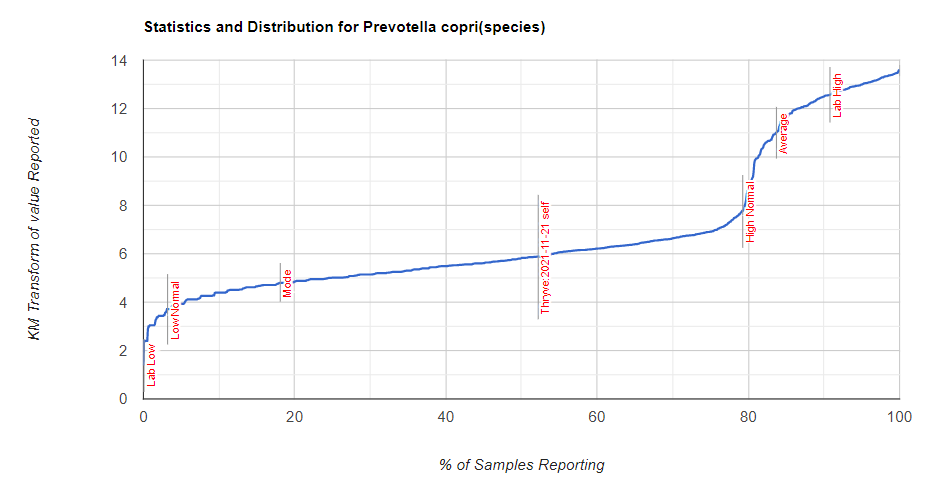
From an autism group that I follow,  Prevotella copri goes high with the presence of mycotoxin [2020], which may explain this rather dramatic chart below. There does not appear to be a significant active mycotoxin issue at present.

Scanning thru My Microbiome view I note the following:

This produced a very short list of suggestions: Iron, Zinc and lactobacillus reuteri (probiotics) with some interesting avoids:  folic acid,(supplement Vitamin B9),  quercetin,resveratrol, boulardii (probiotics), glycyrrhizic acid (licorice). Adding in items known for parents/children we see some more probiotics suggested:

It is clear that a B-Complex may have questionable results.

Pro Forma for ME/CFS

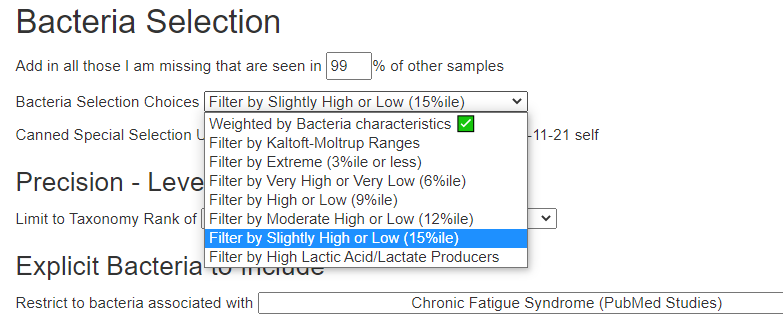
My usual advice for ME/CFS when brain fog is not too severe is to use advance suggestions and slowly work up from 3%ile until you get at least 10 bacteria identified.

  • 6% –> 6 bacteria
  • 9% –> 10 bacteria
  • 12% –> 15 bacteria

At 9%, we have relatively few to take over 0.4 confidence:  iron, linseed(flaxseed),omega-3 fatty acids and some interesting avoids:  soy, inulin (prebiotic), Cacao, resistant starch,  resveratrol (grape seed),mediterranean diet, lactobacillus casei (probiotics). I say interesting because the avoid items are often seen as to take with ME/CFS. For example,  High cocoa polyphenol rich chocolate may reduce the burden of the symptoms in chronic fatigue syndrome Nutrition Journal [2010].

I increased to 12%, and a lot of items appeared.

Finding a good list of suggestions is an iterative process, I usually want to see a good list of items over 0.4 as suggestions — going up to 12%ile produced the desired goal.

Among the interesting items was:

  • Aspirin – it has the same effect on platelets (one factor of blood coagulation) as reservatrol (an AVOID), and should help with cognitive issues. They impact on the microbiome is different. in my own story, aspirin had a dramatic positive effect taking the maximum dosage of aspirin for the maximum duration had on me, and resulted in my MD becoming a believer that hypercoagulation was part of the CFS condition and ordering tests from Hemex Labs (a specialty lab on coagulation) — a significant part in terms of brain fog.

Neither Kegg suggested supplements nor Kegg suggested probiotics returned anything,

Bottom Line

Compare to others with ME/CFS, their microbiome is not an extremely shifted as is often seen. For probiotic dosages, I recommend looking them up here — often people take insufficient to effect change.

The dominant probiotic suggestion is: Lactobacillus Salivarius. Which is available from several sources. My own favorite source is Custom Probiotics (bottle price can be a shock, but the cost per BCFU is a fraction of competition).

Beginner Guide to Getting Suggestions from Microbiome Part 2 – YouTube

Questions from Person and Answers

  1.  iron – very strange. I eat a lot of red meat and take liver supplements. Did you take iron on your journey and what type?
    1. A: Iron uptake depends on the bacteria present. This article goes into the mechanisms. More related studies [2021] [2021]
  2. EBV – sorry actually have this test. I did a protocol for a month but maybe didnt nuke it enough?  My attached isn’t clear if it’s past infection or reinfection though. 
    1. A: This does not indicate an active case (it could be), it indicates that the microbiome has had signs of an EBV shift….
  3. On my Nirvana Biome – does it distinguish good e coli From bad? It said it was high there as well as c.diff ..on 16s test don’t think either showed up as a concern.
    1. None of the 16s tests distinguish good e coli From bad. It is important to know that most E.Coli are good.
  4. Coagulation – your aspirin comment made a big light bulb go off. I remember a few times I would take aspirin right after basketball which may have been for some other issue but I remember feeling like I didn’t crash/get PEM.  Is there any studies on what a good dose might be for this.
    1. A: “baby aspirin” (up to 100 mg) daily is well accepted (see this summary). I would suggest (in consultation with your medical professional), trying to find an effective daily dosage each day. Ideally, it would be taken with food to reduce risks. Take aspirin over other items like acetaminophen.
  5. Looks like I can rule our mycotoxins. I had a bit of elevated ochra a …worked on it a bit. Good news 
    1. A: Reasonable intrepretation
  6. I have a friend who has similar issues and I directed him to your site. He’s getting a 16s and just had a spect scan. Let me know if you’re looking for more blog cases. Happy to ask him. Please let me know if there is anything I can do to help you too!
    1. Yes, please do.

Conditions to test for before concluding Chronic Fatigue Syndrome

A reader in Australia has had CFS for 2 years. She wishes to exclude other treatable diseases that could mimic CFS (and potentially be treatable). The Research definition of CFS states that CFS should only be given as a diagnosis AFTER excluding other possibilities. This is unfortunately not always the case. “Any unexplained abnormality detected on examination or other testing that strongly suggests an exclusionary condition needs to be resolved before attempting further classification.”

[1994 CDC] Any past or current diagnosis of:

  • major depressive disorder with psychotic or melancholic features
  • bipolar affective disorders
  • schizophrenia of any subtype
  • delusional disorders of any subtype
  • dementias of any subtype
  • anorexia nervosa
  • or bulimia nervosa
  • Alcohol or other substance abuse, occurring within 2 years of the onset of chronic fatigue and any time afterwards.

Or

  • untreated hypothyroidism,
  • sleep apnea,
  • narcolepsy, and
  • iatrogenic conditions such as side effects of medication.
  • Severe obesity is defined as having a body mass index equal to or greater than 45

Or

  • diagnosable illnesses may relapse or may not have completely resolved during treatment.
    • hepatitis B or C virus infection
  • Brain Injury – Traumatic or by prior infection

Other items

  • Phosphate Diabetes: 10% of CFS patients had been misdiagnosed and had phosphate diabetes [1998]
  • Pfisteria

  • From British Medical Journal 2015
    • “Infectious mononucleosis antibody titer indicates past infection and fatigue could last a month or 2 at most.”
    • “post parvo virus B19 fatigue. This post viral syndrome is the easiest to spot as it always shows isolated low red cell count.”
  • Young-Onset Monogenetic Parkinsonism [2011]


Picking Probiotics from OATS results

In a series of past posts, I walked thru the many pages of a OATS looking at each line:

A reader of that page presented me with a challenging question: “Which probiotic would reduce ….. ?” I checked the US National Library of Medicine studies — nothing. I am a lateral thinker (read Edward de Bono since I was a teenager) and it occurred to me that, theoretically, we can use data from KEGG: Kyoto Encyclopedia of Genes and Genomes because they have the gene sequence of many probiotics and thus their enzymes. Enzymes are mini-factories that consumes some metabolites and produces other metabolites. There are 5200+ different compounds reported on KEGG.

Since I have all of the data in a friendly (to me) datastore, it was just a matter of constructing a few complex queries and creating some web pages. The result was this page: Probiotics to Change KEGG Compounds

In the video below, I walk thru how we use OATS result and this page. Other test results can be used. OATS happened to be inspiration for this feature.

A series of samples overtime from a CFS/ME person

The reader provide the following history (shortened)

Person’s Narrative

Sample BiomeSight:2021-02-24 In addition to my usual CFS symptoms I had a lot of trouble with gastritis. I was taking Slippery Elm, Marshmallow root, DGL, melatonin, magnesium, probiotic Bio.me Femme UT. I mostly avoided other supplements due to gastric issues. When the results came back I was only able to eat a few foods, so I couldn’t really follow the suggestions. I decided to wait until my stomach got better and retest.

Sample BiomeSight:2021-08-23 Taken after I’ve been on PPIs for 3 months. I haven’t been eating dairy for months which decreased B. Wadsworthia somewhat. I ate a lot of soy milk and soy yogurt. Mostly gluten-free, but eating lots of oatmeal. The combination of PPIs and yogurt made Streptococcus Thermophilus very high. The supplements at the time were melatonin, magnesium, zinc carnosine, d3 & k2, vit A, Omega 3, probiotic Bio.me Femme UT, occasional Slippery Elm to calm the stomach.

After I got results back I started taking:
– Miyarisan (Kegg AI Computed Probiotics),
– glycine (Kegg AI Computed Supplements),
– inulin, burdock root, L. Rhamnosus, L.Reuterii, almonds, oregano tea (suggestions from Targeted bacteria based on symptom Impaired memory & concentration).
I alternated modifiers so I wasn’t taking all of them all of the time.

I stopped:
– vit A and Slippery Elm (suggestions from Targeted bacteria based on symptom Impaired memory & concentration)
– yogurt (high S. Thermophilus)- oatmeal (it seemed to cause hypoglycemia. Replaced with tsampa – roasted barley flour)

Interestingly, Kegg AI Computed Supplements at level <15% reported Iron and 6 weeks later I was found to be anemic. That was an excellent prediction! I wish I would have gone and tested my iron status right away.

Sample BiomeSight:2021-11-28 Still on PPIs. Taken one month after I started taking prescription iron pills and lactulose to help with resulting constipation. Still eating soy milk daily, but no dairy, no yogurt. Taking more supplements at this point.

Analysis

Reading the history, my first question is to see if the predicted shifts from doing PPI (Proton Pump Inhibitors) is reflected between samples. Keep in mind that there are other microbiome compounders (i.e. other eating pattern changes). To this end, I’ve created a new page where you can pick a before, after and a modifier.

See Full Post on Microbiome Prescription Blog with images

What is interesting to note is that the impact diminished overtime (80 -> 65). This agrees with my base model that rotation and re-testing is essential.

We can do combinations, for example PPI and melatonin between first and second sample. We lack studies on combinations and thus have to resort to this experiential approach to see how well predictions agree with actuals.

If a substance did not cause more improvements(Agrees versus Differs), then they are possible items to drop. Remember, the suggestions are theoretical prediction looking at many hundreds of bacteria. This allows you to objectively measure whether they worked well for you! They will not work for every one because of differences in DNA, diet, gender, age etc. I spot checked items like Slippery Elm (46.8 Agrees, 27 Differs), Miyarisan (KEGG Suggestion) (40.8 Agrees, 15 Differs) and was pleased with the results.

Looking at the next Step

Above, we (to my delight) verify that the suggestions are causing changes in the predicted direction for this person (based on their microbiome samples). Looking at predicting symptoms, we had 72% correct for the top 11 items ( So where do we go from here? Remember, the goal is to focus on the bacteria that likely contributed the most to the dysfunction (often high ones)

  • From KEGG, the best probiotic is Sun Wave Pharma/Bio Sun Instant, if it is available. It has several species suggested in it.
  • Looking at KEGG Products out of range — 7 were too low and 190 were too high. We are looking at an overproduction scenario.

I looked thru the predicted symptoms bacteria and there were a lot of secondary matches(shown with a # but very few direct matches. When we moved on to KM outliers, we had 25 items listed — 2 families and 5 genus with these items of considerable note — both for high percentile and high numbers:

So I did a hand picked with just these more extreme values. I tossed in everything we had. No prescription items showed up on the to take, but many (and a few b-vitamins) showed up on the to avoid list.

In terms of typical ME/CFS, we found only two matches, both two high:  Bacteroides ovatus and Streptococcus. In terms of this small subset — only one item was above 0.29 — Human milk oligosaccharides (prebiotic, Holigos, Stachyose) with iron and B-12 being on the to take list.

We also note that the Unhealth Bacteria page, was full of Streptococcus

I tossed all of these into our hand-picked list and ask for new suggestions — the suggestions did not change expect for minor shifts of confidence.

Bottom Line

Two probiotics:  lactobacillus plantarum (probiotics) and the mixture Sun Wave Pharma/Bio Sun Instant. I see the recommendation leads to the same type of breakfast that is regular for me: Barley/Oats with inulin and wheat bran. For all of the items, make sure you check the dosage links (where available)