Microbiome Analysis of a ME/CFS person

This person has an interesting set of symptoms for ME/CFS. 34 yo female

  • Neurological
    • Visual agnosia (inability to interpret sensations and hence to recognize things, typically as a result of brain damage.)
    • Severe hyperphagia ( abnormally strong sensation of hunger or desire to eat often leading)
    • Severe sleep circadian rhythm disturbance (only thing it responded to shortly was methylated Bs)
    • social anxiety (was severe now mild)
    • brain fog 
    • intermittent prosopagnosia ( the inability to recognize the faces of familiar people)
    • sensory overload – can’t stand showers, need darker room often
  • Many of the above responds in some way to antibiotics 
  • Official Diagnosis: autonomic/small fiber neuropathy, POTS, Hashimoto and now Sjogrens sicca with swollen parotids.

The positive response to antibiotics suggests that the microbiome pays a significant factor.

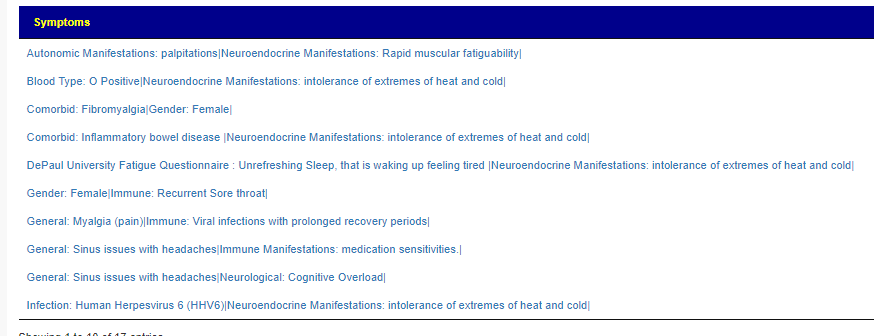
Looking at Naive Predicted Symptoms From Bacteria table, we have:

This is based on machine learning from people adding their symptoms to their microbiome uploads

For predicted medical conditions from PubMed studies, we had one good match, Hay Fever — and for that it was due to no Clostridium butyricum being found. Note that bacteria because it reoccurs as an issue using an entirely different analysis path.

Enzyme Analysis

The awesome results in my last post on an autism child, where the enzymes were identified as coming from bacteria species constantly reported as high with Autism, is causing me to look at enzymes shifts as a good strategy to identify the key bacteria to look at.

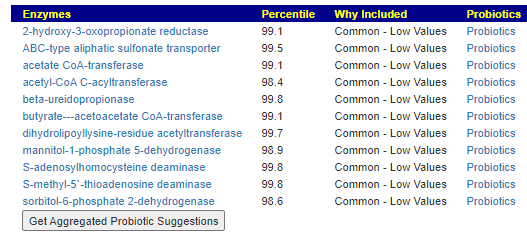
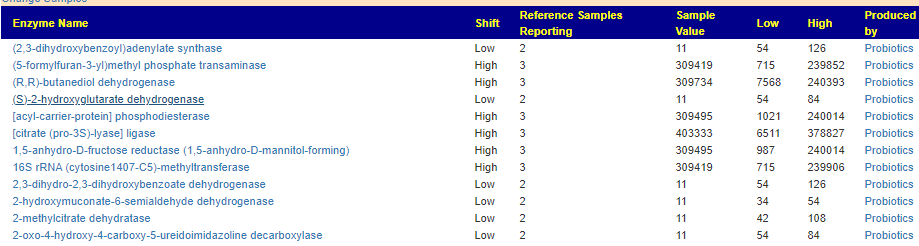
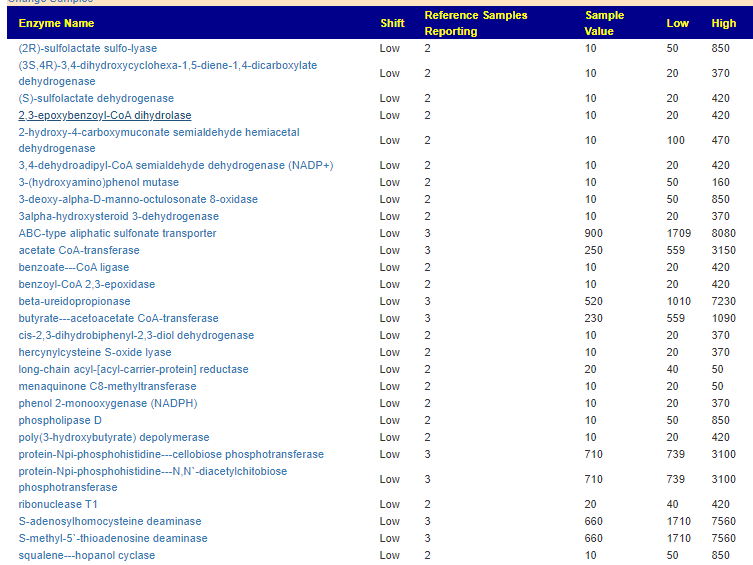
We have a good number of low level items.

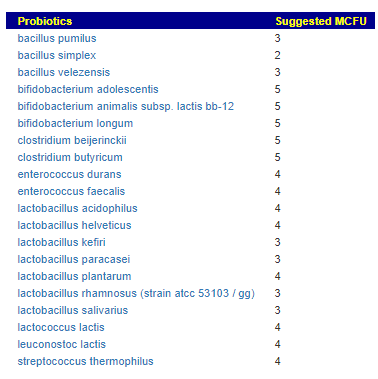
So the next step is to look for probiotics that can also produce these enzymes.

there are 11 enzymes low, those with 11 produces all of the missing enzymes.

The easiest combination to obtain retail from the above are clostridium butyricum (Miyarisan ) which produces all 11 enzymes! and streptococcus thermophilus (which produces 10/11) and is available without other things at Custom Probiotics (with a recommended daily dosage of 320 BCFU). Miyarisan is cited in my 2017 post, What is the ideal probiotic for CFS / IBS / FM patients? As always, start with a low dosage and increase to a therapeutic dosage (typically 3x the normal dosage) after consulting with your medical professional.

Note that the prior analysis of a ME/CFS person’s microbiome also have these two probiotics being the first choice.

KEGG Module Analysis

This is another way to evaluate the functions of the bacteria in a microbiome sample. There are less items then with Enzymes and, to be honest, I have not examined the results much after adding the code and data to compute them. So here goes….

It was a little surprise to see only two

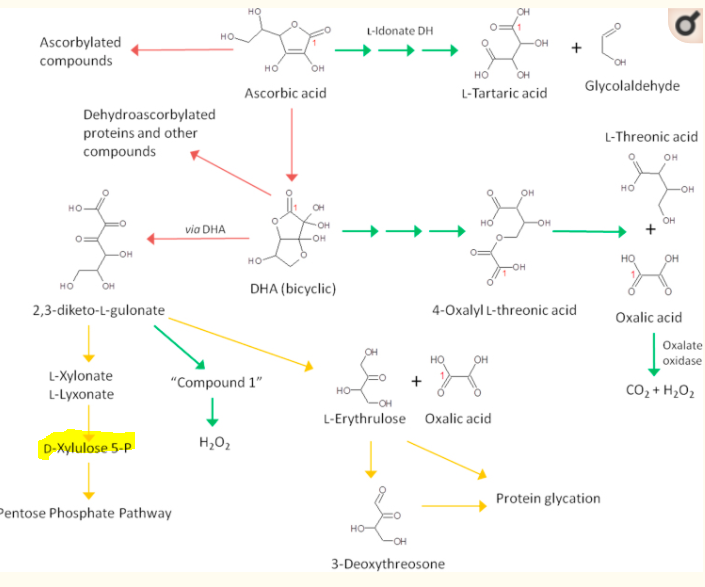
The first item above is associated with Vitamin C (Ascorbate) and influences gene expression [2018]. Looking at the chart below, I notice that H2O2 (hydrogen peroxide) is associated with it. Hydrogen peroxide is a major player for controlling some bacteria. It also feeds the Pentose phosphate pathway which cites “The PPP is one of the three main ways the body creates molecules with reducing power, accounting for approximately 60% of NADPH production in human”

From Ascorbic acid metabolism and functions: A comparison of plants and mammals [2018]

Unfortunately, none of the bacteria producing this exist as probiotics.

End Product Outliers

Nothing was found outside of the ranges, but looking at Core Supplements there are two suggestions (low values, i.e. between 3 and 10ile%) Vitamin D, DAO Producing (diamine oxidase) with Cobalamin (Vitamin B12) and Gamma-Amino butyric acid (GABA) sitting around 15%ile. These are commonly used with ME/CFS and helpful to many. Because this person has cognitive issues, I did a little research on possible dosages.

The above are compensating items that should be taken daily (or broken in every 8-12 hrs) which attempts to create a more healthy/normal environment for the rest of the microbiome and body to be living in. They are symptom relief and likely not cause relief — which takes us to the next step: Clostridium butyricum:

Unlike my last post on an autism child, there were no high enzymes to indicate the troublesome bacteria.

We turn to the Advance Suggestion engine and apply some filters.

Pass 1 for suggestions

First from Citizen Science we look at filtering for neurological decision making and drive a blank until we widen the search as shown below

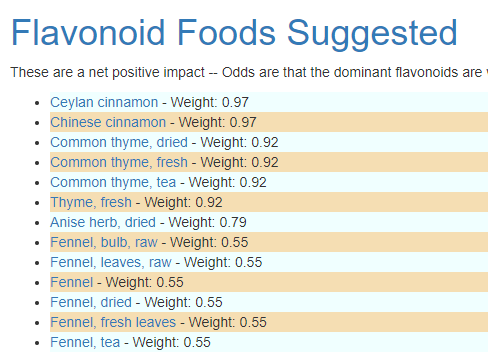
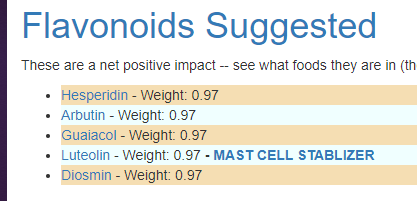
Flavonoid Foods (Most important first): Pomegranate, Apples, Nuts, almonds ,Coconut (and water), Bananas, Cinnamon, and Dates, deglet noor 

Pass 2 for suggestions

We change the filtering to CFS/ME and drop back to the most extreme 3% – where we get results

I usually cut off items at 0.5 rounded
Mutaflor is E.Coli Nissle 1917. E.Coli was reported low in Australian Studies on ME/CFS back in 1998

Flavonoid Foods was similar to above, but apples and banana were dropped off.

Bottom Line

Remember this is strictly on the basis of the microbiome and our current state of knowledge in interpreting and being able to act on it. It is important not to view this as a magic silver bullet. This person has some symptoms where the existing medical literature has suggestions (and which I have done posts summarizing and cited sources for ME/CFS) including the following:

In summary, clinical studies have tested some substances on various conditions which have been reported on PubMed. Microbiome analysis is based on microbiome shifts reported on PubMed by consuming some substances (ignoring medical conditions usually). If you construct a full list of both sets of substances, you will likely have only 10-20% of the substances in common. What has been studies in one context, has not been studied in the other context. Microbiome analysis is complimentary, not a replacement.

From the Microbiome

We have two set of items from above

  • Items that will help shift the microbiome to a better state (fixing the root problem) – this is based on one of dozens of possible filtering of bacteria into subsets.
    • Number 1 item is Cocoa — as in 85% – 92% Chocolate daily (or more often)… a rough prescription
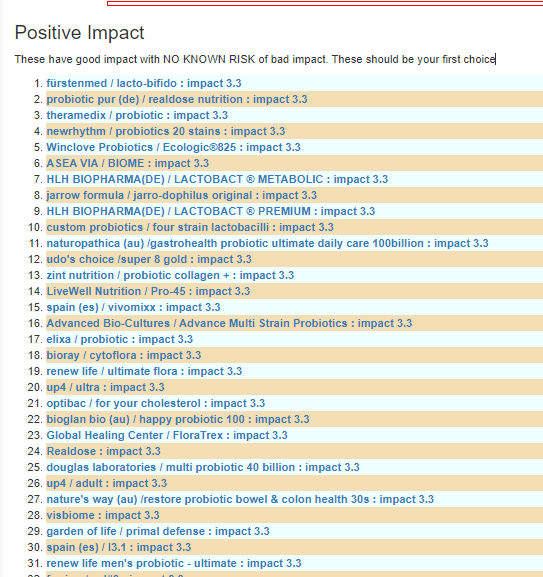
    • Several different probiotics (if you get a mixture — make sure that it is on the positive list. Some species of probiotics will make things worse for some people).

Oops — we forgot antibiotics

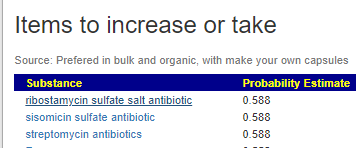
This user had improvement on antibiotics, so which ones are suggested? Back to the suggestion page and checking/unchecking items.

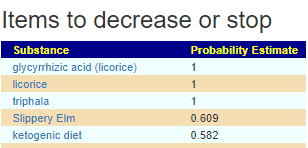
And more important, which ones to avoid!

I must admit that tetracyclines was a surprise, because Dr. Jadin and Dr. Botello had good success with them (70+%). This reader may fall into the 30% that were unsuccessful with that protocol.

As always, to be reviewed with your medical professional before starting. There are algorithm/artificial intelligence generated suggestion based on data that has been entered (usually from gold standard sources).

An Autism Analysis via Enzymes

A reader has been kind and granted permissions to use their samples for another analysis. The samples were done by Thryve, and the FASTQ files processed thru Biome Sight. There was also a GI-MAP result available.

The medical diagnosis is Seizures Lennox-Gastaut syndrome to be exact. And severe low functioning autism. It is suspected/speculated that the cause was vaccine injury.

Enzyme Analysis

First I am going to look at the last sample and then do a comparison to the three prior ones. I am starting to feel that the Enzyme analysis is a good indicator of microbiome dysfunction. It measures thousands of enzymes using the genes found in the bacteria found.

  • Thryve: Literally 139 Items, all HIGH VALUES
  • BiomeSight: 131 items most high with 9 low and 12 low.

Probiotic suggests are only for LOW values (i.e. bacteria that produces the enzymes that you are low in). The list looks similar to prior analysis with lactobacillus paracasei being prominent.


Comparing latest to prior, we found

  • Thryve: Literally 190 Items being outside of the earlier ranges. Some increasing and some decreasing, the general pattern is ones with high ranges are going higher, and those with low ranges are going lower 😦
  • BiomeSight: 36 items all showing lower values than the 3 prior samples

In short, there appears to be a major dysfunction for the enzymes being produced, and it seems to be getting worst.

But…. For End Products, with both samples, there was no change from prior samples. Thryve alone reported possible outliers — all of them them high values (thus no sense in taking supplements for these)

For Bacteria Changes:

GI MAP Report

The following abnormalities were reported.

  • Escherichia spp. – 50% below low bound – Not reported by Thryve or Biomesighe
  • Akkermansia muciniphila – 4700% above high bound (between 30-65%ile on samples)
  • Firmicutes – slightly above high bound (between 20-70%ile)
  • Bacillus spp. – 7800% above high bound (all between 50-75%ile, except for one at 15%ile)
  • Enterococcus faecalis – 8230% above high bound (none reported)
  • Pseudomonas spp. – 132% above (all between 50-70%ile)
  • Streptococcus spp. -2920% above (all between 28%-60%ile)

In short, none of the samples are in agreement with the report from GI-MAP. Personally, I do not have GI-MAP on my reliable/useful lab reports — the above differences are just too troubling.

Approach: Backtrack from Enzymes to Bacteria

These samples are a problem for traditional analysis. Individual bacteria may well be in the normal range, but may be in the high end of these ranges, causing too much enzymes to be produced when a bunch occur at the same time.

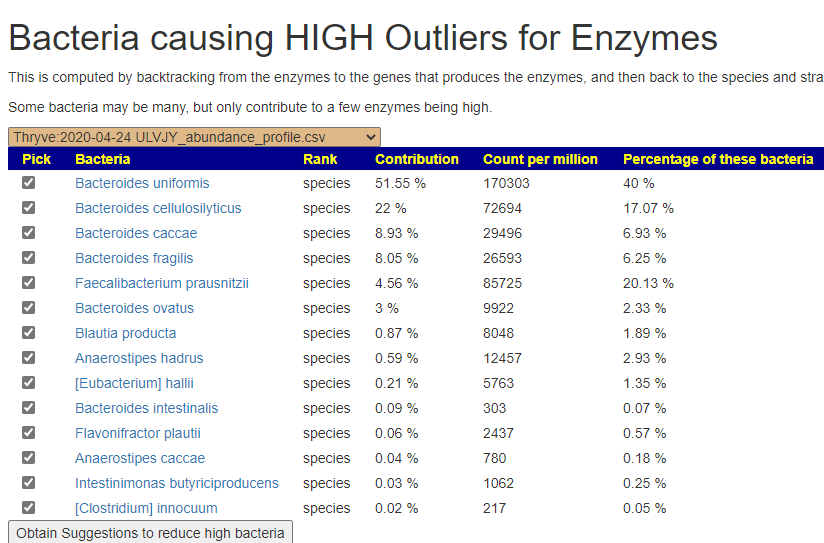
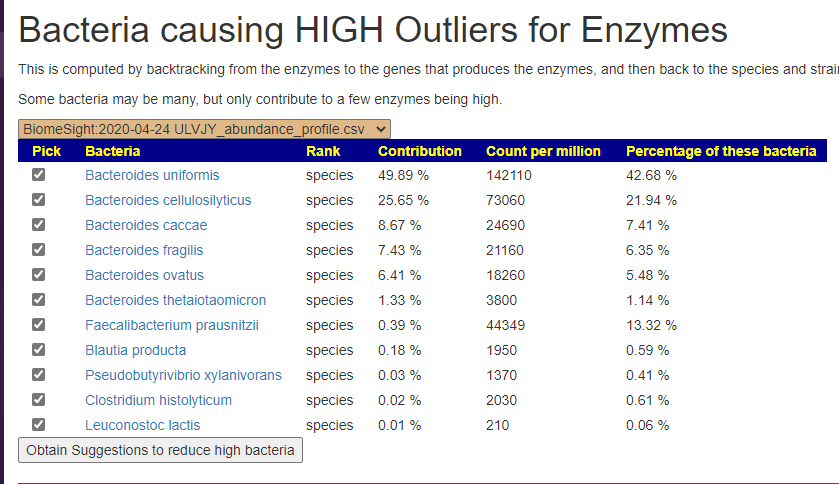
The result was my creating a novel analysis process: Compute by backtracking from the enzymes to the genes that produces the enzymes, and then use these genes to backtrack to the species and strains that have those enzymes. From both labs reading of FASTQ files, we get the same dominant players as shown below. Faecalibacterium prausnitzii was interesting — because of the high count, many will assume it to be a major player… it’s not (remember the counts for this bacteria will be different from each lab).

I then wired this into the existing suggestion system using the hand-picked bacteria approach (all are pre-selected on this page). You will now see a new button on the sample pages.

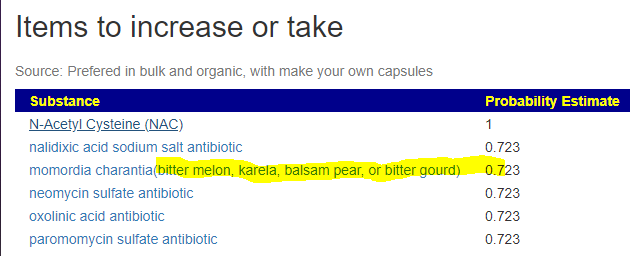
You can then custom tune the suggestions you wish to receive. For example, restricting to drugs and herbs, we have:

Note that the top ones are not prescription nor antibiotics
This is the complete list, we asked for 20 and only got these
There were NO PROBIOTICS suggested

Pass 2

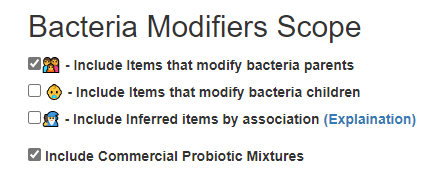
Since we are entirely at the species level, we may wish to include items that modify the genus these species are in. This is a simple change.

Suggestions were very similar without significant changes. Including probiotics, nothing showed a reasonable confidence (i.e. lactobacillus paracasei (probiotics) was a 0.038, I usually stop at 0.5)

Bottom Line

There are many paths for getting suggestions. For this person, the usual paths had been tried before with little success from experts that I know. When I saw the Enzyme madness, I realized that the first goal, a measurable goal in subsequent samples, is reducing these high enzyme levels.

To do this, I had to add more algorithms to the site to allow a backtrace from enzymes to bacteria.

In checking the literature for Epilepsy, I found the following articles which may be worth reviewing

Of interest/concern is that with KD diets, “after KD therapy and revealed significantly decreased abundance of Firmicutes and increased levels of Bacteroidetes.” In this case HIGH Bacteroidetes appear to be the issue, at least specific species, changing the Bacteroidetes species may result in positive results — speculation.

Now going to the other aspect, Autism

My conclusion, for these samples, is that looking at the enzyme shifts lead us back to the same bacteria already identified for autism. What we’ve added is that a contributing factor for autism may be the overproduction of specific enzymes which may lead to alternative treatment approaches. Using this as an assumption, we also can rank order the most important ones to change (i.e. Bacteroides uniformis – links to a list of items that inhibits this specific bacteria)

Recipe book to discussion with Medical Professional

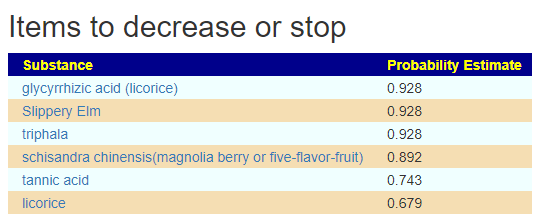
None of the following: Licorice, resistant starch , tannic acid (cranberries, strawberries, blueberries, apricots, barley, peaches, mint, basil, rosemary), stevia, saccharin

Toss up on apples — some of its ingredients may help or make worse. Do as an experiment when he is stable.

Remember this is not medical advice, before doing any changes make sure that you review them with your medical professional. This is what a data nerd logically deduced (showing their logic), and not a qualified medical professional.

Top Microbiome Providers with Discount Codes

For latest codes, see https://cfsremission.wordpress.com/top-microbiome-providers-with-discount-codes/

Using GI Map, Viome and BiomeSight

A reader asked me to take a look at their results from these three. This is not a fun exercise because the data is not machine processable, time consuming and thus prone to more significant errors. The best way to proceed is to use one of these providers.

GI Map Results

The following abnormalities were reported. We cannot get the percentile ranking from MicrobiomePrescription.com because they give counts without declaring what 100% is, it appears to be over 3.3E12 i.e. 3,300,000,000,000, since that is the upper limit for one of the phyla. I attempted on computation below with nonsense results.

  • Clostridia (class) – 200% above their upper limit
  • Enterobacter spp. – 60% above their upper limit
  • Akkermansia muciniphila – 3700% above their upper limit
  • Firmicutes – 29% above their upper limit
  • Bacteroidetes – 29% below their lower limit
  • Bacillus spp. – 433% above their upper limit
  • Enterococcus faecalis – 800% above their upper limit
  • Streptococcus spp. 550% above their upper limit
GI Map reported 9.44e7 out of 3.31e12 as HIGH or 0.0028%, which is less than 99% of other samples!

So, their numbers are useless. We can do manual entry of highs/lows on this page and get very coarse suggestions.

Viome Results

iThis person results shown below are typical for the Viome population. Not better or worst.

I did a tally of their evalutaions:

  • Not Optimal: xxx or 16%
  • Average: xxxxxxxxxxxxxx or 74%
  • Good: xx or 10%
This gives no information on which bacteria are involved or how to improve them

They list the bacteria found but with no percentages or other quantities…

Is this a major overgrowth or under growth — we cannot tell

Bottom Line

IMHO. Viome is not worth anything, at least nothing that can used with microbiome prescription data sources.

Redemption

This person did a biomesight.com test which was one-button-pushed transferred over (thank you Rose again for making life easier for many people).

Starting with Enzyme production,

We get core probiotics suggestions with lactobacillus paracasei again being dominant (as it was in the last posts).

For EndProduct Outliers, we have only one item being low, Urolithins. Nothing under KEGG Module.

Next we look at Core Supplements suggested (these are items that your bacteria may be producing less of due to dysfunction)

GABA, Vitamin B12, and Butyrate are supplement suggestions

Looking at Hawrelak recommended levels we see that Akkermansia is LOW, but GI-MAP reported a massive overgrowth!

Definitely room for improvement here

The next item in my current pro-forma analysis is looking at quick suggestions and the diagnosis specific suggestion. This person’s diagnosis is Rosacea Sub-Type 2 (Inflammatory / Papulopustular/ Acne rosacea) which I do not have in my database. Going over to pubmed to see if there is any appropriate studies, I only found skin studies.

From those and similar, I create a database entry.

Quick Suggestions

Remember, this is done without any reference to conditions or symptoms.

Items to decease were 0.3 or less with high-fat diets being the highest
Apples, Oregano, cinnamon, almond, nuts, fennel, basil, bananas etc were on the Flavonoid Food Suggested

Advanced Suggestions

With the new medical condition and studies added, I no results with the tightest selection and ended up expanding the selection as shown below.

This is what is needed to shift bacteria associated with the conditions in PubMed studies
We see lactobacillus paracasei which the enzyme analysis highlighted greatly as well a B. Longum
Pomegranates, Apples, Oregano, cinnamon, almond, nuts, fennel, basil, bananas etc were on the Flavonoid Food Suggested, similar to above

Bottom Summary

We have two probiotics that should definitely be considered, lactobacillus paracasei and B. longum. Holigos was an interesting item to appear, and I have heard very favorable reports on it. I would suggest getting Vitamin D level, and unless you are in the top 20% of the normal range, supplement appropriately. For other supplements: selenium, magnesium, GABA.

These are suggestions to discuss with your knowledgeable medical professional before starting. Frequently items require to be balanced with other supplement which such a resource may help you with.

I also used the GI Maps results alone with the page cited above and got the following list, with Holigos being at the top. We also see lactobacillus paracasei appearing close to the top of the list.

Analysis of an atypical Crohn’s Microbiome

After the last post on Gene base probiotic selection, another friend asked me to look at her results. I will follow the same pattern as my last post doing an analysis of a ME/CFS person.

The sample was done by Thryve (721 taxonomies identified) and the FASTQ file also processed by BiomeSight.com ( 523 taxonomies identified). This is in the middle range of samples processed there.

Why did I double process? Many people will ask, “Which one is right?” The answer is neither and both. For the technical details see this post from a year ago, The taxonomy nightmare before Christmas… alternatively, see the story of Blind men and an elephant. The description of each gives a better overall understanding.

The most probable predicted symptoms from the microbiome samples are below — they are very correct except for age.

Step 1 – Enzymes Issues

As in the prior post, we will show both processing of the data.

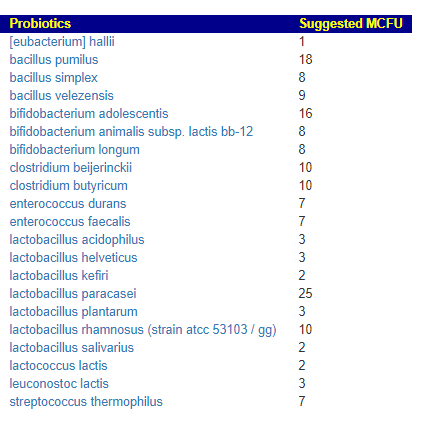
From this we click the button on the bottom and get the two lists below. For one item we have 5 items —lactobacillus paracasei has a count of 5 indicating that it helped 5 of the 15 enzyme aboves. In other words, this is the highest priority probiotics.

In comparing the two sets of suggestions, we see some similar items with a count of 3/3 or 15/15. These are probiotics that produces all of the low enzymes

Clostridium butyricum and streptococcus thermophilus are also the ones we had strongly recommend in our last post for a ME/CFS patient (which has some symptom overlap with this person).

Using Quick Suggestions, we see that the probiotic containing b.pumilus was rated as a should be take

Comparing Core Supplements

This is based on the end products data (similar to enzymes but done by manual review and entry — so more incomplete).

This a interesting:

Remember: In no aspect do we have complete knowledge — only fragmentary information.

Advance Suggestions – Filtered by Crohn’s

As we did with ME/CFS, we filter to the official diagnosis

The above settings is not to find all that is wrong, rather just the most significant to give a focused target.

Again, we will do side by side analysis with a threshold of 0.5, rounded (to be consistent with the last post)

I extended this to lower numbers to show the overlap of suggestions created by both samples

We see this probiotics is tied with 3 others for first choice.

Probiotic Suggestions

Again, we have overlap — often with the same impact estimates seen

Flavonoids

Here, we almost have identical lists with Flaxseed, meal on both, and Cumin – on just one

Bottom Line

The reader can go to the site and make the same advance suggestions pick shown above. I could go off into more complex analysis approaches, but this gives a solid starting protocol.

What we have discovered is that there is general convergence of suggestions from the two different processing of the same sample. Neither is clear better. A user has two main paths: go with items that only both processing are suggesting, or go with the super-set (merge combination).

One path is to do the items in agreement for 3 weeks and then add in the superset items for 3 more weeks. After 6 weeks, I would usually recommend a new sample to see what has changed.

Looking at common outliers

This person has multiple samples processed by biomesight (most are from ubiome), and we can see persisting commonality

The results are similar to those seen for the last sample.

Looking at this sample versus the prior samples, we see some changes. For example, L-lactate dehydrogenase has decreased which implies lactic acid increases (and thus cognitive issues — which agrees with reported symptoms).

We also note an increase is a few items, like diadenosine hexaphosphate hydrolase (ATP-forming). This increases production of ATP (adenosine triphosphate). As often happens, our knowledge of these enzymes is often limited and evolving (Work on ATP resulted in a Nobel Prize in 1997), so we are still on the learning curve. We can identify issues but may not know the meaning or consequences of the issues.… IMHO, we should strive to reduce abnormal enzyme levels.

I have a concern — the microbiome, especially in terms of enzymes, has not changed that much. This may be due to lack of consistency, or the dosages being too low to alter the status quo.

Dosage Problem

In general, dosages / amount of supplements needed is unknown. For ME/CFS, I have tracked down some dosages from human studies but in general, ideal dosage is a mystery. This is compounded by some people almost taking a homeopathic attitude. “Well, all of the items listed are in my one-a-day vitamin. The suggestions did nothing for me!” The same person’s lab test for Vitamin D will show very low (instead of being around the 95%ile, the level I advocate for ME/CFS patients) and they will cite that “I drink milk with Vitamin D, and my one-a-day also have it! I take Vitamin D !!!!!!!”

The reality is that the absorption of Vitamin D depends on gut bacteria and decreases with age. Studies have shown that to get up to mid-range for people in care homes, often 15,000 IU/day is needed. Mayo cites an RDA of 800 IU/day at present, twice the earlier RDA.

This issue can become even more complex. They may take a B-100 because it has all of the Vitamin B recommendations — unfortunately, many of the fillers in it are in the not recommended list. This happens very often with probiotics: people focus on a mixture having most of the recommended probiotics and assume that the others included and the prebiotics included will do nothing or be helpful.

For the person above, look at their avoid list!