Analysis of a ME/CFS Microbiome

After the last post on Gene base probiotic selection, an old ME/CFS friend asked me to look at her results. Usually I avoid doing individual analysis (not enough time) but when it comes to ME/CFS — I tend to make an occasional exception because of the severe cognitive challenges.

The same was done by BiomeSight.com and had 777 taxonomies identified. This is in the high end of samples processed there. My personal observations of ME/CFS is that over-diversity is a characteristic of ME/CFS

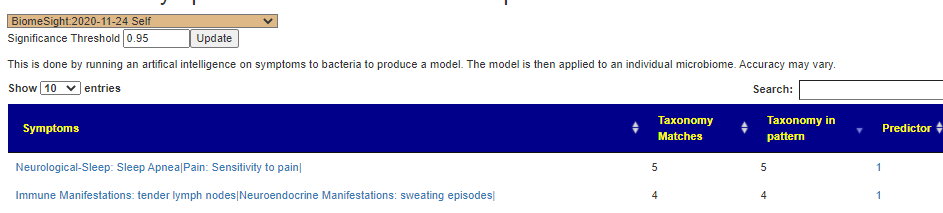
The predicted symptoms from the microbiome sample are below:

We have a gender correct matching

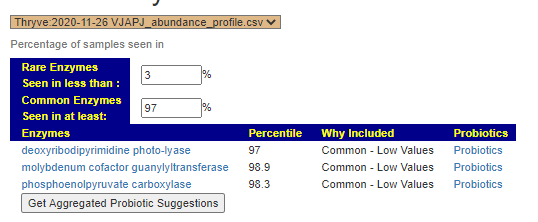
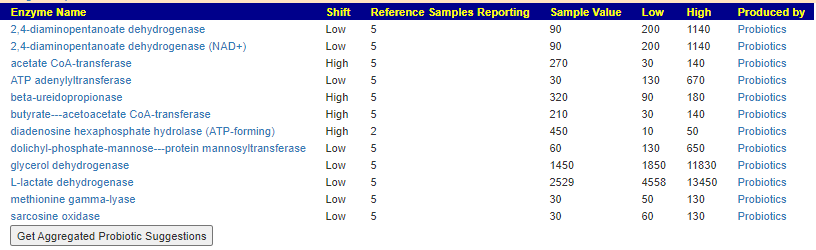
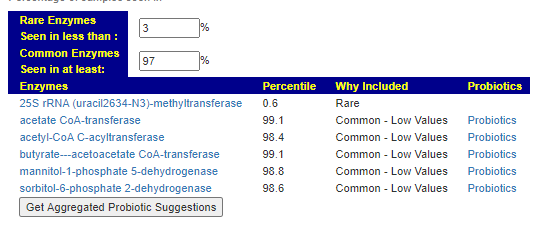
Step 1 – Enzymes Issues

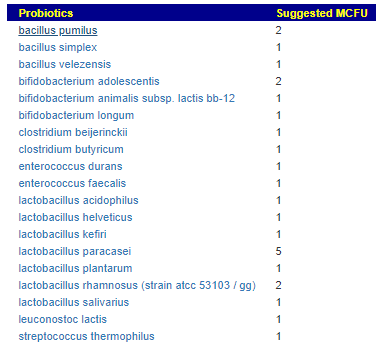
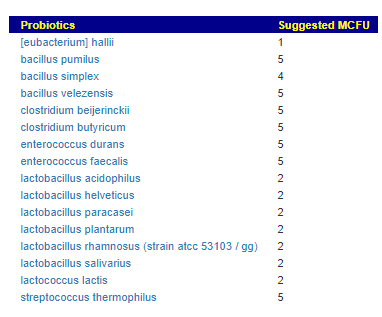
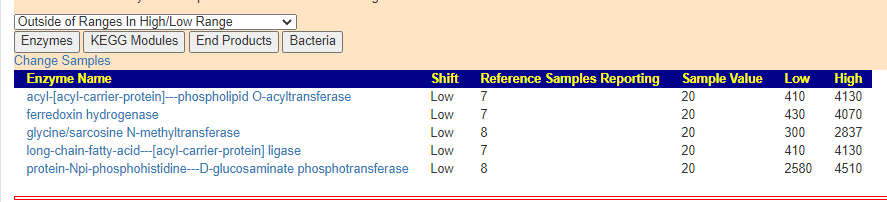
From this we click the button on the bottom and get the list below. We have 5 items above and lactobacillus paracasei has a count of 5 indicating that it helps every enzyme above. In other words, this is the highest priority probiotics.

Note that clostridium butyricum and streptococcus thermophilus were also the top suggestion for another ME/CFS person. See this post

Let us see what is suggested by other routes.

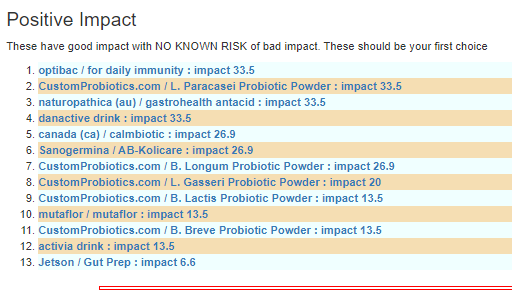
Using Quick Suggestions, we see it has a positive value

Net Factors/ Take Factors/ Avoid Factors

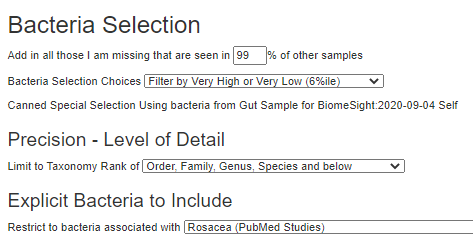
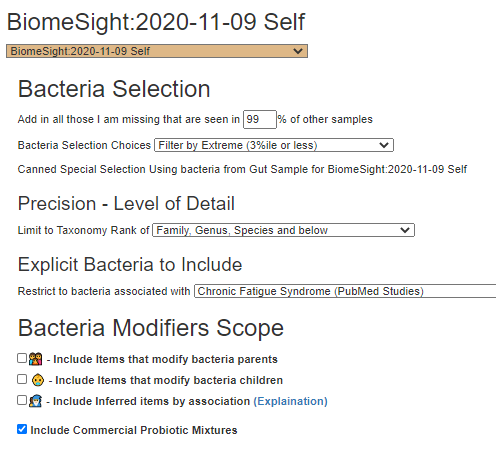
Going to Advance Suggestions and filtering to bacteria associated with ME/CFS (as shown below)

We see this probiotics is tied with 3 others for first choice.

What this suggests is that the enzyme route for probiotics agrees with other paths. The only thing they have in common is the microbiome that they are working on. The logic and algorithms for each is totally different and use different data with no overlap. Many of the enzyme suggested probiotic species lack any significant studies so they do not appear in the usual suggestions list (because those are based on pubmed studies only). My gut feeling is that these enzyme suggested probiotics are very likely good choices.

Other Suggestions

I often cut suggestions off at a probability estimate of 0.5. The main reason is to stop information overload and over-complexity in life and supplements.

Many of the above items are typically recommended for ME/CFS

Flavonoid Foods Suggested

Apples, Coconut, Almond, oolong tea and buckwheat are the de-duplicated list over 0.5

Bottom Line

The reader can go to the site and make the same advance suggestions pick shown above. I could go off into more complex analysis approaches, but with the intended reader having ME/CFS, it is more likely to confuse.

What we have discovered is one particular probiotic species is well recommended by two different paths.

This happens to be the only probiotic strain in DanActive which I believe is available where she lives. Read more in this pubmed study. Note “Study patients received a probiotic yogurt drink, Danactive® (Danone, Boucherville, QC, Canada) containing 10 billion cfu of Lactobacillus casei sp. Paracasei CNCM I-1518 (formally DN-114 001) ” It is sometime cited in the advertising as Lactobacillus casei. At the gene level there are a few differences between generic L.Casei and L. Paracasei. The Enzyme recommendation was done at the gene level.

There is a question of potential dosage, above we have 10 BCFU cited. My usual probiotic supplier, CustomProbiotics.com recommended adult dosage is 320 BCFU. From the above study, we know that 10 BCFU is sufficient to get some results — the question is unclear on what dosage is needed to have a significant impact for ME/CFS.

The reader got back to me, because she has this sitting on her shelf.

No description available.
Both the probiotic and also the Vitamin C suggestions

Gene based Probiotic Suggestions

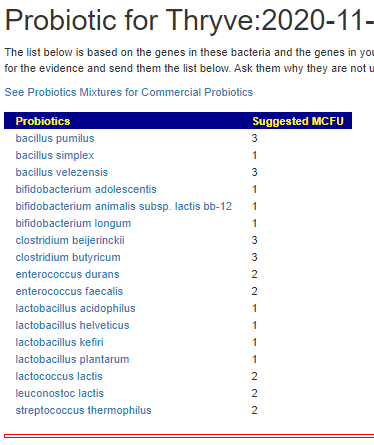
Using the KEGG: Kyoto Encyclopedia of Genes and Genomes, I have implemented suggestions based on the enzymes being produced according to your microbiome results on MicrobiomePrescription. If you are far below normal for production of one of the enzymes, then we lookup which probiotics also produces those enzymes from those known to be commercially available (our current master list is here – some may not be available in your country). The result is a probiotic mixture that should, theoretically, help to increase those enzymes and reduce symptoms.

To use this tool you need a uploadable report from one of the companies listed here. Note: NirvanaBiome.com uses CosmosId and thus may also be used.

Example on my last sample:

It was interesting that this list is similar to those produced by the AI engine for the same sample.

In some cases, there may be none. If there are no low level, there is nothing to increase. The probiotic suggestions are available enzyme by enzyme, or aggregated across the complete sample.

Where do you find this information? There may be up to three places, depending on how many samples you have.

At the bottom there is a button for the aggregate, and on the right, a link for individual enzymes.

Have fun! Be Safe!

A video walkthru

Microbiome Comparisons

Over this weekend I deprecated my earlier comparison tool and replaced it with more comparisons. To use this tool you need at least three samples uploaded. The comparisons available ate:

  • By Bacteria
  • By End Products
  • By Enzyme production
  • By KEGG Module

Purpose or Usage

The intent is to address the following two needs (there may be more)

  • You want to see what has changed from your prior samples. Typically, to see improvement or deterioration.
  • You have an individual with challenges and have other samples from your microbiome bubble.
    • People with shared DNA are part of your bubble
    • People eating the same diet (i.e. family meals) are part of your bubble
    • Conceptually, people with the share medical conditions could by part of the bubble. My observations is that these people should have the same symptoms not just the same diagnosis.

There are four methods of comparison of one specific sample against a collection of reference samples.

  1. Values outside of the values of the reference sample
  2. Values outside of the values of the reference sample increased by one standard deviation up and down
  3. Values outside of the values of the reference sample increased by two standard deviations up and down
  4. Values outside of the values of the reference sample that are also in the extreme compared to other samples uploaded (top or bottom 3-6%)
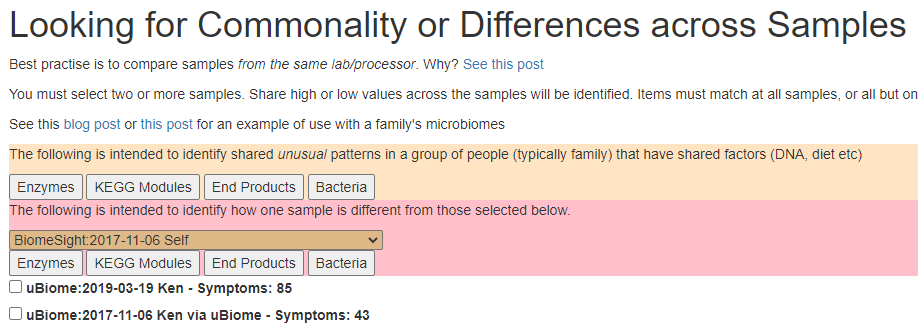
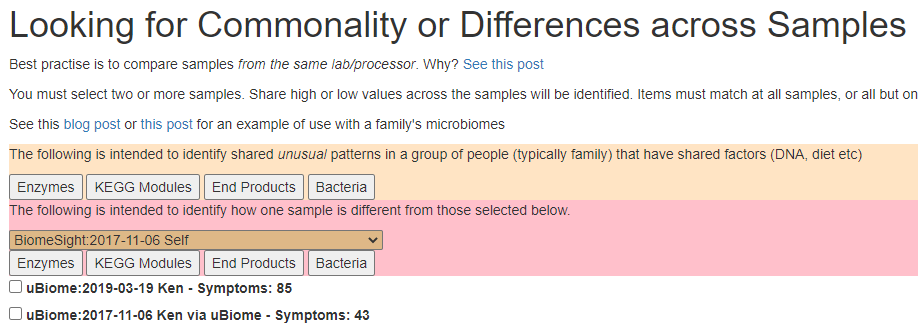
Select the reference below the buttons, pick up the one to compare to above and then click one of the buttons

Bacteria

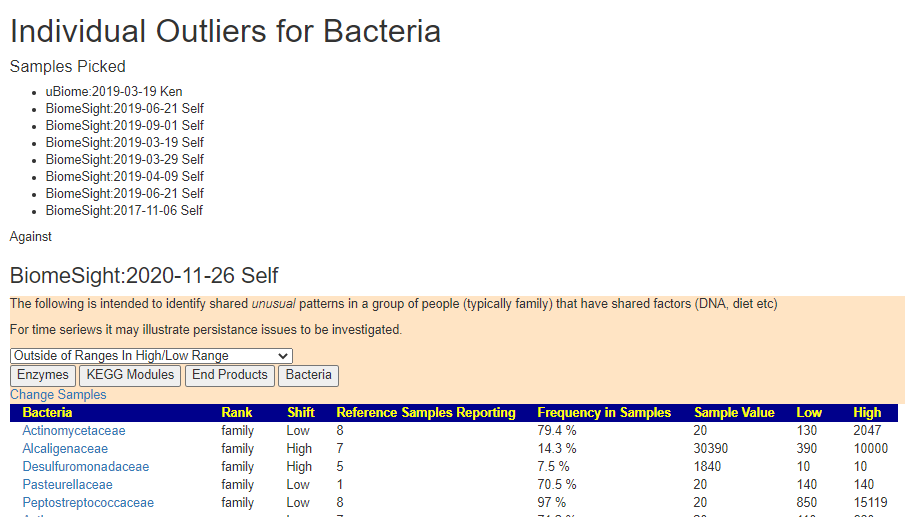
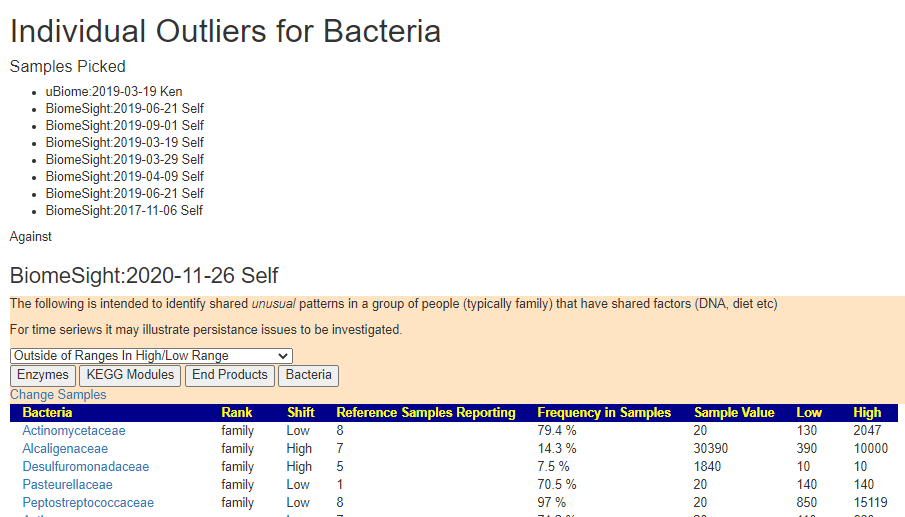
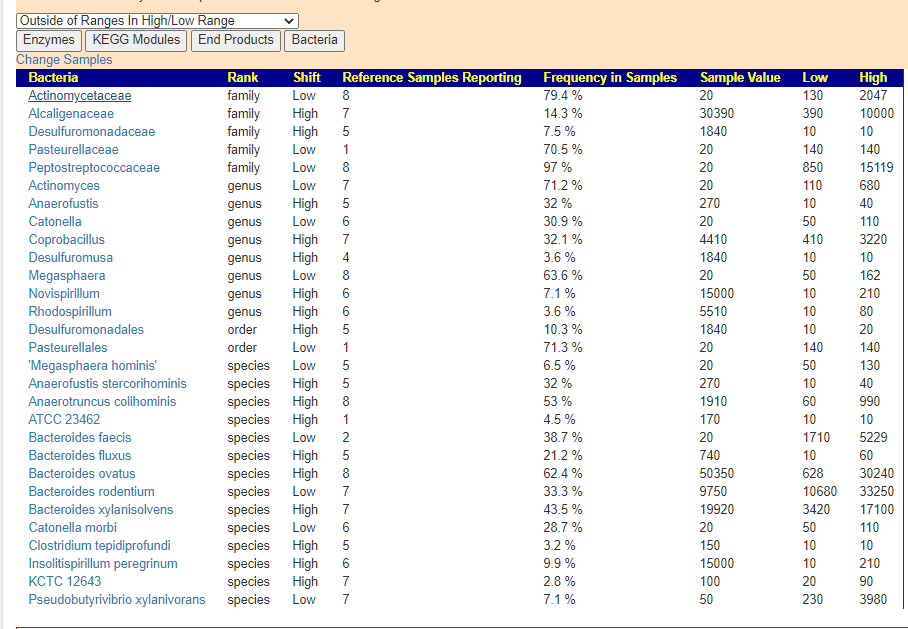
I picked several prior samples and my latest sample for comparison. Note that Reference Samples Reporting if less than all (in this case 8), it means that there were some zero values (and thus, you may wish to ignore shifts being low for those).

I tried different method and was surprise to see a long list of bacteria that have readings very different than than prior samples and also extreme values.

Note: The high and low thresholds are listed and your current values. You may need to use judgement if something is a significant change.

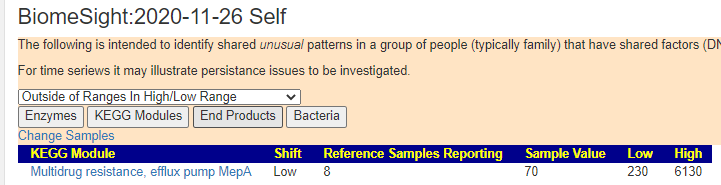
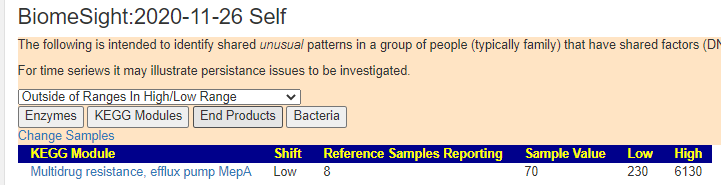
KEGG MODULES

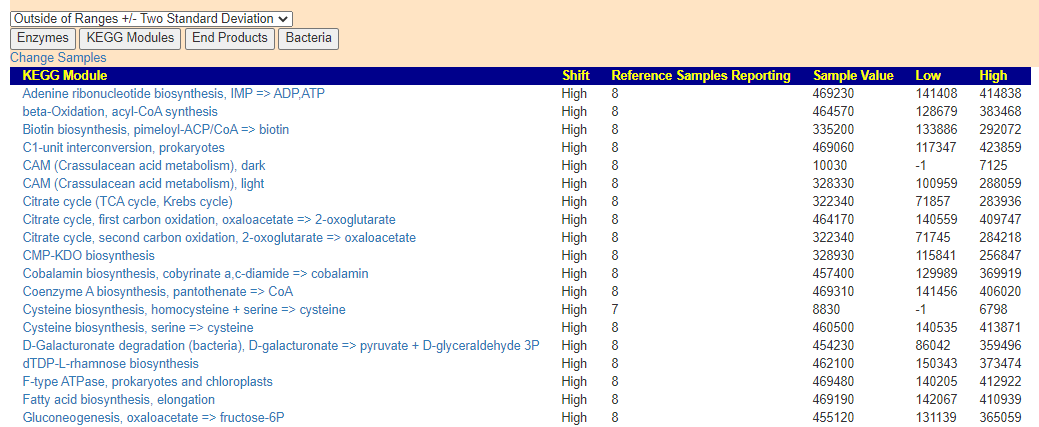
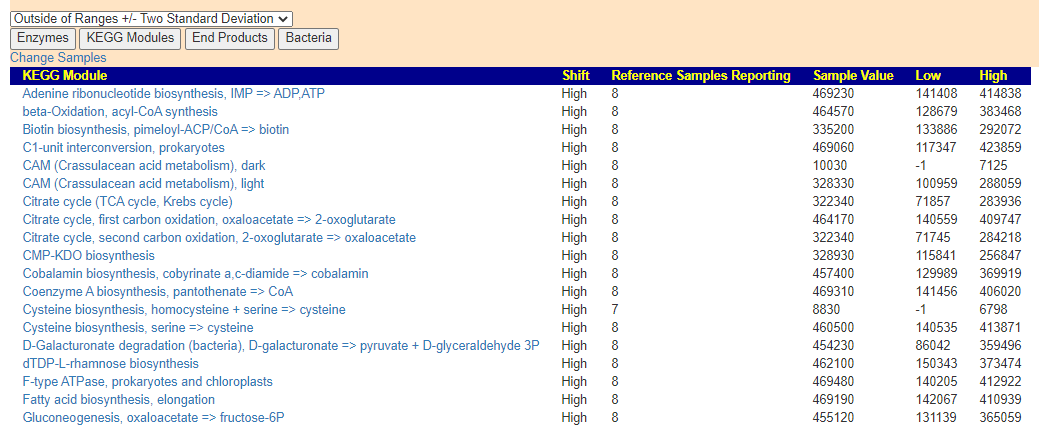
When I want to see just what shifted without restricting to high/low values also, we get a much bigger list.

End Products

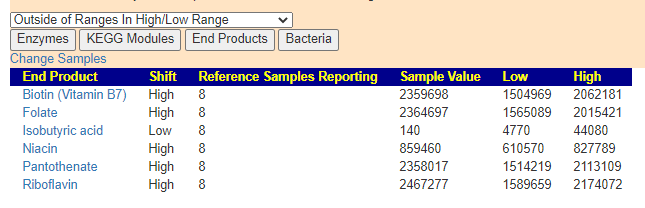
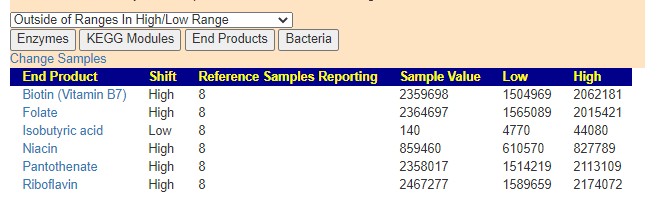
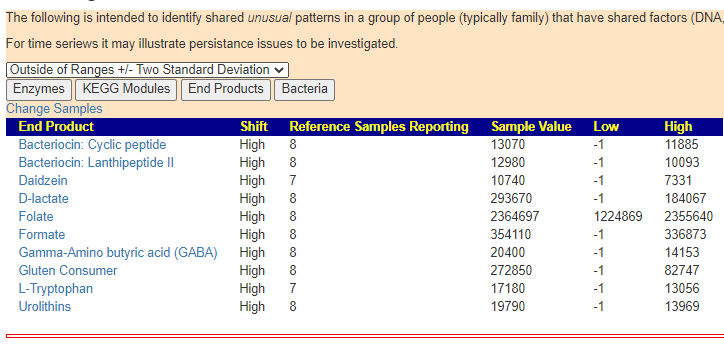
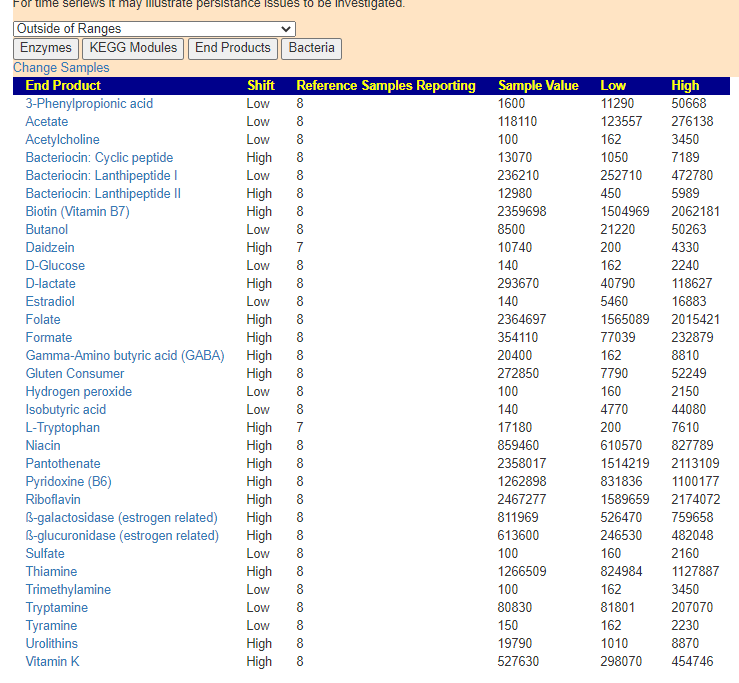
Changes that also pushed values into top and bottom of ranges
Things that significantly changed
Items with some changes

Enzymes

Change with values going to extremes

When I look at changes in general, the list became massive…

Bottom Line

This tool gives information on what changed… what it means and what to do with it is a different question. At the moment, I would suggest reading and researching items that seems to be major. The microbiomeprescription.com site gives suggestions on modifying bacteria numbers.

A family case study: DNA + Microbiome

This is an analysis of a parent with two children with a mixture of challenges. A person’s microbiome and their DNA appears to be related. Ignoring studies, it makes logical sense. The DNA favors certain metabolites, which favors certain bacteria — and the reverse.

Perturbations in the gut microbiota have been linked to atopic diseases. However, the development of atopic diseases depends not only on environmental factors (like microbial stimulation) but also on genetic factors.

Host-microbial interactions in childhood atopy: toll-like receptor 4 (TLR4), CD14, and fecal Escherichia coli [2010]

The family:

  • P – Parent:  No ASD, nor CFS.  No current IBS (I had IBS symptoms 2003-2012). Sample: BiomeSight
  • A : ASD/CFS Sample: Thryve, FASTQ processed thru BiomeSight
  • B : No IBS.  He had SIBO in 2017. Has been in remission from PANS for about 1 year prior to sample. Sample: BiomeSight

They live in the same household with similar meals.

Looking for Family Shifts

I looked first for bacteria that were high (top 6%) or low (bottom 6%) across multiple samples and found some interesting patterns:

Items like Limnobacter and Amoebophilus really jumps out. They are rare, so the odds of 2 people at random having them and both being in the top 6% is about 0.002%. Adjusting for BiomeSight samples only, the odds decrease but still less than 1%.

Tissierellia and Faecalibacterium were high in all three samples.

The unfortunate aspect is that of these 4 bacteria, we only have significant data on how to reduce Faecalibacterium. Checking PubMed on Limbobacterm, we see barely 40 studies with the count being low in Parkinson’s disease [2018]

End Products Shift Shared

Applying the same criteria for End Products being produced, we have d-lactate being #1. This is common with CFS and I have written about it before (see posts below). It is also likely common with ASD.

For which bacteria produces which end products, see this page. I have on my backlog of features a page that makes suggestions based on end products to be shifted only. At the moment, it’s a manual process of hand picking bacteria.

KEGG Module

Here, we will use top and bottom 3% since we have a lot more categories to examine. We found no shared items.

KEGG Enzymes

Here, we had only one hit.

Bottom Line

The intent of this post was to look at commonality over a genetic related group of people living in the same house and likely eating the same diet.

For individual suggestions by person, I would advocate doing a hand picked taxonomy and working from there. For the child with ASD/CFS, I went and did that with their sample

The resulting suggestions are shown below:

Items to take are low in values, thus items to avoid is of greater importance
Many of the above would be “internet myth” as being good to take blindly.

As always, these are suggestions that should be reviewed with your medical professional before doing. They are items believed to have better odds of making favorable changes than picking random items to try.

Future Pages

Most of the analysis above was done via ‘the backdoor’ and not available yet on the web site. The analysis code is written, it’s just a matter of getting time to create and test the pages.

Microbiome – Suggestions

This is the third post dealing with my latest microbiome results. The prior two were:

The results of the above review put my focus on three items

  • Reducing bacteria associated with high blood pressure
  • Reducing bacteria associated with BMI/obesity
  • Increasing Bifidobacterium — which largely disappeared with the last CFS/ME flare.

Suggestions

Quick Suggestions

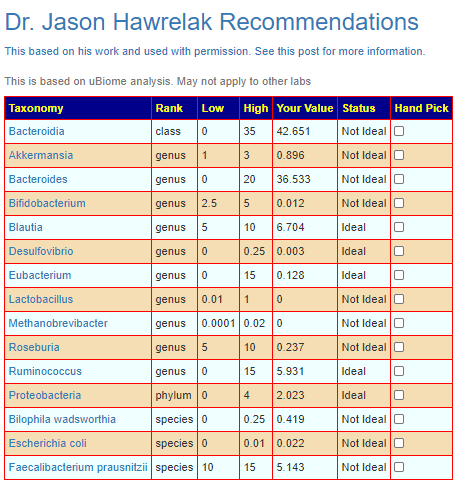
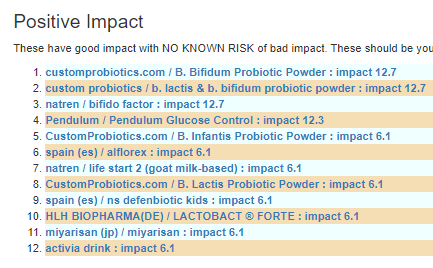
If I was new to the microbiome or not sure what to do, I would have gone with Quick Suggestions. This restrict the changes to Dr. Jason Hawrelak Recommendations; based on his work and used with permission. See this post for more information.

The suggestions are below. Many of which I am already doing.

All items to avoid was down at 0.261 or less, so I excluded them

The high priority probiotics are below

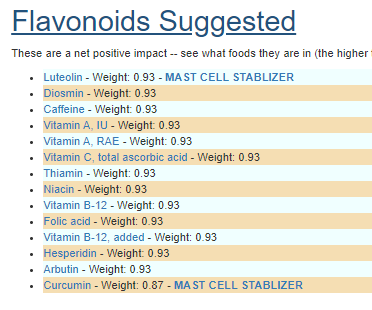
Based on foods containing desired flavonoids

Targeted Suggestions

Target suggestions means hand picking the bacteria and then getting the suggestions based on that specific subset.

Obesity – Medical Literature

Where you find this

This is easy to do, just go to the page and check (under include) the items and then click [Create a custom suggestion profile…] button

I now do the same for high blood pressure. I am not surprised to see only one item because I have been using supplements shown to reduce blood pressure for a few months (see Hypertension – What we know)

Last item was Bifidobacterium … I do not need to do anything because it is included in the lists above.

Getting Custom Suggestions

Once you have hand picked items, a new drop down appears as shown below.

You can review what is in the hand picked suggestions, your values and the values seen from others.

With Quick suggestions, the items below were pre-selected. You can modify them as you wish

Hand Picked Suggestions

The suggestions are generally similar but a few new items appear and the weight of some items have moved up or down.

What is different is that some items were above 0.4 in the avoid list:

Some of these items I am/was taking

The list of probiotics changed significantly

Notice the addition of specific Bifidobacterium probiotics

Flavonoid Foods are similar but cinnamon, nutmeg, and oregano are gone.

The list of Flavonoids is much larger and contain several supplements.

Bottom Line

I will be working off the handpicked taxa suggestions because they are more likely to be effective for my three goals.

The more focused (the fewer the goals, the better the suggestions should be because there is less noise).

Barley porridge with soy or almond milk and walnuts will likely be my standard breakfast for a few months. I have ordered B. Longum and B. Infantis from CustomProbiotics which is by far the cheapest BCFU per $, but IMHO also superior because it is pure with no additives or other species. For other sources see this post – remember to cost out BCFU per $, you may get some wallet shocks!