Any role for Lithium?

A reader asked me about this element today. I know that the abundance or absence of some minerals/elements have health impact. A simple introduction is here. A quick summary of interesting studies is shown below

Problems

Lithium increases hypothyroidism [2020] [2020], unfortunately hypothyroidism is common with ME/CFS [2019]. This makes it a high risk experiment if thyroid levels are low. Zinc supplements may reduce the risk [2017]

It’s known impact on the microbiome is below (and has been added to the analysis site)

” Lithium, valproate and aripiprazole administration significantly increased microbial species richness and diversity, while the other treatments were not significantly different from controls. At the genus level, several species belonging to Clostridium, Peptoclostridium, Intestinibacter and Christenellaceae were increased following treatment with lithium, valproate and aripiprazole when compared to the control group. “

Differential effects of psychotropic drugs on microbiome composition and gastrointestinal function [2018]

“Bacterial richness was increased in both treatments compared to vehicle-treated animals; moreover, at the genus level, lithium increased the relative abundance of Ruminococcaceae and decreased Bacteroides

Psychotropics and the Microbiome: a Chamber of Secrets [2019]

Bottom Line

It appears that Lithium was tried on ME/CFS patients a few decades ago [See the old egroup CFSFMExperimental posts on the wayback machine). We can infer that the results were not significant on the patient population as a whole. On the flip side, it does appear to have positive neurological impact for select conditions, with some risk. For Autism where it is known that the SHANK3 defect is present, we need a well constructed study to determine the benefits to risk factors.

Fecal Matter Transplants and Phages

FMTs have been tried for Chronic Fatigue Syndrome/ME with mixed success. The why of failures has been an ongoing interest of mine. We may now have a significant factor that has been ignored in these attempts.

 Fecal microbiota transplantation (FMT) as a special organ transplant therapy, which can rebuild the intestinal flora, has raised the clinical concerns. It has been used in the refractory Clostridium difficile, inflammatory bowel disease, irritable bowel syndrome, chronic fatigue syndrome, and some non-intestinal diseases related to the metabolic disorders. But this method of treatment has not become a normal treatment, and many clinicians and patients can not accept it. 

[Research progress of fecal microbiota transplantation] 2015

This week’s Economist had an extended essay on Viruses and the like: The aliens among us/The Outsider within, this provides good background.

In addition to this, there was a podcast reporting success with FMT was associated with higher Phage Diversity in the donor. Phages are the police of the microbiome.

In this retrospective analysis, FMTs with increased bacteriophage α-diversity were more likely to successfully treat rCDI. In addition, the relative number of bacteriophage reads was lower in donations leading to a successful FMT. These results suggest that bacteriophage abundance may have some role in determining the relative success of FMT.

The success of fecal microbial transplantation in Clostridium difficile infection correlates with bacteriophage relative abundance in the donor: a retrospective cohort study (2019)

My earlier posts on FMT

Bottom Line

This implies that for a greater chance of success and less risk, than DYI fecal transfer, that a lab that tests for possible infections AND for phage state may yield the best results.

Microbiome Symptom Cascade

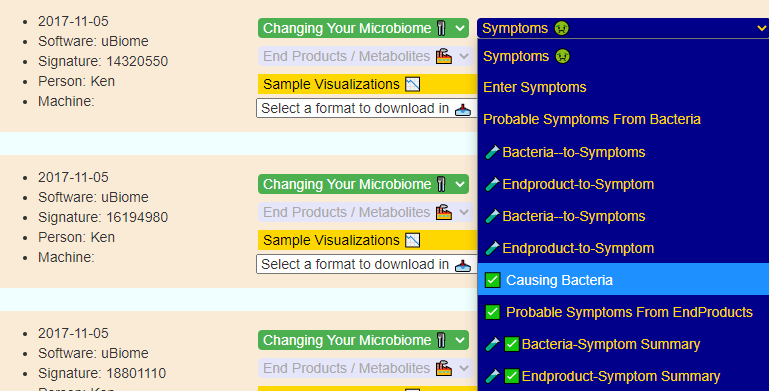
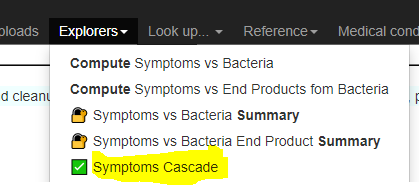
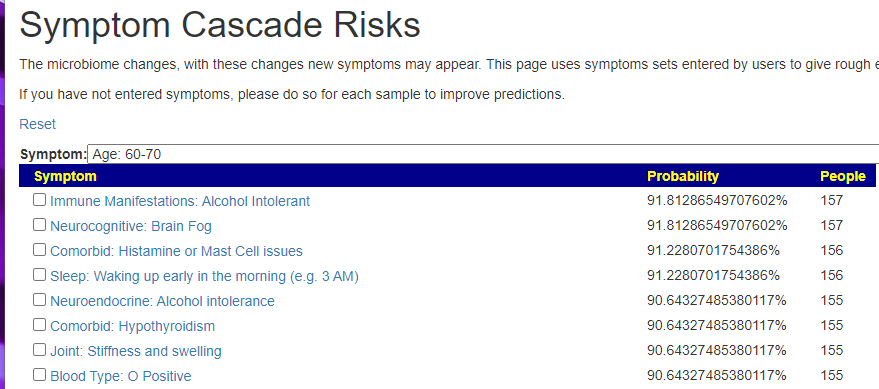
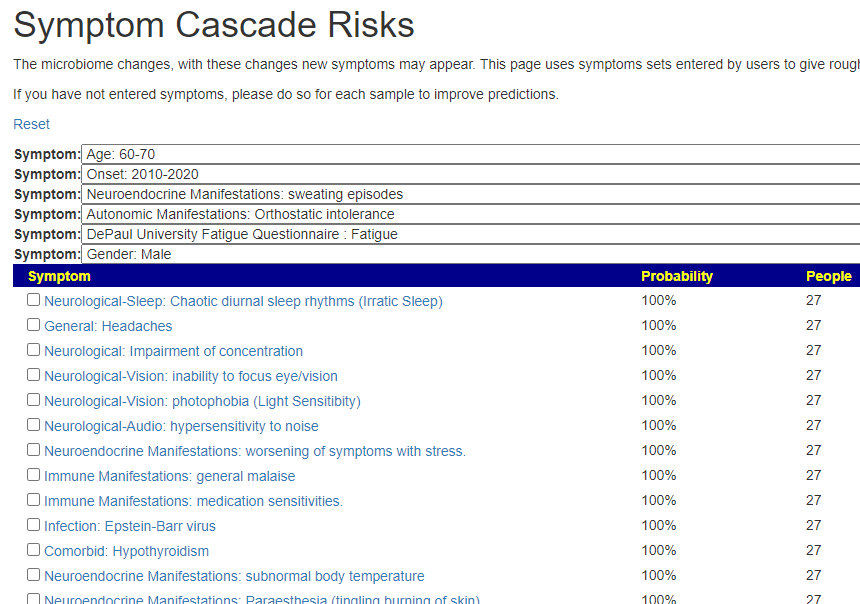
I just pushed a new page. The model is simple: as the microbiome changes, these changes may cause new symptoms to appear. I have personally seen this cascade in people around me. This page uses symptoms sets entered by users to give rough estimates of what may be occurring next. In some cases, seeing the future may encourage pre-emptive actions today.

https://www.microbiomeprescription.com/Explorer/SymptomCascade

The process is simple, pick an initial symptom in the drop down.

For the symptoms below, just click the one that you have also. This will build up a list symptoms and a qualified list of predictions.

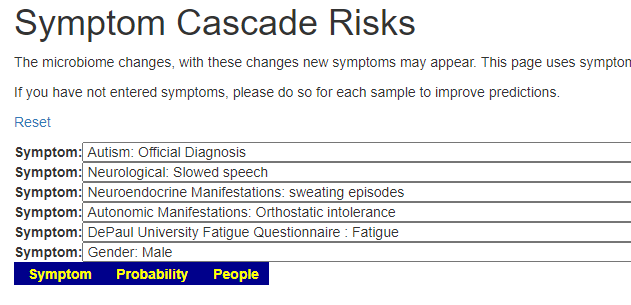
You can change any selected items… in some cases, it may result in nothing being shown.

You can reset to the top one only, or modify what is shown (more or less)

Click Reset to return to just one symptom.

Digging down to the bacteria pattern

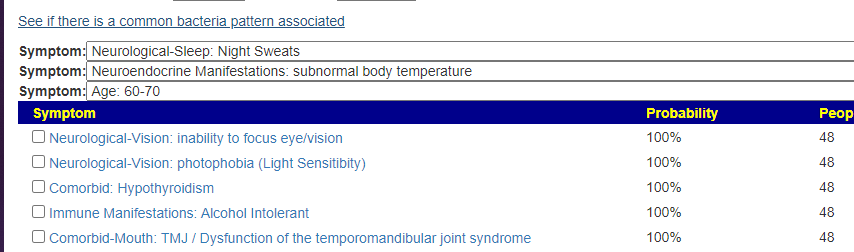
As you build up a collection of symptoms, you can quickly determine if there is a bacteria pattern associated. There is nothing gained from adding a 100% item to it…. it means that everyone is the subset has those symptoms so it is redundant. You want to add items that are less then 100%, ideally a symptom you have with the lowest probability.

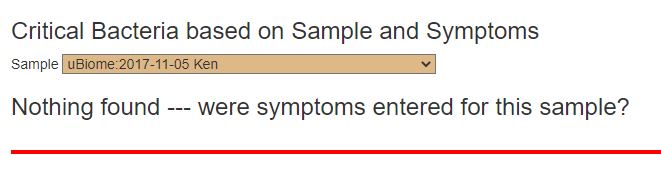
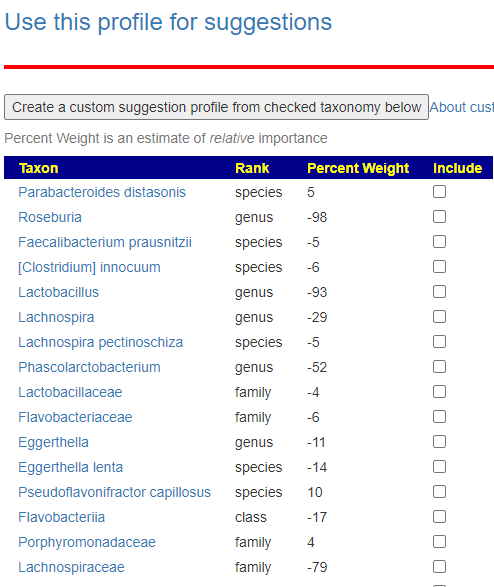
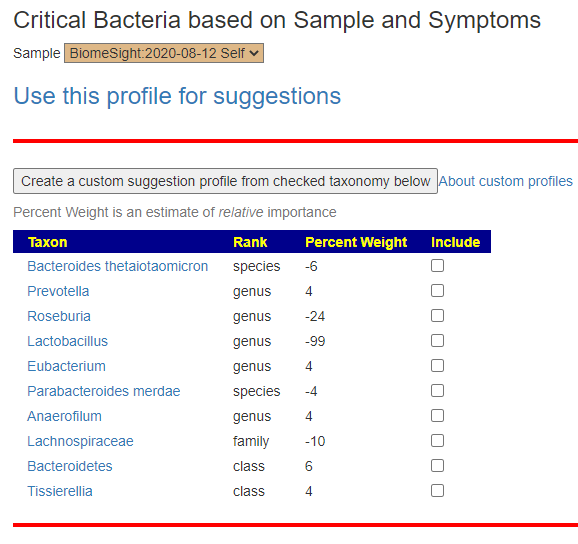
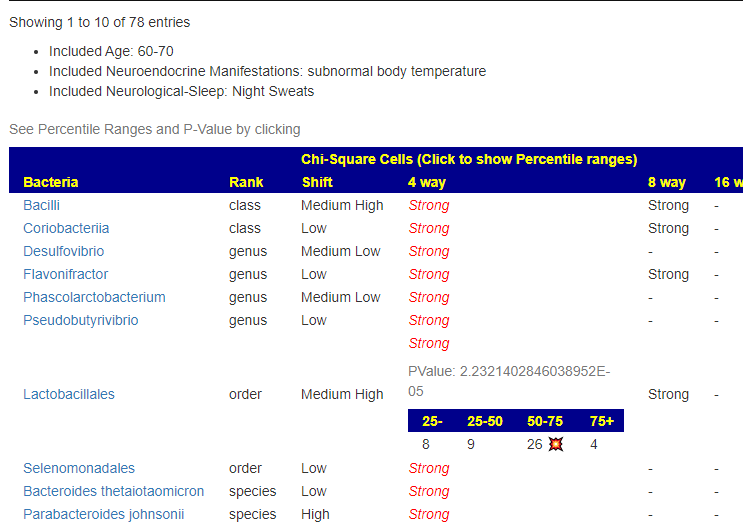
This transfers your selection across to the page that does statistical analysis on the associated bacteria, as shown below

Accuracy of Prediction depends on YOUR Symptoms being added!

I know there is a “bias” in the data because we do not have an ideal population of samples and symptoms to work from. This page uses what we have, I believe the prediction is better than what a typical medical professional would suggest.

It can be made better by people adding more microbiomes and associated symptoms to the database. This is Citizen Science.

The problem with “normal ranges” from Labs

I have a M.Sc. in Statistics and roll my eyes with the ranges being given by most commercial labs. I know precisely the process that most are rote-following:

To set the normal range, take samples from a group of people with no known issues. Compute their average and standard deviation. Abnormally low is average – 1.95 standard deviations and abnormally high is average plus 1.95 standard deviations.

Other approaches use just 40 people with the values of the 2.5%ile and 97.5%ile being used. Unfortunately, with 40 people that becomes the lowest value and the highest value. At both ends, that is a volatile number 😦

My goal with MicrobiomePrescription is to show the numbers from over a thousand samples and let people determine if the numbers are actually unusual by visual inspection.

What should be seen is illustrated below. The average line should be close to the 50%ile with this large of a sample. Two views are usually best.

The log view will give a straight line usually. Where it is not straight, we may have a problem. In this case, below 10%ile is suspect, below 5% is suspect. Over 92%ile is also suspect.
Looking at actual numbers or percentage, gives you better numbers. A typical range is from 35% to 72%

Atypical Bacteria

This bacteria is only reported by one lab, Ombre Labs was Thryve Inside. If is actually is a sibling to Bifidobacteria genus, both are children of Bifidobacteriaceae.

For another bacteria, we have the average a long distance from the 50%ile and we see what looks like three patterns — each with their own straight line (and not one like above). To get the true 50%ile (including those with zero count) it’s (50+38.2)/(100+38.32 [for Zeros]) = 63%ile on the chart.

The apparent area of concern is the 50%ile above, and issue may be 60%ile
Translating to percentage, Over 0.3% may indicate atypical amounts.

Is it bad to be atypical? If there is not a medical condition or illness associated with it, then likely not. Variety is the spice of life, and the reality of the microbiome.

Some Extreme Examples

For this bacteria, having the average or higher is suspect, factoring in the zeros, we have the average actually being the (82+40)/(100+40) = 87%ile. Visually you can see that things are not looking good.

Bottom Line

Bacteria have a wide variety of growth patterns. Without inspect of the distributions and related information, you may either assume that there is no problem (because the lab ranges are poor — a false positive), or there is a problem when you may have 40% of people have less or more than you (– a false negative).

Do not expect labs to look at the distributions — they only have time to print the numbers and give a canned interpretation. For the microbiome, a canned interpretation is dangerous because of the impact of diet can have. I have oatmeal for breakfast every day, dark 100% rye sandwich for lunch, indian food with chicken for supper. I am pretty much wheat free… and that absence will shift my microbiome greatly.

You have to look at them yourself. You can look up most bacteria reported by labs at this URL: https://microbiomeprescription.com/Library/Lookup

Drill down into Irritable Bowel Syndrome

I am reasonably complete in updating the database. If you know of any substances not shown below that have published peer review studies (a.k.a. PubMed) please email me with links so I may update it.

IBS is often concurrent with ME/CFS and FM.

The drill down page requires you to login. Which means nothing more than going to the login page, enter your email and wait for a login link to arrive in your email. The page is below for those who do not wish to login … my comments continue below it in “Review”

Irritable Bowel Syndrome

This list modifiers reported for specific conditions with links to studies.

Some of the items listed as improving may have inconsistent results from studies. It is recommended that the studies cited be review before considering any change.

ModifierImpactCitations
aloe veraCan cause/Worsen1
aloe veraImproves/Treats1
bacillus coagulans (probiotics)Improves/Treats8
bifidobacterium (probiotics)Improves/Treats1
Boswellia serrataImproves/Treats2
clostridium butyricum (probiotics)Improves/Treats4
enterococcus faecium (probiotic)Improves/Treats1
Human milk oligosaccharides (prebiotic, Holigos)Improves/Treats2
hypericin(St. John’s Wort)Can cause/Worsen1
lactobacillus plantarum (probiotics)Can cause/Worsen2
lactobacillus plantarum (probiotics)Improves/Treats2
lactobacillus rhamnosus gg (probiotics)Improves/Treats4
l-glutamineImproves/Treats1
low fodmap dietImproves/Treats13
mutaflor escherichia coli nissle 1917 (probiotics)Improves/Treats1
peppermint (spice, oil)Improves/Treats5
Prescript Assist (Original Formula)Improves/Treats2
rifaximin antibioticsImproves/Treats2
Serum-derived bovine immunoglobulin/protein isolateImproves/Treats4
symbioflor 2 e.coli probioticsImproves/Treats1
vitamin dImproves/Treats3
vsl#3 (probiotics)Improves/Treats5

Quantities from PubMed Studies on Irritable Bowel Syndrome

Show 30100200All entriesSearch:

DirectionSubstanceNotesSource
Improvesvitamin dsupplemented weekly with 50,000 IU Vitamin D improve the severity of symptoms and QOL in patients with IBSSource
Improvesvitamin doral vitamin D3 2000IU/day for 6 months can be effective in treating adolescents with IBS and vitamin D deficiencySource
Improvesvitamin d50 000 IU vitamin D3 The IBSSS and the IBS-QoL scores in the vitamin D group significantly improved comparedSource

Showing 1 to 3 of 3 entriesPrevious1Next

Bacteria shifts from Pub Studies

Click to get custom suggestions

Show 30100200All entriesSearch:

ObservedBacteria NameRankDocumentation
High LevelsActinobacteriaphylumCitation
High LevelsAkkermansia muciniphilaspeciesCitation
High LevelsBacillus aeruginosusspeciesCitation
High LevelsBacteroidaceaefamilyCitation
High LevelsBacteroidesgenusCitation
High LevelsBacteroides thetaiotaomicronspeciesCitation
High LevelsChristensenellaceaefamilyCitation
High LevelsClostridiaclassCitation
High LevelsClostridialesorderCitation
High LevelsDesulfovibriogenusCitation
High LevelsDesulfovibrionaceaefamilyCitation
High LevelsDialister invisusspeciesCitation
High LevelsEnterobactergenusCitation
High LevelsEnterobacteriaceaefamilyCitation
High LevelsEnterococcusgenusCitation
High LevelsErysipelotrichaceaefamilyCitation
High LevelsEscherichia colispeciesCitation
High LevelsFaecalitaleagenusCitation
High LevelsLachnospiraceaefamilyCitation
High LevelsMethanobrevibacter smithiispeciesCitation
High LevelsMycoplasma hominisspeciesCitation
High LevelsOscillospiraceaefamilyCitation
High LevelsPrevotellagenusCitation

Showing 1 to 30 of 74 entriesPrevious123Next

Bacteria shifts from Citizen Science

This is based on the machine learning implemented on this site. Unpublished results.

Click to get custom suggestions

ObservedBacteria NameRankRelative Strength
High LevelsEubacteriaceaefamily62
High LevelsEubacteriumgenus48
Low LevelsAkkermansiagenus105
Low LevelsBifidobacteriumgenus100
Low LevelsPseudobutyrivibriogenus77
Low LevelsSubdoligranulumgenus76
Low LevelsLactobacillusgenus72
Low LevelsAnaerotruncusgenus61
Low LevelsBlautiagenus60
Low LevelsCoriobacteriiaclass58
Low LevelsRoseburiagenus55
Low LevelsRoseburia faecisspecies55
Low LevelsAcidaminococcalesorder53
Low LevelsErysipelatoclostridiumgenus52
Low LevelsBacteroides thetaiotaomicronspecies51
Low LevelsFaecalibacteriumgenus51
Low LevelsPeptostreptococcaceaefamily45
Low LevelsVerrucomicrobiaceaefamily45
Low LevelsLachnospiraceaefamily44
Low LevelsDorea formicigeneransspecies44

Review

For citizen science looking at probiotics, we actually have a short list and a longer one from PubMed. Lactobacillus GG showed up on both, and on the actual studies list. Clostridium butyricum (probiotics) also has a match from PubMed bacteria to Actual Studies. Different oligosaccharides were on the take and avoid list. Unfortunately, most studies on IBS did not test differences (i.e. tested the forest and not the tree species).

From Citizen Science
From PubMed

On the avoid list was inulin and it’s associated jerusalem artichoke. Recommending that is a “pro-forma” suggestions from many physicians. So what gives? For that one I did find a study. The study results suggested that you should avoid it — a nice agreement.

 However, flatulence severity was improved by prebiotics at doses ≤6 g/d (SMD: -0.35; 95% CI: -0.71, 0.00; P = 0.05) and by non-inulin-type fructan prebiotics (SMD: -0.34; 95% CI: -0.66, -0.01; P = 0.04), while inulin-type fructans worsened flatulence (SMD: 0.85; 95% CI: 0.23, 1.47; P = 0.007).

Prebiotics in irritable bowel syndrome and other functional bowel disorders in adults: a systematic review and meta-analysis of randomized controlled trials 2019