Your probiotics could be causing thick blood

A reader asked:

“Do you still think thick blood is a common issue and do you still recommend getting the multiple labs for thick blood? Is there a viscosity test you recommend for seeing that the thickness is at any given time?”

Given that I have been focusing on the microbiome  (mainly because it is actionable in many ways — diet, probiotics, antibiotics; and easily measurable => ubiome.com), it is a good question to ask and to remind people that this can be a significant factor and it is not isolated from the microbiome!

Literature

“Many bacteria and bacterial components can directly activate individual human coagulation factors. However, direct initiation of the coagulation cascade and the formation of a propagating clot are not typically observed1117. These bacterial components usually activate low levels of coagulation factors, which does not result in the amplification and positive feedback necessary to form a clot that can grow and propagate. For example, Staphylococcus aureus produces coagulase, a protein that binds prothrombin stoichiometrically and leads to cleavage of fibrinogen to fibrin14. However, this conversion simply precipitates fibrin and does not result in production of thrombin, feedback or amplification of the coagulation cascade. Escherichia coli that express the protein Curli are also known to activate coagulation factors, such as factor XII (ref. 17). This process was shown to cause slower initiation of coagulation due to depletion of factor XII (ref. 17). Bacteria are also well known to directly initiate coagulation in some organisms, such as horseshoe crabs, but this mechanism of controlling infection is believed to have been lost during the evolution of vertebrates18. All of these results prompt the following simple question: are bacteria capable of directly initiating the coagulation cascade and causing coagulation of human blood?” [2008]

This went on to give some results from experiments

  • “Clusters of B. cereus initiated coagulation of flowing human whole blood in 3-13 min (Fig. 2b,c), whereas coagulation did not occur until 48-59 min in experiments with the control strain of E. coli (Fig. 2dP < 0.001)…. both coagulation factor X and prothrombin are required for initiation of coagulation by B. cereus, which is not expected for S. aureus-type coagulase activity.”
  • “In addition to B. cereus, we found that clusters of several other Bacillus species, including B. anthracis, the anthrax-causing pathogen, rapidly initiated coagulation of human blood plasma (Fig. 4a). The closely related species Bacillus thuringiensis and other species, including Bacillus subtilis and Bacillus licheniformis, also initiated coagulation. “
  • “We predict that other bacterial species that activate coagulation factors may demonstrate this quorum-acting mechanism, although this prediction remains to be tested. Porphyromonas gingivalis, a causative agent of gum disease, is one likely candidate. Purified proteases of P. gingivalis are particularly potent and known to activate many coagulation factors and reduce coagulation times in standard assays11P. gingivalis infections have also been linked to cardiovascular disease, although the nature of this connection is still under investigation49.”

IN OTHER WORDS _- TAKING ANY BACILLUS PROBIOTICS MAY ENCOURAGE THICK BLOOD.

Bottom Line

We only have partial knowledge on which bacteria can cause coagulation / thick blood. We do see that one of them, Staphylococcus aureus, is strongly associated with CFS (see my last post on the new study from Australia-New Zealand). Of special concern is that a common type of probiotic was demonstrated to cause coagulation!

The reader asked if there was “Is there a viscosity test you recommend for seeing that the thickness is at any given time?”, See Erythrocyte Sedimentation Rate – SED

For more reading on this see these posts (from almost 2 decades ago!)
Thick Blood, Clots dimension of CFS etc

New CFS Study — but almost nothing new :-(

The title sounded grander than what it actually contained

Open-label pilot for treatment targeting gut dysbiosis in myalgic encephalomyelitis/chronic fatigue syndrome: neuropsychological symptoms and sex comparisons [2018] – Full text

“Conclusions

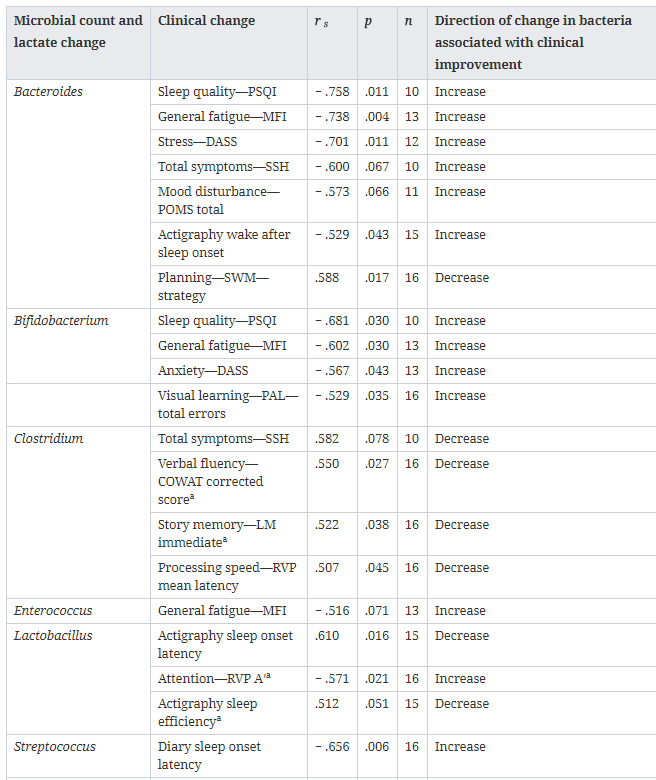
Results support the notion that specific microorganisms interact with some ME/CFS symptoms and offer promise for the therapeutic potential of targeting gut dysbiosis in this population. Streptococcus spp. are not the primary or sole producers of d-lactate. Further investigation of lactate concentrations are needed to elucidate any role of d-lactate in this population. Concurrent microbial shifts that may be associated with clinical improvement (i.e., increased Bacteroides and Bifidobacterium or decreased Clostridium in males) invite enquiry into alternative strategies for individualised treatment.”

The role of staphylococcus was known in 2015, and I did a post on it in January  2016. The d-lactic aspect, I posted about in 2015 in this post Approaches to D-Lactic Acidosis.

What they appear to miss was streptococcus causing histamine issues, see this 2014 post,  Histamine intolerance – a possible CFS mechanism.

Their Protocol?

Alternative weeks of:

Antibiotic

Erythromycin

400 mg/b.d.

Probiotic

Pro4-50 d-Lactate Free Multistrain

1 tablet b.d.

It was interesting to note that there was no attempt to reduce streptoccocus by diet etc. The suggestions from existing literature are on the ubiome analysis site. A small example:

The choice of Erythromycin is a bit of a puzzle, because of increasing resistance of many streptoccocus to this antibiotics. I pointed this out in my 2017 post, Reducing Streptococcus genus  where I cited this study

Phenotypic and genotypic characterization of antibiotic resistance of methicillin-resistant Staphylococcus aureus  isolated from hospital food. [2017]

  • MRSA strains harbored the highest prevalence of resistance against penicillin (100%), ceftaroline (100%), tetracycline (100%), erythromycin (89.18%) and trimethoprim-sulfamethoxazole

Symptoms to Bacteria Association

They did find that shifts of bacteria did result in improvement of symptoms — which is exactly what I expected to see.

improvementBottom Line

This study supports and illustrates the basics  of my model. If you are not too brain fogged, it is an interesting read. Their approach seems a little simplistic, but they did obtain good results.


Recommendations are Art and not definitive!

The recommendations are based on studies or trusted sources.  Studies do not always produce the same effect — diet, disease and a dozen other factors may change the conclusion for a study. To illustrate this, let us look at berberine, listed at this page: http://microbiomeprescription.com/Library/GutModifier/?name=berberine

Looking at the results we see some consistency across multiple studies:

We also see some slight disagreement:

And others which are a toss up…

The AI processing of the recommendations attempts to balance these factors (I hope to get the next generation coded this weekend). The recommendations are not guarantees of being effective, just items with better odds.

Items with multiple names

Different studies may describe what may be the same item in different ways. For example:

Or

And for other cases — spelling difference

or

or

This can result in some odd recommendations, with one being on Avoid and one on Take. As the data gets better cleaned up, we should see less of these.

Bottom Line

“When in doubt, leave it out


Symptoms to Bacteria Explorer is released

One of the original intents of the mechanized analysis site at: http://microbiomeprescription.azurewebsites.net was to try to identify which bacteria shifts are related to which symptoms. Over the last week I have been coding and testing a symptom explorer and it is ready for beta release.

It is found at: http://microbiomeprescription.com/Data/SymptomExplorer

Overview

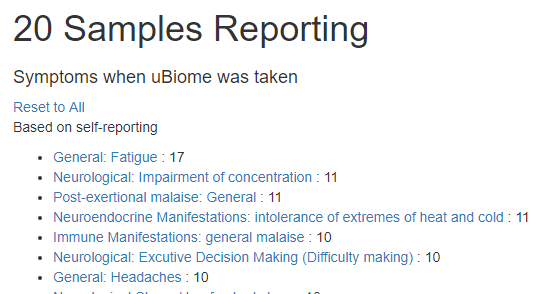
When you open the page, you will see information about the data we have.

ex1

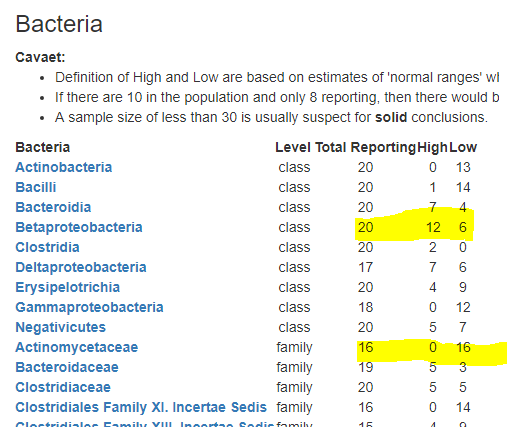
Below this are the significant bacteria seen for what is selected.

ex2

We may see patterns that are dominant. For example, of the samples, Actinomycetaceae is low in 16 of the 20 samples, and because it is reported in only 16, 4 had no measurable amount of this bacteria. The unanswered question is whether this is normal or a characteristic of this subset of the illness. I do not have an answer for that.

Drilling Down

Click on any of the symptoms and the page will be filtered by this symptom. For example

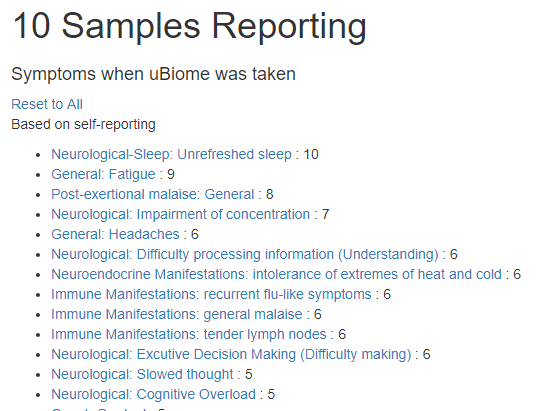
Results in the symptoms also seen with the selection being displayed

ex3

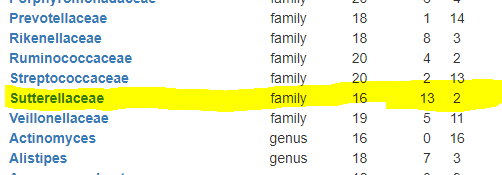
And below it, the bacteria associated.

ex4

For example, it seems that high overgrowth of Sutterellaceae is associated with this condition.

Bottom Line

This is a beta release which will allow people to explore. If you find something very significant, please add it as a comment on this post.

CAUTION: We really need at least 100 samples with symptoms to make progress that would be solid statistically. If you have contributed your uBiome but have not provided symptoms — please consider doing so.

,

Look below for microbiome modifiers added

A reader wrote:

“Hi Ken, what is your take on reducing, I can only find 3 things that may reduce Proteobacterium, L. taurine, and walnuts from your site and Chris’s pubmed study above which shows L. Reuteri works.

It seems to me this would be a great direction.

I’m thinking of adding L. Reuteri and L. Taurine.

thoughts?”

When you want to change something, my old blog posts are not complete. The best source of information is the http://microbiomeprescription.com/ site.

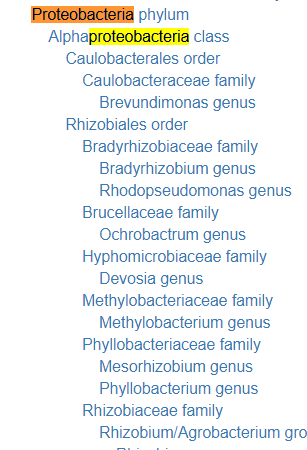
Go to http://microbiomeprescription.azurewebsites.net/Library/Tree and scroll down until you find Proteobacterium. You will notice there are layers of children below it.

Proteo4

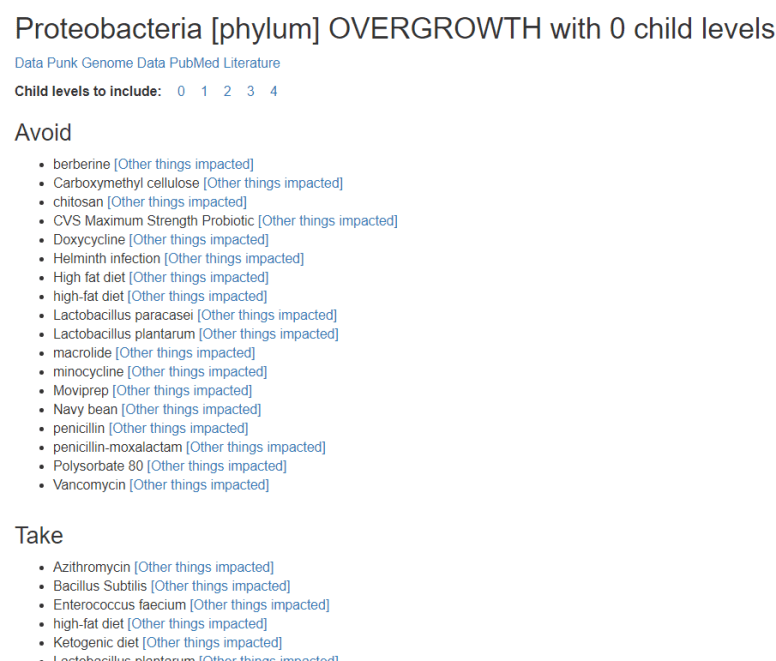
Clicking it will take you the current information in the database as show below.

prot2

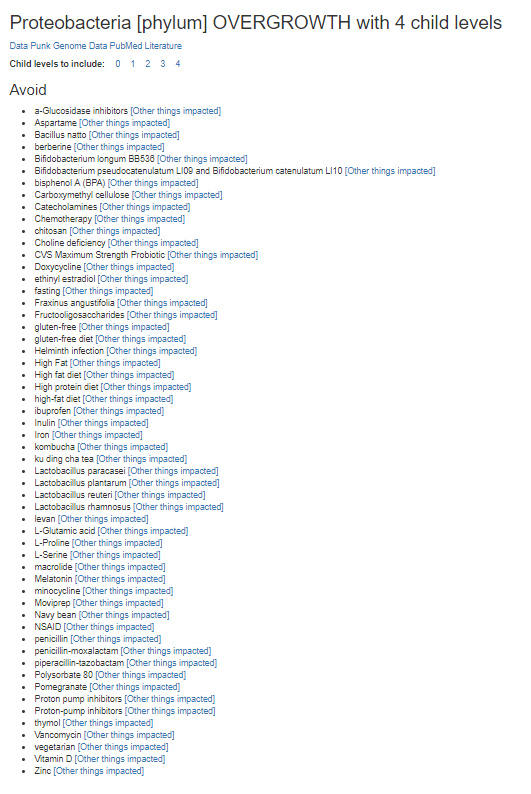
This weekend, I added an enhancement. You see the 0 1 2 3 4 links above. These will take the known information about this bacteria item AND 0-4 children layers and roll up all of the information into one set of recommendations.

  • If it reduces the population of one group of a population, it likely reduces the entire population.

For example, with 4 the number of items are greatly increased.

prot3

This gives you bigger lists (but also more chance of an item appearing on both lists).

Bottom Line

The new site, with the AI and database behind it, produces a much richer list of action items.  I am planning to include this in the AI engine for recommendations at some time in the future — but for the moment, you can manually look at a concern and it’s children.