Reducing Faecalibacterium genus

Some CFS patients are low and some are high.  I have done 2 earlier posts:

This consolidates and expands with new data.

For updated information see Microbiome Prescription

DataPunk.Net Data

NUTRIENTS/ SUBSTRATES

INHIBITED BY

ENHANCED BY

ANTIBIOTIC RESISTANCE

INHIBITED BY

PubMed Data

There are 540+ articles on PubMed. Over 320 of the articles deal explicitly with Faecalibacterium prausnitzii

  • Disease:
    • “major depressive disorder … reduced levels of Faecalibacterium. ” [2015]
    • Faecalibacterium, was lower in patients with multiple sclerosis.” [2015]
    • “The relative abundance of the bacterial genera …Faecalibacterium… was significantly decreased in children at risk of asthma” [2015]
    • “Bacteria from the genus Faecalibacterium were significantly more abundant in the mucosa of controls than Parkinson’s disease”. [2015]
    • “Lower in autism” [2013]
    • “At the genus level, we observed significant increases in… Faecalibacterium, … the Food Sensitivity group.”[2016]
    • “relative abundance of … Faecalibacterium…was reduced in Sjögren syndrome compared to controls. ” [2016]
    • ” Faecalibacterium prausnitzii was sharply decreased in both the fecal and biopsy specimens of the active CD patients” [2014]
  • Diet:
    • “after 6 weeks of intervention with flaxseed mucilage showed alterations in abundance of thirty-three metagenomic species (P< 0.01), including decreased relative abundance of eight Faecalibacterium species. ” [2015]
    • “Associated growth of levan-degrading (e.g. Bacteroides) and butyric acid-producing (e.g. Faecalibacterium) taxa was observed in levan-supplemented media. ” [2015]
    • Increased gut microbiota diversity and abundance of Faecalibacterium prausnitzii and Akkermansia after fasting: a pilot study [2015].
    • The microbial groups that increased significantly from lupin seeds (Lupinus albus) and broad beans (Vicia faba)…Faecalibacterium prausnitzii [2015]
    • “All strains tested were bile sensitive, showing at least 80% growth inhibition in the presence of 0.5 μg/ml bile salts, “[2012]
    • ” Faecalibacterium prausnitzii proportions decreased (P = 0.007, P = 0.031 and P = 0.009, respectively) as a result of the gluten-free diet” [2009]
    • “was found to be significantly lower in broccoli-fed mice.” [2012]
    • “chitooligosaccharides (COS) and low molar mass chitosans (LMWC)…decreased in all strains ” [2012] [2006]
  • Probiotics:
  • Antibiotics
    • Rifaximin appeared to influence mainly potentially detrimental bacteria, such as Clostridium, but increasing the presence of some species, such as Faecalibacterium prausnitzii.” [2015]
    • Metronidazole… known to decrease anaerobes such as Faecalibacterium” [2016]
    • “The relative abundance of Faecalibacterium prausnitzii was unaffected except with thymol [Thyme Oil] at 500 p.p.m. of essential oils tested”
    • “proton pump inhibitor…was accompanied by a lower abundance of Faecalibacterium spp.” [2012]
    • “Oral Iron supplements treatment was associated with decreased abundances of operational taxonomic units assigned to the species Faecalibacterium prausnitzii,”  [2017]

Bottom Line

Avoid

  • VSL#3 Probiotics
  • Bifidobacterium adolescentis  Probiotics
  • Bifidobacterium pseudocatenulatum
  • Saccharomyces boulardii
  • Enterococcus probiotics
  • Walnuts (or pomegranates)
  • Jerusalem artichoke, Inulin, Chicory
  • Berberine
  • High Fiber Diet
  • red wine (or grape seed extract or reservatol)
  • Rifaximin

Take

Reducing Collinsella genus

For updated information see Microbiome Prescription

DataPunk.Net Data

NUTRIENTS/ SUBSTRATES

INHIBITED BY

ENHANCED BY

INHIBITED BY

PubMed Data

There are about 80+ articles on PubMed.

  • Disease
    • “The abundance of Collinsella correlated strongly with high levels of alpha-aminoadipic acid and asparagine as well as production of the proinflammatory cytokine IL-17A. A role for Collinsella in altering gut permeability and disease severity was confirmed in experimental arthritis.” [2016]
    • “Genus Collinsella…found to be significantly increased in type 2 diabetes compared to the other groups ” [2015]
    • “the genus Collinsella was enriched in patients with symptomatic atherosclerosis,” [2012]
    • Collinsella have been correlated or causally related to rheumatic disease.” [2016]
    • “At the genus level, we observed significant increases in the numbers of … Collinsella,… in the Food Sensitive group. ” [2016]
    • “Unaffected relatives of patients with Crohn’s Disease had less Collinsella aerofaciens ” [2011]
    • “a positive correlation was detected between serum cholesterol and Collinsella (Coriobacteriaceae). ” [2013]
    • “Collinsella aerofaciens, an abundant actinobacterium, were significantly
      decreased in all IBS subtypes compared with the Healthy Controls.” [2010]
  • Diet:
    • Collinsella decreased significantly at week 4 compared to baseline[ with pomegranate extract] . ” [2015]
    • “decreased, along with Collinsella aerofaciens, on reduced carbohydrate weight loss (WL) diet.” [2011]
    • “The the fibre-rich macrobiotic Ma-Pi 2 diet , but not the control diet, was also effective in counteracting the increase of possible pro-inflammatory groups, such as Collinsella and Streptococcus, in the gut ecosystem, ” [2016]
    • “certain bacterial groups was lower (…Collinsella ..)  among vegetarians,” [2014]
    • “bacteria related to Collinsella and members of the Clostridium clusters IV and XI increased  in the group consuming refined wheat breads. ” [2013]
    • “In addition, the genera Eggerthella, Collinsella and Corynebacterium within Actinobacteria, along with bacteria related to Bacteroides vulgatus and Prevotella oralis, were stimulated after the  non-starch polysaccharides  diet.” [2014]
  • Prebiotics:
    •  Collinsella sp., were detected in microbiota of the rats fed raffinose. [2016]
    • “The synbiotic increased relative abundances of the Collinsella, ” [2014]
  • Probiotics:
    • “Lactobacillus reuteri DSM 17938  … lower Collinsella and higher Enterococcus and Coprococcus abundance at 4 months.” [2016]
  •  Antibiotics:
    • ” Collinsella spp., and Eubacterium spp. showed variable resistance to penicillin. ” [2014]
  • “lower numbers of Collinsella spp. were evident in the elderly subjects with non-steroidal anti-inflammatory drugs (NSAID) compared both with young adults and the elderly without NSAID, suggesting that the use of NSAID along with age may also influence the composition of intestinal microbiota. ” [2010]
  • “per oral iron replacement treatment was associated with decreased abundances of operational taxonomic units assigned to the species Faecalibacterium prausnitziiRuminococcus bromiiDorea sp. and Collinsella aerofaciens.” [2017]
  • “The relative proportions of …Collinsella, … were significantly correlated with weight loss induced by tea extracts” [2017]

Bottom Line

Avoid

  • wheat

Take

  • oral iron supplements
  • Green or black tea
  • pomegranate (walnuts is likely helpful too)
  • NSAIDs (see list here), I prefer aspirin as first choice.

Reducing Subdoligranulum genus

For updated information see Microbiome Prescription

Another high bacteria genus — this appears to occur in only 1/4 of the CFS uBiomes that I have seen.

For updated information see Microbiome Prescription

DataPunk.Net Data

NUTRIENTS/ SUBSTRATES

INHIBITED BY

ENHANCED BY

INHIBITED BY

PubMed Data

There are some 28+ articles on PubMed.

  • Disease:
    • “At the genus level, we observed significant increases in the numbers of Sphingomonas, Sutterella, Bifidobacterium, Collinsella, Clostridium sensu stricto, Clostridium IV, Enterococcus, Lactobacillus, Roseburia, Faecalibacterium, Ruminococcus, Subdoligranulum, and Akkermansia in the Food Sensitive group. ” [2016]
    • “Behçet’s syndrome patients were significantly depleted in the genera Roseburia and Subdoligranulum.” [2015]
  • Diet:
    • “a low fermentable substrate diet ..increased abundance of bacterial taxa belonging to the genera Sporobacter (P<0.05) and Subdoligranulum” [2014]
    • higher (Subdoligranulum) among vegetarians, indicating the association of dietary type with bacterial community composition. [2014]
    • “Omega3 ..remarkable increase in ..and Subdoligranulum (4.93% versus 7.57%). ” [2016]
  • Prebiotics:
    • ” short-chain fructo-oligosaccharides (scFOS) on the gut bacterial populations…Subdoligranulum variabile-like species were elevated” [2010]
    • “The inhibitory effect of xylooligosaccharide (XOS) on other opportunistic pathogens, such as Clostridia, Streptococcaceae, and Subdoligranulum, further supports that XOS can potentially promote an optimal gut microbiota profile” [2015]
    • ” A negative correlation was detected between inulin utilization and Subdoligranulum (r = −0.73, p ≤ 0.01) [2013]
  • Probiotics:
    • ” Lactobacillus salivarius SMXD51…subdoligranulum sp. increase.” [2017]
    • Subdoligranulum was higher in mice supplemented with L. casei (p < 0.05), whereas it tended to be higher in mice supplemented with B. breve (p = 0.05), as compared with control mice” [2016]
  • Antibiotics:
    • “Vancomycin targets …as for the low levels of Subdoligranulum.” [2015]

Bottom Line

Avoid

  • Lactobacillus salivarius
  • Lactobacillus Casei
  • Bifidobacterim Breve
  • Omega 3
  • Walnuts (and likely no  pomegranate – both are high urolithin)
  • Saccharomyces boulardii
  • Berberine

Take

  • Inulin

While there is no direct evidence, I would suggest trying some of the probiotics for Anaerostipes.

A solution to some probiotic challenges

A friend  has very high Anaerostipes and Clostridium genus. If you look at my posts on these:

You will see that Inulin and other common prebiotics encourages their growth.

The following probiotics reduces them:

  •  Lactobacillus paracasei
  • Streptocuccus thermophilus

I went to find such and found that all of the usual commercial ones included inulin or similar 😦 A nasty dilemma!

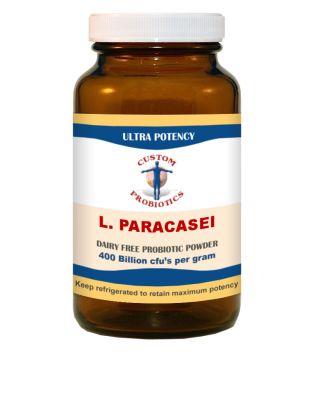
A friend referred me to Custom Biotics, and after an email exchange they confirmed that these were 100% probiotics (at 400 BFCU per gram!!) without these prebiotics.

l-paracasei-powder_311x400

Price wise: 400 BCFU x 50 gm = 20,000 BCFU for $115 or 11500/20000 =  1/2 cent per BCFU which is 1/10 of the cost most commercial probiotis, see this post for price comparison.

While there may be ‘sticker shock’ at the price per bottle — it is CHEAP per BCFU if you know the specific probiotic you want.

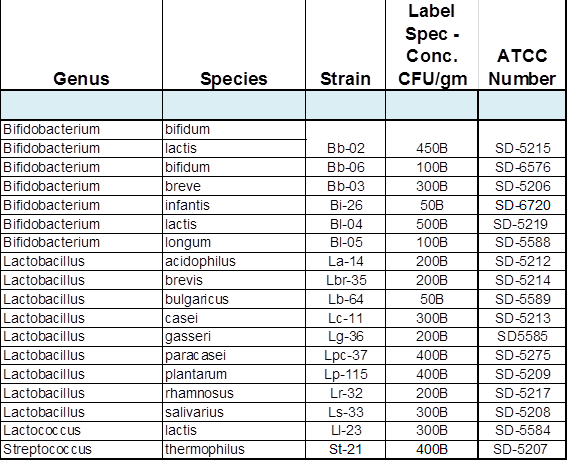
I was also very glad to receive information on the strains

species

Reducing Gordonibacter genus

This genus may be associated with MCS (see this post). High levels are seen with Irritable bowel syndrome patients negative for Blastocystis carriage [2016].

For updated information see Microbiome Prescription

DataPunk.Net Data

Nothing 😦

PubMed Data

There are just 20 citations on PubMed.

  • “At the genus level, there were declines in Christensenella, Gordonibacter and Anaerotruncus in the florfenicol group” [2017]
  • “Pomegranate polyphenols enhanced urolithin and propionate production, as well as Akkermansia and Gordonibacter prevalence with the highest effect in the descending colon” [2017] [2017]
    • “Walnuts act like pomegrantes” [2017]
  • In vitro susceptibilities to penicillin, metronidazole, vancomycin, and amoxicillin-clavulanate were determined using the Etest method….The fever gradually subsided after 3 days of amoxicillin-clavulanate, and the patient’s general condition gradually improved. ” [2010]

Bottom Line

Avoid

  • pomegranate
  • walnuts

known.

Take