A ME/CFS – Lyme Patient Recovering

A reader emailed me and asked some questions.

My good friend that also has CFS/Lyme said to me that he is about 80% better in all his symptoms after using Ivermectin that his Lyme doctor prescribed him. His was almost bedridden, had extreme brain fog with depersonalization, low motivation etc. He used Ivermectin 2x a week 3ml oral. After 2 months he is now adding Metronidazol with minocyclin and his state is extremely improving. 
I tried to find some info on your blog but I didn’t find anything. Do you maybe know what Ivermectin did?  I also saw that his skin/face is looking like a baby hahahah he looks 15 years younger. 

I have a site for non-prescription items and give the list of items here. This site also provides prescription items for professionals. I looked up on that list and found:

Mino is a member of the tetracycline family that is shown below

I checked on the other common member,doxycycline (antibiotic)s, and found that it did not have a good impact.

The other item: Ivermectin,(prescription)  did not have a good profile for ME/CFS – but it does impact a lot of different bacteria

Chronic Lyme Prediction

Again, the cyclines are there with zero bad impact.

With ivermectin,(prescription)  showing good and bad impact.

Bottom Line

This was done with a-priori model of the bacteria shifts, that is, we assume that this person matched the typical shift seen in many studies and ignore the amount of shift. We know that there is a great variation of microbiome from person to person with the same diagnosis.

My criteria is that the suggestions have better odds of helping than hurting. In this case we see 2 takes appear to have worked, and one avoid did not. That is 2/3 or 66% success rate (which is above 50% — thus my criteria is satisfied, we did better than with random picks).

Microbiome Modelled Suggestions for ME/CFS

This list (with live time updates as data is added) on Microbiome Prescription web site. All suggestions from this page should be reviewed by your medical professionals. These are based on modelling and not clinical studies. These are based on family and lower taxonomy ranks (genus,species,strains) reported in studies on US National Library of Medicine.

In general, people report improvements from at least half of the items on the top of the list. Many items listed have been reports in clinical studies to help a significant percentage of patients. Items of special interest are those that are low in bad impact and high in good impact (i.e. Whey, pomegranate, fish oil, trametes versicolor( mushroom))
Best prediction is done when using a 16s microbiome result for the patient

NetSubstanceGood ImpactBad
Impact
24bacillus subtilis (probiotics)3410
21lactobacillus casei (probiotics)309
20pomegranate277
19resistant starch3415
19whey223
19bifidobacterium longum (probiotics)223
18pediococcus acidilactic (probiotic)213
17brown rice236
17wheat247
17oregano (origanum vulgare, oil) |247
16almonds/ almond skins182
15soy2510
15vitamin d2914
14walnuts2713
14whole-grain barley228
14pectin228
14wheat bran2410
14Cacao217
14dietary fiber140
14lactobacillus plantarum,xylooligosaccharides,(prebiotic) (probiotics)162
14lactobacillus reuteri (probiotics)2713
14fish oil173
14proline (amino acid)195
14bifidobacterium bifidum (probiotics)2511
13lactobacillus paracasei (probiotics)229
13lactobacillus acidophilus (probiotics)229
13Human milk oligosaccharides (prebiotic, Holigos, Stachyose)2815
12raffinose(sugar beet)164
12lauric acid(fatty acid in coconut oil,in palm kernel oil,)175
12high fiber diet208
12rosmarinus officinalis (rosemary)2513
12Conjugated Linoleic Acid142
12Alpha-Ketoglutarate186
12Burdock Root164
11glycine176
11Glucomannan110
11pea (fiber, protein)165
11fructo-oligosaccharides (prebiotic)2615
11lactobacillus rhamnosus (probiotics)2312
11lactobacillus rhamnosus gg (probiotics)198
11lactobacillus casei shirota (probiotics)132
11fat209
11bifidobacterium pseudocatenulatum,(probiotics)154
11bifidobacterium infantis,(probiotics)176
11polyphenols143
11saccharomyces boulardii (probiotics)209
11oligofructose (prebiotic)121
11apple2110
11whole grain,bran110
10vsl#3 (probiotics)144
10naringenin(grapefruit) (Flavonoid)133
10lupin seeds (anaphylaxis risk, toxic if not prepared properly)2010
10magnesium122
10red wine2313
10broad beans2010
10fasting166
10lactobacillus plantarum (probiotics)2818
10inulin (prebiotic)2616
10enterococcus faecium (probiotic)155
10hou-po-da-huang-tang111
9Goji (berry,juice)156
9fruit/legume fibre167
9oligosaccharides (prebiotic)123
9banana101
9bifidobacterium adolescentis,(probiotics)123
9bifidobacterium animalis lactis (probiotics)167
9anise134
9triphala3425
9zinc2718
9vitamin a2314
8trametes versicolor( mushroom)102
8red chiles (Capsicum)80
8xylooligosaccharide (prebiotic)91
8thyme157
8trametes versicolor(Turkey tail mushroom)102
8peppermint135
8persimmon tannin91
8resistant maltodextrin168
8selenium91
8mediterranean diet2113
8omega-3 fatty acids146
8palm kernel meal124
8bifidobacterium catenulatum,(probiotics)102
8bacillus subtilis natto (probiotics)91
8cinnamon (oil. spice)2113
8high resistant starch124
8green tea146
8jerusalem artichoke (prebiotic)113
8ketogenic diet1810
8noni124
8Acacia Gum91
8bacillus,lactobacillus,streptococcus,saccharomyces probiotic80
8yogurt80
8sarcodiotheca gaudichaudii (red sea weed)113
8brown algae113
8Soymilk80
7plantago asiatica l.125
7lactose114
7Codonopsis pilosula70
7rosa rugosa114
7dietary phytoestrogens (isoflavones)125
7chicken70
7sialyllactose (oligosaccharide ) (prebiotic)114
7polygonatum kingianum(Orange Flower Solomon’s Seal.)70
7arabinoxylan oligosaccharides (prebiotic)2013
7bacillus pumilus92
7lactobacillus gasseri (probiotics)169
7glutamate70
7foeniculum vulgare (Fennel)125
7dates92
7black raspberries125
7arabinogalactan (prebiotic)81
7garlic (allium sativum)2013
7neem136
7methyl gallate103
7polysorbate 80114
7Vitamin B-12 (Cyanocobalamin)70
7blueberry125
6buckwheat82
6vitamin b2(Riboflavin)71
6germinated barley food-stuff60
6schinus molle (herb)71
6raw potato starch104
6sesame cake/meal71
6safflower oil71
6barley2519
6chicory (prebiotic)82
6chrysanthemum morifolium126
6fibre-rich macrobiotic ma-pi 2 diet137
6daesiho-tang60
6lactobacillus salivarius (probiotics)1610
6lactobacillus brevis (probiotics)93
6Lactobacillus Johnsonii (probiotic)126
6Oyster Mushroom71
6corn60
6sesame71
6rye71
6grape fiber60
6chondrus crispus (red sea weed)93
5xylaria hypoxylon (fungi)72
5lactobacillus sakei (probiotics)50
5purple sweet potatoes94
5d-ribose50
5Whole Milk61
5brassica juncea94
5galla rhois83
5Kiwifruit72
5lactobacillus acidophilus,cellobiose (probiotics)61
5gum arabic (prebiotic)61
5chamomile (chamaemelum nobile)83
5cabbage50
5barley,oat1510
5basil61
5bacillus (probiotics)50
5rhubarb149
5navy bean1510
5n-acetyl-d-glucosamine50
5oats72
5bifidobacterium lactis bb12 (probiotics)105
5green-lipped mussel116
5genistein83
5salt (sodium chloride)83
4saccharomyces cerevisiae (probiotics)95
4sesuvium portulacastrum herb51
4tulsi51
4vegetable40
4resveratrol (grape seed/polyphenols/red wine)2420
4tannic acid106
4marijuana62
4pea protein73
4mutaflor escherichia coli nissle 1917 (probiotics)51
4moderate-protein moderate-carbohydrate51
4marjoram51
4rosa canina40
4plantain bananas40
4bifidobacterium longum bb536 (probiotics)139
4black beans73
4chitosan,(sugar)2016
4glucose (sugar)40
4fruit73
4koji aspergillus oryzae51
4laminaria digitata(oarweed – seaweed)95
4Psyllium (Plantago Ovata Husk)139
4Beet40
4Bifidobacterium animalis40
4wasabi40
4fucoidan51
4punicic acid40
4asparagus40
4Vitamin E40
4Vitamin B40
4lemon62
4western diet40
4allium cepa40
4Opium poppy (Papaver somniferum)40
4Spearmint(mentha spicata)40
4Mango ginger(curcuma amada)40
4cinnamomum zeylanicum40
4cinnamomum tamala40
4Exercise106
4potatoes106
4bifidobacterium breve (probiotic)62
4spirulina(cyanobacteria)40
4low protein diet128
4papaya40
4bean51
4fenugreek73
4quercetin,resveratrol139
4rosehip tea51
4pomegranate blossom tea51
4grape polyphenols139
4hypericum scabrum herb51
4high amylose cornstarch40
4maize40
4mannitol40
4tabebuia impetiginosa (taheebo) bark51
4vitex negundo (herb)40
3nigella sativa seed (black cumin)52
3whole-grain wheat52
3sorghum85
3lactulose1411
3bifidobacterium longum,lactobacillus helveticus (probiotics)52
3Curcumin52
3White-leaved Savory(micromeria fruticosa)52
3amaranth85
3Agavins (agave sugar)74
3avocado peel41
3Slippery Elm3027
3Gallic acid41
3Ajwain (trachyspermum ammi)63
3Taxifolin52
3Ginseng74
3Lithium96
3Dendrobium officinale74
3lactobacillus fermentum (probiotics)107
3low animal protein diet41
3l-sorbose41
3fraxinus angustifolia (narrow-leafed ash)30
3capsaicin (hot pepper)41
3coriander oil74
3enterococcus durans (probiotics)41
3aspartame (sweetner)96
3animal-based diet1411
3polymannuronic acid1714
3momordia charantia(bitter melon, karela, balsam pear, or bitter gourd)52
3low processed foods diet41
3lychee fruit (nephelium longan)30
3xylan (prebiotic)1310
3xylitol74
3sunflower oil41
3syzygium aromaticum (clove)74
3galacto-oligosaccharides (prebiotic)1916
2oolong tea polyphenols31
2oolong teas31
2tomato powder31
2tea1816
2vitamim e20
2oligofructose-enriched inulin (prebiotic)119
2oregano essential oil31
2paenibacillus polymyxa (prescript assist) (probiotics)31
2olea europaea (olive leaf)53
2mint20
2satureia montana(Winter savory)31
2(+)-catechin42
2abies alba mill. (silver fir)31
2bioflorin,enterococcus faecium sf 68,(probiotics)31
2bacopa monnieri20
2carum carvi (Caraway)31
2catechol31
2choline deficiency20
2chitooligosaccharides (prebiotic)1412
2chaga (mushroom)20
2grapes42
2l-phenylalanine20
2l-arginine20
2lemon oil20
2lemongrass oil53
2lactobacillus helveticus,lactobacillus rhamnosus (probiotics)20
2Pork86
2camellia20
2rice bran64
2Tryptophan64
2nobiletin20
2Konjaku flour64
2lactobacillus helveticus20
2bacillus laterosporus (probiotic)64
2Immortelle(helichrysum italicum)31
2milk thistle(silybum marianum)20
2bandicoot berry(leea indica)20
2Bacillus clausii (Probiotics)42
2bifidobacterium (probiotics)64
2xylopia aethiopica (herb)20
2cylicodiscus gabunensis (mimosaceae)20
2d-fructose (sugar)20
2lactobacillus paracasei,lactobacillus acidophilus,bifidobacterium animalis (probiotics)31
1galactose (milk sugar)1211
1hydrogenated palm oil10
1bifidobacterium lactis,streptococcus thermophilus probiotic87
1galla chinensis (herb)109
1Sijunzi decoction43
1Baking Soda (Sodium Bicarbonate)76
1strawberry43
1Fiber, total dietary32
1Haritaki10
1quinoa21
1Cacoa flavonoids10
1lactobacillus kefiri (NOT KEFIR)1110
1grape seed extract87
1fumarate10
1ginger109
1doenjang (fermented bean paste)21
1aloe vera21
1ashwagandha (withania somnifera)32
1bacillus licheniformis,(probiotics)109
1ß-glucan1716
1salvia officinalis (sage)10
1plant-rich diet10
1peppermint (spice, oil)54
1moderate-carbohydrate diet10
1magnolia bark21
1peganum harmala (rue)21
1thyme oil10
1thyme (thymol, thyme oil)87

A quick revisit to Coagulation Testing for ME/CFS

A reader wrote and a blog post was the easiest

Hi Ken,
tomorrow I have an appointment with a cardiologist, and I want to check for thick blood/coagulation if possible. What blood values would I need to test? Fibrinogen, Prothrombin Fragment 1+2, Thrombin/ AntiThrombin Complexes, Soluble Fibrin Monomer, and Platelet Activation. Is that right?

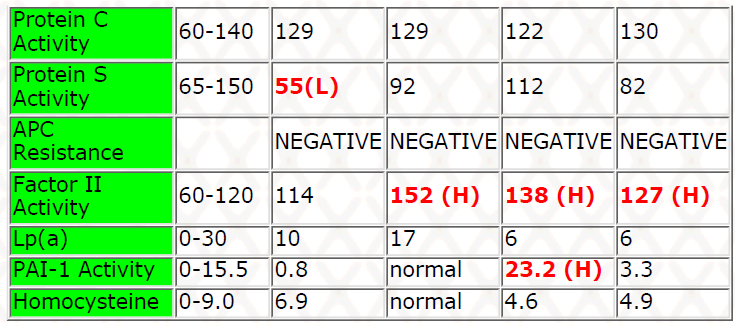
This has been part of my model of ME/CFS for a long time. It is a co-factor to things like the microbiome. A summary of the old treatment advice from Hemex and transcripts of talks with Dave Berg is here.

  • Soluble Fibrin Monomer (SFM) – Normal Range 0-15mg/L
  • Fibrinogen – Normal Range 200-300
  • Prothrombin Fragment 1+2 test
  • Antithrombin III (AT),
  • Protein C,
  • Protein S,
  • APC Resistance
  • Factor II level or the Prothrombin Gene Mutation
  • Lp(a)
  • PAI-1
  • SED (Below 5 is a concern per Berg)

Example of the Family Reports from Hemex

This is from my ancient 2000’s CFS blog that is available here

Follow up to: A German CFS Patient Experience and Analysis

The patient has done another sample and this continues the analysis. The original post, A German CFS Patient Experience and Analysis from July 2021. I am always interested in seeing changes that occur from the AI suggestions, they worked for me –I am as interested in them not working (to motivate improving algorithms).

What has changed?

There are a set of automatic comparison tools between samples, so I will check those first

I went to compare taxonomy outliers for the two samples and found just two items were on both. There was a lot of changes. We can ignore blues with no data besides – they were all likely what I term transitory bacteria that comes and goes. What we are interested

The two items of focus are VERY high on both:

Other component comparisons:

  • End Product — most were unchanged except for Polyhydroxyalkanoic acids which jumped from none to 98%ile
  • KEGG Bacteria Products nothing in common, on first sample we had only low values at risk, on latest sample only high values at risk
  • KEGG Enzymes — the same thing, earlier sample has all risks being low samples, latest high values
  • KEGG Modules — earlier sample had no risk items, latest had one high value
  • Medical Condition (PubMed) — nothing for either sample

The overall impression is that things have changed significantly. This does not say that the person is better — only that the suggestions have changed the microbiome

Non-Automated Comparisons

Next I will look at various aspects and do side by side comparisons. First, using Dr. Jason Hawrelak Criteria, shown below. The worst shift was for Blautia, the best shifts was for Roseburia and Faecalibacterium prausnitzii

LatestSampleEarlier Sample
TaxonomyRankLowHighYour ValueStatusYour ValueStatus
Bacteroidiaclass03538.369Not Ideal33.945Ideal
Akkermansiagenus130.21Not Ideal0.017Not Ideal
Bacteroidesgenus02025.986Not Ideal25.266Not Ideal
Bifidobacteriumgenus2.550.03Not Ideal0.021Not Ideal
Blautiagenus51011.557Not Ideal6.174Ideal
Desulfovibriogenus00.250.062Ideal0.091Ideal
Eubacteriumgenus0150.008Ideal0.004Ideal
Lactobacillusgenus0.0110.012Ideal0.017Ideal
Methanobrevibactergenus0.00010.020Not Ideal0.052Not Ideal
Roseburiagenus5105.166Ideal0.624Not Ideal
Ruminococcusgenus0152.848Ideal3.792Ideal
Proteobacteriaphylum0411.225Not Ideal5.753Not Ideal
Bilophila wadsworthiaspecies00.250.598Not Ideal0.848Not Ideal
Escherichia colispecies00.010Ideal0.022Not Ideal
Faecalibacterium prausnitziispecies101510.612Ideal3.415Not Ideal
Three improved, Two deteriorated

Health Status changes were a toss up, but appears marginally better

  • Latest: 0 Healthy, 4 unhealthy
  • Earlier: 2 Healthy, 6 unhealthy

KEGG Suggested Probiotics

  • Earlier Sample had 11 probiotics listed with a maximum weight of 12 (most of the time I see much higher weights indicating greater dysfunction)
  • Later Sample had 0 probiotics – this is actually a rare occurrence which hints at a better balance microbiome

KEGG Suggested Supplements

  • Earlier sample has 3 items suggested (using default percentile)
  • Later sample has 0 items suggested (using default percentile)

Pub Med CFS Profile

  • Earlier sample had 5 low matches, 5 high matches
  • Later sample has just 4 high matches

Citizen Science Models

  • Early Sample: Total Matching Bacteria :26. Very Strong: 15, Strong: 8, Weak: 2, Very Weak: 1
  • Later Sample: Total Matching Bacteria :24. Very Strong: 19, Strong: 4, Weak: 1, Very Weak: 0
  • Less matching bacteria (means some have disappeared), while strong/very strong are the same, the weak association have dropped

From looking at all of the available objective measures:

  • The microbiome has changed (our primary goal)
  • Many measurements show indicate that the microbiome is moving towards normal, none has a suggestion of things getting worst.

Remember our goal is not to attempt a one-step cure

Our earlier post used this diagram, we appear to have successfully moved along the path to recovery. We need to see what our next step is.

Symptoms Forecasts To Reported Symptoms

This reader was a good user and entered their symptoms – we have a 80% match rate. What is interesting is that one of the items not checked was a Keto Diet — this is interesting because a recent post dealt with a Keto diet resulting in Chronic Fatigue Like symptoms, with “Keto Flu” is some studies. A Keto diet is DEFINITELY NOT A SUGGESTION for this person, it will likely make things worst.

Updated Suggestions

For the earlier post, the consensus reports were not available. My intent is to run each of the matched predicted symptoms, the PubMed profile for ME/CFS and Citizen Science for ME/CFS – a total of 18 sets of suggestions will be merged. There are two ways of doing this:

  • Only the Auto Checked (which picks a few best items)
  • Auto Checked plus suggested one (marked with a light bulb).

This first pass is only with auto checked items (the most conservative approach) The bacteria selected are shown below, while there was some duplicates between symptoms, there was significant independence:

  • Acidobacteria Too Low
  • Anaerovibrio Too High
  • Anaerovibrio lipolyticus Too High
  • Bacteroides cellulosilyticus Too High
  • Bacteroides finegoldii Too High
  • Bacteroides salanitronis Too High
  • Bifidobacteriaceae Too Low
  • Bifidobacteriales Too Low
  • Bilophila Too High
  • Bilophila wadsworthia Too High
  • Candidatus Phytoplasma Too High
  • Clostridium malenominatum Too Low
  • Deinococcaceae Too High
  • Deinococcales Too High
  • Deinococcus Too High
  • Lelliottia Too Low
  • Lelliottia amnigena Too Low
  • Mitsuokella Too High
  • Oscillospira Too High
  • Parabacteroides johnsonii Too High
  • Rhodocyclaceae Too Low
  • Sphingobacterium bambusae Too High
  • Sutterella stercoricanis Too Low

I noted that many are atypical bacteria that I do not see usually in pub med studies.

Safest Takes is full of items that I often have seen on my own (and other ME/CFS results).

On the Safer Take, we find a regular pattern of 3 takes and 1 oppose.

Whey has historically been helpful to a subset of ME/CFS patients

The avoid list is relatively short and most are from a single suggestion (which suggests that it may be ignored). high red meat is the greatest avoid, with saturated fats variation being right behind.

Done with Secondary Suggestions

Since I have just implemented this feature, I am curious about it’s impact. The number of bacteria almost doubled with a variety. A lot of bacteria appeared multiple time.

  • Absiella Too Low
  • Acidobacteria Too Low
  • Acidobacteriaceae Too Low
  • Acidobacteriales Too Low
  • Acidobacteriia Too Low
  • Adlercreutzia Too Low
  • Adlercreutzia equolifaciens Too Low
  • Anaerovibrio Too High
  • Anaerovibrio Too High
  • Anaerovibrio lipolyticus Too High
  • Bacteroides cellulosilyticus Too High
  • Bacteroides finegoldii Too High
  • Bacteroides salanitronis Too High
  • Bacteroides vulgatus Too High
  • Bifidobacteriales Too Low
  • Bifidobacterium Too Low
  • Bilophila Too High
  • Bilophila wadsworthia Too High
  • Blautia hansenii Too High
  • Butyricimonas Too High
  • Candidatus Phytoplasma Too High
  • Clostridium malenominatum Too Low
  • Collinsella intestinalis Too Low
  • Coriobacteriia Too Low
  • Deinococcaceae Too High
  • Deinococcales Too High
  • Deinococcus Too High
  • Eubacterium dolichum Too Low
  • Eubacterium oxidoreducens Too Low
  • Finegoldia magna Too Low
  • Hymenobacter Too High
  • Lelliottia Too Low
  • Lelliottia amnigena Too Low
  • Leptospira Too Low
  • Leptospiraceae Too Low
  • Leptospirales Too Low
  • Megasphaera Too Low
  • Mitsuokella Too High
  • Oscillospira Too High
  • Parabacteroides johnsonii Too High
  • Peptococcaceae Too High
  • Porphyromonas Too High
  • Pseudanabaenaceae Too High
  • Pseudonocardiaceae Too Low
  • Rhodocyclaceae Too Low
  • Rickettsiaceae Too Low
  • Rickettsieae Too Low
  • Selenomonas artemidis Too Low
  • Slackia Too High
  • Sphingobacterium bambusae Too High
  • Streptococcus thermophilus Too High
  • Sutterella stercoricanis Too Low
  • Synechococcaceae Too High
  • Synechococcales Too High
  • Veillonellaceae Too High
  • Veillonellales Too High

As expected, the suggests are similar

The risk items are similar with saturated fats dominating

Bottom Line

Earlier today, I updated this post Ketogenic diet did not help a health issue, it created one where the person ended up with a ME/CFS like scenario. Many of these suggestions were very similar. The main items suggested are:

  • Fibre
    • Inulin like items (chicory, Jerusalem artichoke, inulin)
    • Fruit and legume fiber
    • Barley, Oats
  • Cacao (usually I suggest working up to 85% cacao or higher chocolate bars)
  • Apple
  • clostridium butyricum (probiotics)
  • rosmarinus officinalis (rosemary)
  • B Vitamins (classic CFS MD recommended supplements)
  • Vitamin D
  • Soy
  • Human milk oligosaccharides (prebiotic, Holigos, Stachyose)

In general, I favor “intact” fiber and herbs. I have seen several studies that the intact had a greater impact than the extract. Watch out for saturated fats — for example Pork is on the to avoid list

The excel file download (CSV) had only 291 items, less than other samples that I processed. I attached it as an example.

My usual advice is to take two weeks to sort out (and in some cases slowly move up to) the suggestions that are picked. It is helpful to check my Supplement Dosage page. That page is not numbers that I picked out of the air, but dosages used in various clinical trials (thus the dosages are likely safe, and more important, are sufficient to cause a change). Then at least 4 weeks for the microbiome to stabilize, then retest to find out the new status quo that will need to be adjusted.

For myself, I did notice a pendulum swing in my series of samples — an item was a take, then the next sample it was an avoid, then it became a take again and stayed as a take. The path is not always straight!

Nattokinase – Update for ME/CFS and Long COVID

This post was kick-started by a post to a study on a Spanish ME/CFS site shown below

This is extra relevant because Nattokinase is one of my personal favorite tools for dealing with hypo-perfusion (low oxygen to the brain), something that I have experienced during ME/CFS flares. It is also the subject of my last post. I have cited Nattokinase in prior posts, some 9 years ago, and it seems time to update what we know.

So what more has been added to our knowledge base. Nattokinase comes from Bacillus Subtilis Natto. This strain has been traditionally used in a Japanese dessert called “Natto” which you can buy is some Asian shops – it is a bit of an acquired taste (but I like it)

What Natto looks like in stores. This is a living bacteria.

Putting it together

Nattokinase seems to treat many conditions associated with western diet. The next question is simple, what are dosages used in studies?

Usually 100 mg = 2000 FU on most commercial products, so the range in trials is 1-7 100mg capsules per day.