What is CFS Remission Site About?

I have been observing the Myalgic Encephalomyelitis/Chronic Fatigue Syndrome (ME/CFS) community for almost 35 years. I have been an active member of this community. I have also been in remission for it, but deeply interested in understanding it; I have had several relapses. I wanted to prevent future relapses hence great interest in reading and researching.

Microbiome Analysis as a path with good results

My main focus in 2023 is on the microbiome of ME/CFS people. I have a collections of reviews of individual microbiome samples reviews available. The data from the suggested tests are processed using the free expert system at Microbiome Prescription. So far, every person who has done this route and repeated the microbiome tests have reported subject improvement and objective improvement. It can be a long journey, we take one step at a time.

During those decades I have seen a huge number of theories, suggested treatments and clinical findings. I have seen many “this cured me” which failed to deliver remission for anyone else. I have seen treatment plans proposed / sold by well-meaning MDs that worsen the condition and persisted for years. I see this still going on today for both ME/CFS and Long Hauler COVID.

My training is in science: mathematics, statistics, general sciences. I have been an instructor in those areas at many universities, colleges and even high schools. My remissions resulted from following gold or silver standard evidence. I have read several thousand published papers on ME/CFS (with and without brain fog).

What is on this site?

Most of the posts results from reading a new paper, readers asking questions, seeing a question asked on some online groups. The posts follow this pattern:

  • The question or concern that started the post
  • A review of all literature on the US National Library of Medicine, conference papers, etc.
    • Quotes provided from papers or their titles
    • Links to the paper so people or their medical professionals can read for themselves
  • A bottom line section which are my conclusions inferred from the literature.

To quote Seargent Friday from the old Dragnet TV Series, “All we want are the facts, ma’am“.

Use the site as an Encyclopedia

There is another similar site, Encyclopedia Myalgic encephalomyelitis, [me-pedia.org], which I also use. I actually have had more page views than that site! What the difference? I seem to cover things in more depth. I just searched for “grapeseed” on that site and found nothing. I searched on this site and literally had dozens of posts cited. Resveratrol Revisited [2015], Resveratrol Recap [2017], Mast Cell Moderators — non-drugs and suspect bacteria [2023]

The fastest way to find information is to go to google search, enter site:cfsremission.com followed by what you are interested in.

I Promote No Protocol, I promote evidence based treatment.

As a statistician, I recognized that ME/CFS consists of many, many, many, different subsets. To treat successfully means getting information. I know that my own ME/CFS was usually triggered by the interaction of an inherited coagulation defect (Prothrombin G20210A a.k.a. Factor II Mutation) interacting with stress and a microbiome that goes bad with stress. What works for me may not work for another with ME/CFS.

My Unified Model of ME/CFS and Long COVID

I have a hypothesis on the causes of ME/CFS and a treatment approach (not a protocol) that is likely to reduce the severity of ME/CFS. Some may go into remission.

The Cause of ME/CFS

The cause is rather simple: anything that causes an alteration of the microbiome. This may be food poisoning , an infection (COVID, Flu, Lyme, Epstein-Barr virus), a vaccination, a prescription or over the counter drug, pesticides, bad diet. This alteration and happenstance cascade into a microbiome dysfunction that mucks up your system. Too much of some metabolites /chemicals are being produced, too little of others, the chemicals used by the body are “hacked” and the body manifests a huge variety of symptoms.

Treatment Approach

Over the 30+ years, I have been a good mathematical modeler. Trying to find a model that agrees with all of the facts, explains all of the observations and last, can make predictions that are testable. Not that many years ago I came to the realization that the microbiome dysregulation model was an extremely good fit. More important, it made predictions that could be tested.

A 1999 study in Australia found a common pattern with ME/CFS patients microbiome. If something helps ME/CFS then it is likely that this same thing would influence the bacteria found to move closer to normal. This post from 2013, Finally! Someone verified the 1999 Studies – Thank you Kenny De Meirleir! shifted me further down this path. Finding that the most effective antibiotic protocols for ME/CFS and Lyme would also correct the reported microbiome function (see Why Jadin’s Antibiotics Protocol usually work — Pasteur Institute got the solution right and the explanation wrong? ).

I keep monitoring ME/CFS studies. My current effort is dealing with improving the ability to correct the microbiome. This is done on a separate site, Microbiome Prescription, and a separate blog site.

I have a page linking to people experience with this approach. Each person is different.

Analysis Posts on Long COVID and ME/CFS

I believe that most ME/CFS people will improve significantly with microbiome testing followed by appropriate adjustments. This is often an iterative approach (test-adjust-repeat).
Reducing Lactic Acid Producing Bacteria – LABO

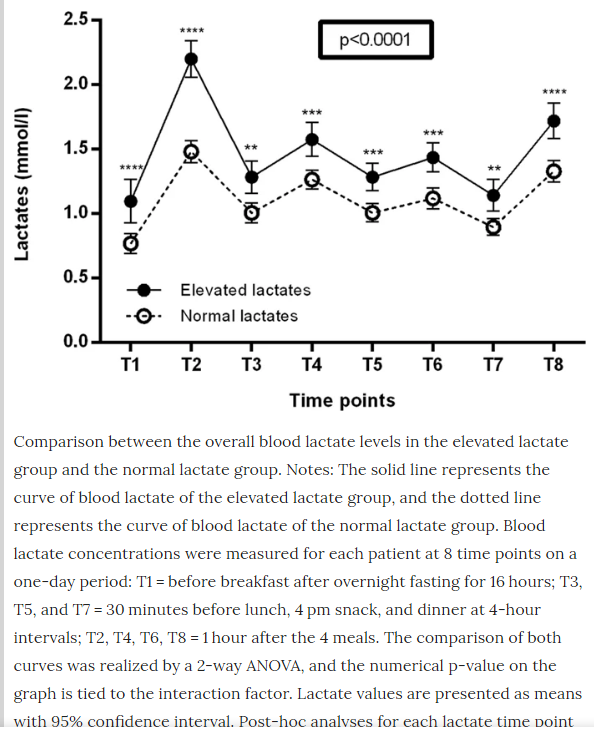
A new study in Nature “Elevated blood lactate in resting conditions correlate with post-exertional malaise severity in patients with Myalgic encephalomyelitis/Chronic fatigue syndrome” [2019] re-affirms many earlier studies. ME/CFS patients have increased level of lactate acid. One probable cause is LABO – Lactic Acid Bacterial Overgrowth, a possible variation of SIBO – Small Intestine Bacterial Overgrowth.

ME/CFS starts with higher level of lactate acid and has a greater increase of lactate acid after activitiy.

I have written about this in prior posts:

I have also created a list of common probiotics that contain lactic acid producers. The list is here. These are probiotics that should be avoided.

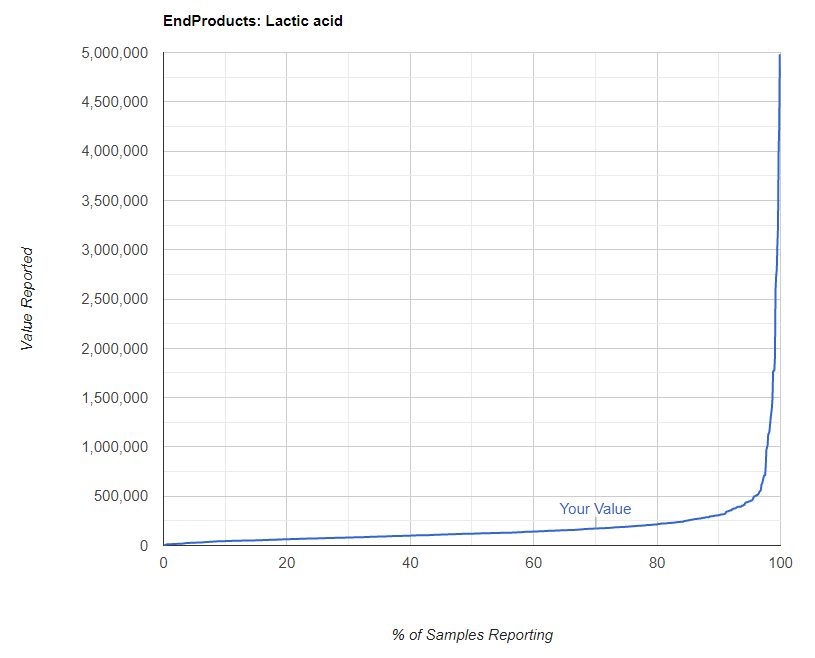
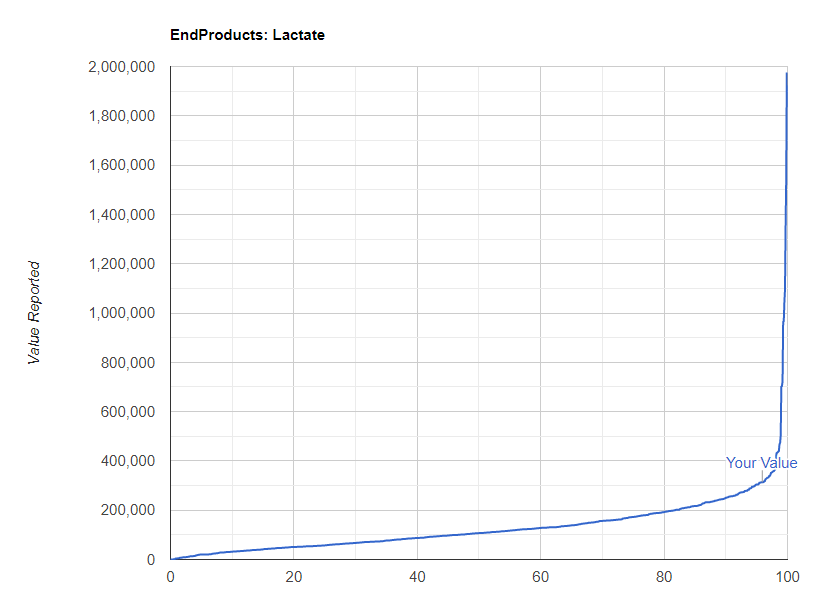
NOTE: This is just one viable model. Another model is too few lactic acid consumers. Another model is acute and chronic hepatic insufficiency [1977]. If you have uploaded your microbiome, you can see your relative ranking for production (with a crude estimate for the amount)

http://microbiomeprescription.com/library/Distribution?sampleId=1234567&dcid=92
http://microbiomeprescription.com/library/Distribution?sampleId=1234567&dcid=70

In addition to the above, the microbiome prescription site site has a option to explicitly reduce the lactic acid producers in your microbiome.

A video of what I describe below

When you go to Advance Suggestions and click see Bacteria Selection Choices

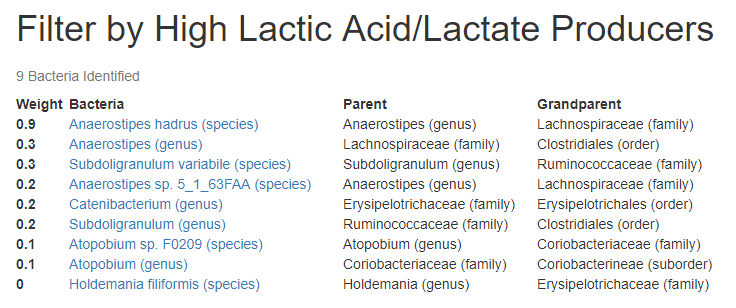
You will find at the bottom of the page, a new section: the Lactic acid/Lactate producing bacteria reported in your sample where you have more than the median amount.

Note that I have no Lactobacillus or Bifidobacterium in this list.

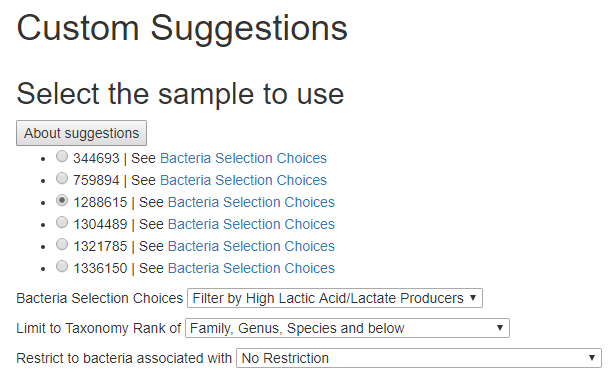
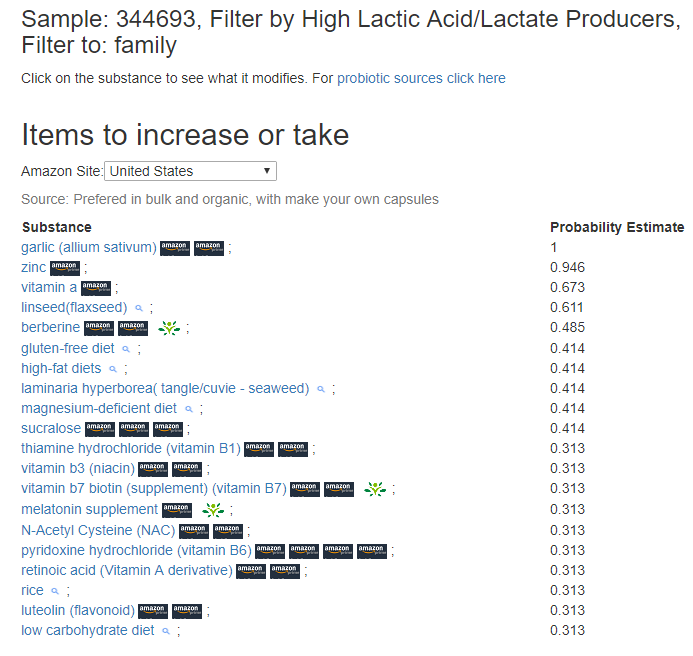
Back on the custom suggestion pages, I select this filter option, as shown below.

Then filter the modifiers and click for suggestions:

Bottom Line

This is all theoretical and focuses solely on reducing bacteria associated with lactic acid and lactate production. The suggestions should be reviewed by a medical professional before starting. It may potentially make other issues worst, so use caution and make sure you are being monitored.

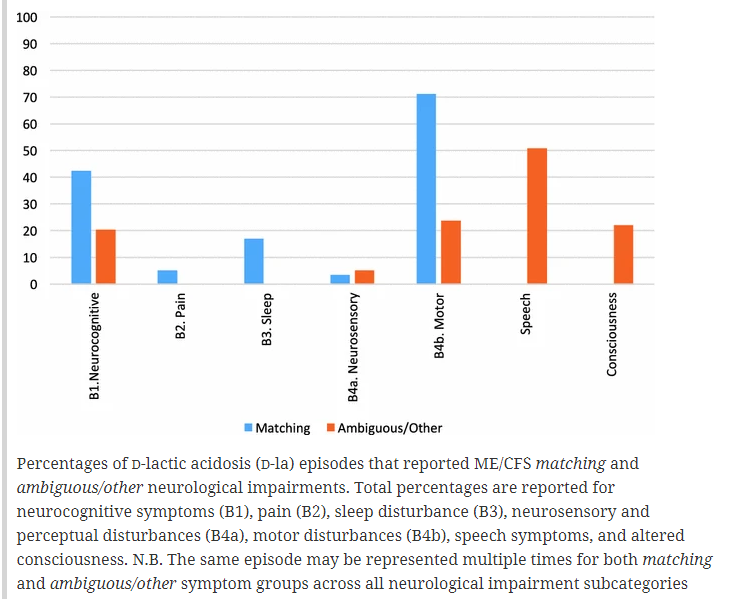
Reminder of D-Lactic acidosis and ME/CFS

A reader email indicating that he believe that some of my suggestions also produced lactic acid. At present that is no option for filtering, but I am working on that. This appears to be a subset of ME/CFS patients. A 2015 Guest Blog post on Health Rising provided a summary of early studies. The latest study is below.

Examining clinical similarities between myalgic encephalomyelitis/chronic fatigue syndrome and D-lactic acidosis: a systematic review. [2017]

This is associated with neurlogical issues (brain fog etc).

Sleep Consequences

Sleep issues in ME/CFS may be connected to excessive D-Lactic acid (A known characteristic of ME/CFS)

Results and conclusion: Administration of L-lactate does not influence sleep-wake cycle of experimental animals. At the same time, its artificial optical analog D-lactate induces the significant (as compared to the control) decrease in wake (34.8% to 26.5%) and increase in slow wave sleep (57.4% to 69.2%). It has been suggested that D-lactate may be the antagonist of one or several L-lactate receptors.

[D-lactate as a novel somnogenic factor?] [2020]

Root cause: Low Veillonella?

See this post: on what this bacteria does with lactic acid.

I have lactate acid producer estimates on the microbiomeprescription site for uploaded 16s samples (typically ubiome). My own numbers appear to follow the research. With onset it kept increasing, and with the last ubiome started to decrease.

I did not have significant neurological issues BUT these values are all low according to the uploaded samples. Which suggests that while the amount increased, it did not reach impairing levels for neurological issues

The list below are what is in the database as producing the two items above. If you know of additional items, please forward the information (with a link to the study of course!).

Acidiphilium (genus)
Acidiphilium cryptum (species)
Aerococcus (genus)
Aerococcus christensenii (species)
Aerococcus urinae (species)
Aerococcus urinaeequi (species)
Aerococcus vaginalis (species)
Aerococcus viridans (species)
Allobaculum (genus)
Allobaculum stercoricanis (species)
Anaerostipes (genus)
Anaerostipes butyraticus (species)
Anaerostipes caccae (species)
Anaerostipes hadrus (species)
Anaerostipes sp. 1y-2 (species)
Anaerostipes sp. 3_2_56FAA (species)
Anaerostipes sp. 494a (species)
Anaerostipes sp. 5_1_63FAA (species)
Anaerostipes sp. AIP 183.04 (species)
Anaerostipes sp. IE4 (species)
Atopobium (genus)
Atopobium parvulum (species)
Atopobium rimae (species)
Atopobium sp. BS2 (species)
Atopobium sp. DMCT15023 (species)
Atopobium sp. F0209 (species)
Atopobium sp. HHRM1715 (species)
Atopobium sp. ICM57 (species)
Atopobium sp. ICM58 (species)
Atopobium sp. MVA9 (species)
Atopobium sp. S3MV24 (species)
Atopobium sp. S3PFAA1-4 (species)
Atopobium sp. S4-A11a (species)
Atopobium vaginae (species)
Bacillus coagulans (species)
Bifidobacterium (genus)
Bifidobacterium actinocoloniiforme (species)
Bifidobacterium adolescentis (species)
Bifidobacterium angulatum (species)
Bifidobacterium animalis (species)
Bifidobacterium asteroides (species)
Bifidobacterium biavatii (species)
Bifidobacterium bifidum (species)
Bifidobacterium bohemicum (species)
Bifidobacterium bombi (species)
Bifidobacterium boum (species)
Bifidobacterium breve (species)
Bifidobacterium catenulatum (species)
Bifidobacterium choerinum (species)
Bifidobacterium commune (species)
Bifidobacterium dentium (species)
Bifidobacterium gallicum (species)
Bifidobacterium gallinarum (species)
Bifidobacterium indicum (species)
Bifidobacterium kashiwanohense (species)
Bifidobacterium longum (species)
Bifidobacterium magnum (species)
Bifidobacterium merycicum (species)
Bifidobacterium minimum (species)
Bifidobacterium mongoliense (species)
Bifidobacterium pseudocatenulatum (species)
Bifidobacterium pseudolongum (species)
Bifidobacterium pullorum (species)
Bifidobacterium ruminantium (species)
Bifidobacterium saeculare (species)
Bifidobacterium scardovii (species)
Bifidobacterium sp. (species)
Bifidobacterium sp. 120 (species)
Bifidobacterium sp. 138 (species)
Bifidobacterium sp. 65947 (species)
Bifidobacterium sp. MSX5B (species)
Bifidobacterium stercoris (species)
Bifidobacterium subtile (species)
Bifidobacterium thermacidophilum (species)
Bifidobacterium tsurumiense (species)
Cardiobacterium (genus)
Cardiobacterium hominis (species)
Cardiobacterium valvarum (species)
Carnobacterium (genus)
Carnobacterium divergens (species)
Carnobacterium maltaromaticum (species)
Catenibacterium (genus)
Catenibacterium mitsuokai (species)
Collinsella (genus)
Collinsella aerofaciens (species)
Collinsella intestinalis (species)
Collinsella sp. GD3 (species)
Collinsella stercoris (species)
Collinsella tanakaei (species)
Comamonas (genus)
Comamonas testosteroni (species)
Coprobacillus (genus)
Coprobacillus cateniformis (species)
Coprobacillus sp. D6 (species)
Desulfitobacterium (genus)
Desulfitobacterium aromaticivorans (species)
Desulfitobacterium metallireducens (species)
Desulfobacterium (genus)
Desulfobacterium autotrophicum (species)
Enterococcus (genus)
Enterococcus alcedinis (species)
Enterococcus asini (species)
Enterococcus avium (species)
Enterococcus canis (species)
Enterococcus casseliflavus (species)
Enterococcus cecorum (species)
Enterococcus columbae (species)
Enterococcus durans (species)
Enterococcus faecalis (species)
Enterococcus faecium (species)
Enterococcus gilvus (species)
Enterococcus haemoperoxidus (species)
Enterococcus hermanniensis (species)
Enterococcus hirae (species)
Enterococcus italicus (species)
Enterococcus malodoratus (species)
Enterococcus mundtii (species)
Enterococcus pallens (species)
Enterococcus raffinosus (species)
Enterococcus sp. C6I11 (species)
Enterococcus sp. SI-4 (species)
Enterococcus sulfureus (species)
Enterococcus ureasiticus (species)
Fusobacterium (genus)
Fusobacterium equinum (species)
Fusobacterium gonidiaformans (species)
Fusobacterium mortiferum (species)
Fusobacterium necrogenes (species)
Fusobacterium necrophorum (species)
Fusobacterium nucleatum (species)
Fusobacterium perfoetens (species)
Fusobacterium periodonticum (species)
Fusobacterium sp. ACB2 (species)
Fusobacterium sp. CM21 (species)
Fusobacterium sp. CM22 (species)
Fusobacterium sp. CM55 (species)
Fusobacterium sp. DJF_B100 (species)
Fusobacterium sp. OBRC1 (species)
Fusobacterium ulcerans (species)
Fusobacterium varium (species)
Gemella (genus)
Gemella asaccharolytica (species)
Gemella haemolysans (species)
Gemella morbillorum (species)
Gemella palaticanis (species)
Gemella sp. 933-88 (species)
Gemella sp. oral strain A31SC (species)
Haemophilus (genus)
Haemophilus aegyptius (species)
Haemophilus ducreyi (species)
Haemophilus haemoglobinophilus (species)
Haemophilus haemolyticus (species)
Haemophilus influenzae (species)
Haemophilus parahaemolyticus (species)
Haemophilus parainfluenzae (species)
Haemophilus pittmaniae (species)
Haemophilus sputorum (species)
Holdemania (genus)
Holdemania filiformis (species)
Lachnobacterium (genus)
Lachnobacterium bovis (species)
Lactobacillus (genus)
Lactobacillus acetotolerans (species)
Lactobacillus acidophilus (species)
Lactobacillus agilis (species)
Lactobacillus algidus (species)
Lactobacillus amylolyticus (species)
Lactobacillus animalis (species)
Lactobacillus antri (species)
Lactobacillus apis (species)
Lactobacillus bifermentans (species)
Lactobacillus brantae (species)
Lactobacillus brevis (species)
Lactobacillus casei (species)
Lactobacillus ceti (species)
Lactobacillus coleohominis (species)
Lactobacillus composti (species)
Lactobacillus coryniformis (species)
Lactobacillus crispatus (species)
Lactobacillus crustorum (species)
Lactobacillus curvatus (species)
Lactobacillus delbrueckii (species)
Lactobacillus fermentum (species)
Lactobacillus floricola (species)
Lactobacillus fornicalis (species)
Lactobacillus gasseri (species)
Lactobacillus harbinensis (species)
Lactobacillus hayakitensis (species)
Lactobacillus helveticus (species)
Lactobacillus iners (species)
Lactobacillus ingluviei (species)
Lactobacillus intestinalis (species)
Lactobacillus jensenii (species)
Lactobacillus johnsonii (species)
Lactobacillus kefiranofaciens (species)
Lactobacillus kefiri (species)
Lactobacillus kitasatonis (species)
Lactobacillus lindneri (species)
Lactobacillus malefermentans (species)
Lactobacillus mellifer (species)
Lactobacillus mellis (species)
Lactobacillus mucosae (species)
lactobacillus murinus (Species)
Lactobacillus namurensis (species)
Lactobacillus nodensis (species)
Lactobacillus oligofermentans (species)
Lactobacillus oris (species)
Lactobacillus oryzae (species)
Lactobacillus ozensis (species)
Lactobacillus paracasei (species)
Lactobacillus parafarraginis (species)
Lactobacillus paralimentarius (species)
Lactobacillus perolens (species)
Lactobacillus plantarum (species)
Lactobacillus psittaci (species)
Lactobacillus rapi (species)
Lactobacillus reuteri (species)
Lactobacillus rhamnosus (species)
Lactobacillus rodentium (species)
Lactobacillus rogosae (species)
Lactobacillus ruminis (species)
Lactobacillus saerimneri (species)
Lactobacillus sakei (species)
Lactobacillus salivarius (species)
Lactobacillus sanfranciscensis (species)
Lactobacillus saniviri (species)
Lactobacillus selangorensis (species)
Lactobacillus songhuajiangensis (species)
Lactobacillus sp. 66c (species)
Lactobacillus sp. 7_1_47FAA (species)
Lactobacillus sp. Akhmro1 (species)
Lactobacillus sp. BL302 (species)
Lactobacillus sp. C30An8 (species)
Lactobacillus sp. C4I18 (species)
Lactobacillus sp. CR-609S (species)
Lactobacillus sp. NRCT-KU 1 (species)
Lactobacillus sp. S16 (species)
Lactobacillus sp. TAB-22 (species)
Lactobacillus sp. TAB-26 (species)
Lactobacillus sp. TAB-30 (species)
Lactobacillus taiwanensis (species)
Lactobacillus ultunensis (species)
Lactobacillus vaccinostercus (species)
Lactobacillus vaginalis (species)
Lactobacillus vini (species)
Lactococcus (genus)
Lactococcus fujiensis (species)
Lactococcus garvieae (species)
Lactococcus lactis (species)
Lactococcus raffinolactis (species)
Lactococcus sp. D2 (species)
Lactococcus sp. MH5-2 (species)
Lactococcus sp. STM1 (species)
Lactococcus sp. STM31 (species)
Lactococcus sp. TP1MJ (species)
Lactococcus sp. TP2MJ (species)
Leptotrichia (genus)
Leptotrichia genomosp. C1 (species)
Leptotrichia goodfellowii (species)
Leptotrichia hofstadii (species)
Leptotrichia hongkongensis (species)
Leptotrichia shahii (species)
Leptotrichia sp. oral taxon 223 (species)
Leptotrichia sp. oral taxon 225 (species)
Leptotrichia sp. PG10 (species)
Leptotrichia sp. PTE15 (species)
Leptotrichia wadei (species)
Leuconostoc (genus)
Leuconostoc carnosum (species)
Leuconostoc fallax (species)
Leuconostoc gelidum (species)
Leuconostoc inhae (species)
Leuconostoc lactis (species)
Leuconostoc mesenteroides (species)
Leuconostoc miyukkimchii (species)
Leuconostoc pseudomesenteroides (species)
Leuconostoc sp. C7I4 (species)
Methylobacterium (genus)
Microbacterium (genus)
Microbacterium arborescens (species)
Microbacterium aurantiacum (species)
Microbacterium halophilum (species)
Microbacterium lacus (species)
Microbacterium profundi (species)
Microbacterium saperdae (species)
Microbacterium trichothecenolyticum (species)
Microbacterium xylanilyticum (species)
Microbacterium yannicii (species)
Moryella (genus)
Moryella indoligenes (species)
Oenococcus (genus)
Pediococcus (genus)
Pediococcus argentinicus (species)
Pediococcus pentosaceus (species)
Pediococcus siamensis (species)
Pediococcus sp. 3107O2 (species)
Pediococcus sp. MFC1 (species)
Rhizobium (genus)
Rhizobium leguminosarum (species)
Roseburia (genus)
Roseburia cecicola (species)
Roseburia faecis (species)
Roseburia hominis (species)
Roseburia intestinalis (species)
Roseburia inulinivorans (species)
Roseburia sp. 11SE38 (species)
Roseburia sp. 11SE39 (species)
Roseburia sp. 499 (species)
Roseburia sp. DJF_RR73 (species)
Rothia (genus)
Rothia aeria (species)
Rothia dentocariosa (species)
Rothia mucilaginosa (species)
Rothia sp. BBH4 (species)
Rothia sp. THG-N7 (species)
Rothia terrae (species)
Ruminococcus (genus)
Ruminococcus albus (species)
Ruminococcus bromii (genus)
Ruminococcus callidus (species)
Ruminococcus champanellensis (species)
Ruminococcus faecis (species)
Ruminococcus flavefaciens (species)
Ruminococcus gauvreauii (species)
Ruminococcus lactaris (genus)
Scardovia (genus)
Scardovia wiggsiae (species)
Selenomonas (genus)
Selenomonas artemidis (species)
Selenomonas bovis (species)
Selenomonas dianae (species)
Selenomonas flueggei (species)
Selenomonas genomosp. P5 (species)
Selenomonas infelix (species)
Selenomonas lacticifex (species)
Selenomonas noxia (species)
selenomonas ruminantium (species)
Selenomonas sp. oral taxon 137 (species)
Selenomonas sputigena (species)
Serratia (genus)
Serratia marcescens (species)
Streptococcus (genus)
Streptococcus agalactiae (species)
Streptococcus australis (species)
Streptococcus constellatus (species)
Streptococcus cristatus (species)
Streptococcus danieliae (species)
Streptococcus dentapri (species)
Streptococcus dentasini (species)
Streptococcus dentirousetti (species)
Streptococcus didelphis (species)
Streptococcus equinus (species)
Streptococcus gallolyticus (species)
Streptococcus gordonii (species)
Streptococcus hyointestinalis (species)
Streptococcus infantarius (species)
Streptococcus infantis (species)
Streptococcus iniae (species)
Streptococcus marimammalium (species)
Streptococcus massiliensis (species)
Streptococcus merionis (species)
Streptococcus mitis (species)
Streptococcus mutans (species)
Streptococcus oralis (species)
Streptococcus orisasini (species)
Streptococcus orisratti (species)
Streptococcus parasanguinis (species)
Streptococcus parauberis (species)
Streptococcus pasteurianus (species)
Streptococcus peroris (species)
Streptococcus pneumoniae (species)
Streptococcus pseudoporcinus (species)
Streptococcus rubneri (species)
Streptococcus rupicaprae (species)
Streptococcus salivarius (species)
Streptococcus sanguinis (species)
Streptococcus seminale (species)
Streptococcus sobrinus (species)
Streptococcus sp. 11aTha1 (species)
Streptococcus sp. 2011_Ileo_MS_A10 (species)
Streptococcus sp. 2011_Oral_MS_A3 (species)
Streptococcus sp. 3244O2 (species)
Streptococcus sp. BS35a (species)
Streptococcus sp. GMD6S (species)
Streptococcus sp. HPH0090 (species)
Streptococcus sp. oral taxon 071 (species)
Streptococcus sp. oral taxon G59 (species)
Streptococcus sp. oral taxon G63 (species)
Streptococcus sp. S16-11 (species)
Streptococcus suis (species)
Streptococcus thermophilus (species)
Streptococcus urinalis (species)
Streptococcus vestibularis (Species)
Subdoligranulum (genus)
Subdoligranulum variabile (species)
Tetragenococcus (genus)
Tetragenococcus koreensis (species)
Tetragenococcus muriaticus (species)
Tetragenococcus solitarius (species)
Turicibacter (genus)
Turicibacter sanguinis (species)
Vagococcus (genus)
Vagococcus entomophilus (species)
Vagococcus fluvialis (species)
Vagococcus lutrae (species)
Vagococcus salmoninarum (species)
Vagococcus teuberi (species)
Weissella (genus)

Entering Symptoms When taking microbiome sample

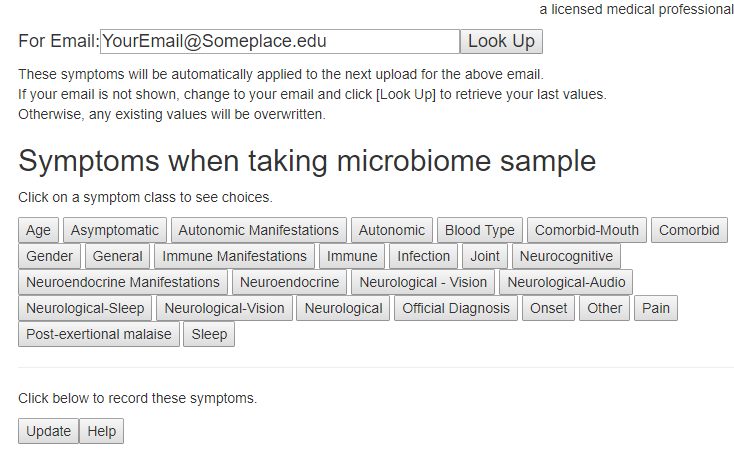
A reader expressed frustration because he could not remember his symptoms when he took his ubiome sample. In response to this, I have added a new page to allow you to record symptoms when you do a sample AND these symptoms will be automatically applied to your next upload.

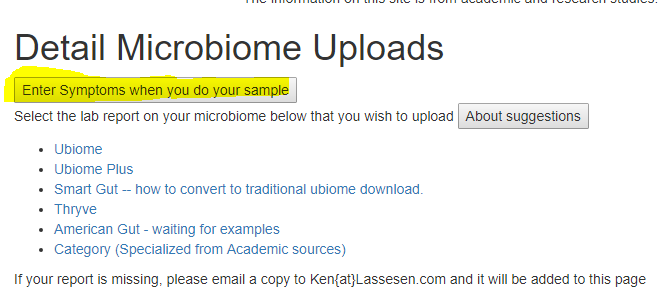
This is located on the detail upload page ( http://microbiomeprescription.com/upload)_

http://microbiomeprescription.com/upload

This will take you over to the new page.

If you log on first, the email should be yours. If you have never done an upload, then enter your email, click Look Up (to clear out any symptom that some one added to the bogus email) and proceed.

You can return later and adjust the symptoms if you wish.

Naive Prediction of Symptoms from microbiome

This item has been on my backburner for a while and today I came up with an efficient algorithm to compute a short most probable symptoms. The results on my own samples were actually quite accurate.

The process is simple: Apply analysis (AI techniques) to the uploaded microbiome samples annotated with symptoms. We then flip the results to predict from an individual sample using these results. A lot of computational magic going in and out.

I have MTHFR issues (reported by conventional testing), this is my age range, cold hands and feet, I have been well aware since the 1970’s of eye focus issues (from eye specialist). The disorientation matches up with my being a high functioning autism spectrum person. The last item makes it a slam dunk….

I checked another person who I know the medical history. The person has TMJ, and just about every symptom listed!

Where is this new feature

One thing that I realized that it predicted symptoms that I would NOT associate with my current state– but actually matches the long term medical issues. For example, eye focus issues — that goes back 40 years and which is not on my radar as an active symptom.

I suspect “mouth sores” which showed up on other issues — may include gum disease being active.

Addendum

A reader try it and posted on facebook.

As a result, I added a link to the page to also give extended prediction with an indicator of the prediction confidence (score).

I suspect there will be misses in this list.