Is ME/CFS a case of CBIS?

A reader asked me to review a new paper “Chronic bacterial intoxication syndrome under the mask of CFS/ME” that is being discussed a lot on Phoenix Rising. I tend to have an interesting perspective:

  • being in remission from CFS/ME I have deep desired to be current but far from desperate
  • many people reading and discussing are desperate. Desperation often diminished critical analysis
  • I am well trained professionally — not only in the scientific method, but also in statistical analysis.

Key Weakness of CBIS paper

Over the last few decades, it is common for a forlorn hope discovery to be done solely on some finding of a group of ME/CFS patients. The critical test is a simple one: a third party lab confirming the findings with a different group of ME/CFS patients with a matching control/healthy group. The ideal is multiple labs confirming this. Failure to replicate is too frequently the slow death of theories (but many “believers” will continue to advocate the theory – they want something to believe in).

Participants: All patients (children up infancy and adults aged till 80 years) who seeked advice in
clinics during 2009-2020 with complaints consistent with a diagnosis of CFS, which was previously
diagnosed in almost a third of patients on former stages of examination and treatment.

There are no Controls being cited. Additionally all of the patients appears to be from two clinics in the Ukraine. This may be an environmentally homogenous group (shared DNA, shared diet, shared vaccine history).

In all patients with typical features of CFS there was revealed a focus of chronic bacterial infection
in the kidneys, which more often remained clinically locally asymptomatic and was called Nephro
dysbacteriosis.

The term “Nephro dysbacteriosis” is not found on PubMed, so how can it be “was called

The issue of being “asymptomatic” is a term of today, with asymptomatic COVID being an echo. The concept is not new, with hypercoagulation model — we have it being asymptomatic in terms of expected symptoms (strokes,  Deep Vein Thrombosis etc) but symptomatic with fertility issues. Similarly with Cecile Jadin model, we have “occult infections” which do not appear with typical tests, but are detected with specialized tests.

If it is true, what should be forecasted? Well, a chronic low level kidney infection should manifest itself with kidney diseases and lab tests over time. Over the last many decades, there appears to be only a single paper, with no commonality.

 Increases in pain distribution were associated with reductions in serum essential amino acids, urea, serum sodium and increases in serum glucose and the 24-hour urine volume; however the biochemistry was different for each pain area. Regression modelling revealed potential acetylation and methylation defects in the pain subjects. 

Widespread pain and altered renal function in ME/CFS patients[2016]”

Skipping the 14 pages of the paper is reciting history and many more pages on individual histories, we come to identification of the bacteria

Bacteria that had to live naturally in our intestines and work there productively, providing human life. But which, apparently by mistake, but purposefully settled in the kidneys. Most often they were enterococci and enterobacteria-Escherichia coli, Klebsiella, Proteus, Enterobacteriaceae, Morganella, Acinetobacteria, Hafnia,
Seratia and others, in no single cases – Staphylococcus and Streptococcus, less often – Nosocomial Pseudomonas aeruginosa.

“A toxicological blood test, the results of which will be presented in Report 8, was considered as a laboratory confirmation of the diagnosis CBIS.” – problem is this, a blood test is not kidney specific. We could be detecting bacteria escaping from the guts only.

Note also, this is not a test normally available — it is “a toxicological blood test using the “Toxicon” diagnostic system developed by a group of Ukrainian scientists

What is their treatment?

The treatment are “bacterial vaccines”. This is a concept not well known in the west and will likely be at least a decade before any significant approval would be granted in the west. A 2018 review is well worth readin , Vaccine development for enteric bacterial pathogens: Where do we stand? (Full article PDF). Two quotes from the paper:

“During the first course of immunization with bacterial autovaccine, the intensity of pain in all patients decreased
significantly, and after 2-3 courses – completely passed. During follow-up observation there were no recurrences of trigeminitis.”

“There was prepared bacterial auto vaccine and was carried out immunization with a course of 10 injections. Already during vaccination and for the next 2 years of the follow-up observation there were no more abdominal pain attacks.”

Attitude Issues

The following indicate bravado and bias — they can be effective in winning an audience and a following. Often this helps with raising funds for the person to continue research.

  • the new revolutionary previously unknown diagnosis Chronic Bacterial Intoxication Syndrome (CBIS) that gives such a long-awaited in-depth clinical understanding and discovery of the true basic etiological and pathogenetic causes of the long-known and worldwide-spread, but still etiologically mysterious CFS/ME”
  • “Moreover, it was found that in at least 90% of patient’s nephron dysbacteriosis and CBIS had developed precisely after thoughtless, expansive and aggressive antibiotic therapy, which often began in childhood.” — someone is on soap box describing a popular demon.

Bottom Line

A vaccine against a kidney bacteria will also have direct impact on the same bacteria in the gut microbiome. On the flip side, appropriate antibiotics would also impact the same bacteria in the Jadin’s protocol using antibiotics will also impact kidney infections.

There is one important difference: vaccines have a longer life of action(typically a year or more) than an antibiotics. Also be aware that the study cited that up to 10 courses of vaccines were needed with some. This sounds a bit like 10 rounds of antibiotics!!

Is it Kidney or Gut? Do we need to use a vaccine or bacteria phages or antibiotics or other forms of microbial manipulations?

Their asserted results are similar to that asserted from both Jadin’s antibiotics protocol and the Hemex protocol (which often uses antibiotics with anticoagulants like heparin).

In 30/35 (85.7%) cases there was almost complete clinical remission in the course of both fibromyalgia and in general CBIS, which in 23/35 (65.7%) patients lasted from 3 to 5 years (observation period).

page 48

The statement that in the basis of chronic fatigue in various diseases there is a single pathogenetic mechanism – persistent chronic bacterial intoxication due to nephrodisbacteriosis may be a little premature.

page 82.

To my mind, for treatment of CFS/ME, the root cause is excessive growth of multiple bacteria with both this model and my microbiome model. The goal is to correct this — vaccine, antibiotics, phages, diet and supplement changes? Whatever works. The key factor is that it is NOT a cure, it is a remission — one that needs to be worked on to maintain.

Until vaccines become available, appropriate multiple courses of the right antibiotics is available today (MD willing!!!). Unfortunately, most MDs are not trained on addressing multiple bacterial infection without nuking the gut.
Their results are creditable, their treatment is creditable — their model may not be

Fecal Matter Transplant for ME/CFS – 2023 Update

Just in, July 29, 2023 study:

FMT was safe but did not relieve symptoms or improve ... patients with CFS.

Randomized, double-blinded, placebo-controlled pilot study: efficacy of faecal microbiota transplantation on chronic fatigue syndrome [2023]

The earlier post from 2021 is below.

A reader wrote me with some good questions. My answer is focused on ME/CFS but the analysis applies to UC, Crohn’s, IBS, Sibo, Autism and every disease with distinctive microbiome shift (here’s a partial list).

My wife is considering a fecal microbiota transplant(FMT) because of her chronic (CFS/Fibromyalgia) complaints and tested leaky gut, SIBO and microbiome dysbiosis.

We’ve found a company that claims to deliver fully prepared stool of “super donors” for about $1900 all included. Do you know this company and do you think they are trustworthy in their claims? https://microbioma.org/en/home-eng/

Do you have any other advice for us in relation to FMT, for example other trustworthy companies maybe in the area that we live (Europe) or perhaps an evidence based warning that she should not do this?

Hope to hear from you.

A 2019 article is worth reading The potential and pitfalls of fecal transplants

FMT is effectively an Organ Transplant…

For conventional medicine, there is a 10-15% rejection rate with the use of medications to prevent rejection. The following are factors to consider for organ transplants and likely apply to fecal matter transplants.

  • Ensure recipient and donor have compatible blood types
  • Perform genetic testing to ensure compatible recipient and donor matches
  • In the case of living donors, donor organs from relatives are preferred

Blood Type

Not only should blood type be a factor, but secretor status. There should be a match – being a “super donor” implies a naïve understanding of FMT and transplants in general.

Generic Testing

There is little literature here. My own feeling is that we need at least strain level comparisons between donors and recipient having considerable agreement. The volumes may be different, but the strains should be similar for bacteria not associated with the condition (i.e. for ME/CFS those that are high in the species the list here ideally, those species will be missing). Adding a page to the website on this issue would not be too hard (when there is a demand for it).

Donations from relatives are preferred

Bacteriophage α-diversity is important!

In this retrospective analysis, FMTs with increased bacteriophage α-diversity were more likely to successfully treat rCDI. In addition, the relative number of bacteriophage reads was lower in donations leading to a successful FMT. These results suggest that bacteriophage abundance may have some role in determining the relative success of FMT.

The success of fecal microbial transplantation in Clostridium difficile infection correlates with bacteriophage relative abundance in the donor: a retrospective cohort study (2019)

Other Preparation tests

From Johns Hopkins: “A potential donor will need to be screened by their physician for infectious pathogens by undergoing the following tests:

  • Blood tests: Hepatitis A, B, and C serologies; HIV; RPR
  • Stool tests: Ova and parasites; C. difficile PCR; culture and sensitivity; giardia antigen”

Microbiome is a hot topic — hence money maker

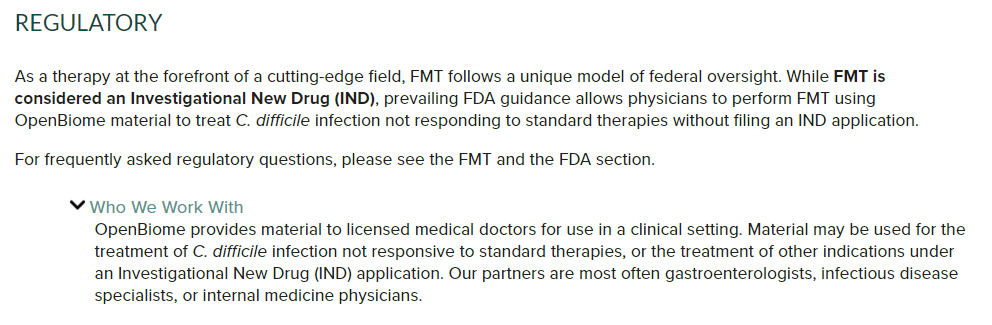
Microbiome transplants, including “turkey baster DYI” are hot. A summary is given on WebMd. One of the few FDA approved sources is OpenBiome. You should note their scope of operation:

https://www.openbiome.org/regulatory

This reader cites, Microbioma.org. It is based in the Principality of Asturias, an  autonomous community in northwest Spain, I suspect that this is to avoid government oversight (i.e. “off-shore unregulated havens”). I could not find either hospital or universities or similar that are associated with them — there were no studies on PubMed citing this organization.

Ideally, this firm would provide 16s strain level data on all available donors. They claim using AI to match. While, having done AI for decades, I would want to see their algorithms because AI often is biased or simply wrong. With no publications (and thus peer review), there is no evidence that their AI works. Citing AI is a good marketing strategy.

A few years ago, the Dove Clinic for Integrate Medicine in the UK offered FMT for CFS. They no longer do but for leaky gut offers “Gut Flora Replacement Therapy

ME-Pedia on FMT

This page is current on FMT for ME/CFS. Australia allows it to occur for ME/CFS with Thomas J. Borody, MD and  Paul Froomes, MD being the best known. I observe the following:

Some of their patients have shared their experiences. It was not uncommon to hear “almost immediate remission that lasted about 6 weeks and then ME came back” followed by many additional FMT attempts.

Large treatment effects were observed for the intention-to-treat sample with a reduction in Streptococcus viable count and improvement on several clinical outcomes including total symptoms, some sleep (less awakenings, greater efficiency and quality) and cognitive symptoms (attention, processing speed, cognitive flexibility, story memory and verbal fluency). Mood, fatigue and urine D:L lactate ratio remained similar across time. Ancillary results infer that shifts in microbiota were associated with more of the variance in clinical changes for males compared with females.

Open-label pilot for treatment targeting gut dysbiosis in myalgic encephalomyelitis/chronic fatigue syndrome: neuropsychological symptoms and sex comparisons [2018]

“Based on the selected studies, the Adverse Effects(AE) rate of FMT is 39.3%, with most AE being mild and self-limiting. Severe Adverse Effects (SAE) were uncommon at 5.3%, and many were only possibly related to the FMT. ” i.e. 1/20 odds of SAE Adverse events of fecal microbiota transplantation: a meta-analysis of high-quality studies [2021]

“However, while current FDA regulations permit use of FMT for treating C. difficile infections that
have not responded to standard antibiotic therapy, use of FMT for any other indication requires
submittal and approval of an IND (investigational new drug) application to the FDA.”

Fecal Microbiota Transplantation, Washington State Health Care Authority

“[FMT Capsules] is an unapproved new drug and unlicensed biological product, which was introduced or delivered for introduction into interstate commerce in violation of the Federal Food, Drug, and Cosmetic Act (FD&C Act) [21 U.S.C. § 331(d)] and the Public Health Service Act (PHS Act) [42 U.S.C. § 262(a)(1)]. …statements indicate that your product is intended for use in the mitigation, treatment, or prevention of disease, your product is a drug under section 201(g)(1)(B) of the FD&C Act [21 U.S.C. § 321(g)(1)(B)]. 
Please be advised that to lawfully market a drug that is also a biological product, a valid biologics license application (BLA) must be in effect [42 U.S.C. § 262(a)]. Such licenses are issued only after a demonstration that the product is safe, pure, and potent. While in the development stage, such products may be distributed for clinical use in humans only if the sponsor has an investigational new drug application (IND) in effect as specified by FDA regulations (21 U.S.C. § 355(i); 42 U.S.C. § 262(a)(3); 21 CFR Part 312). “

From existing FDA warning letters for other biological products

IMHO: Both the seller and any medical person involved would likely have no viable defense against lawsuits (all types). Remember, ignorance of the law (and the FDA) is not an acceptable excuse to the courts. If someone attempts to sell, ask for a copy of their BLA.

Bottom-Line

As with clostridium difficile (C.diff), FMT should only be done after repeated attempts with antibiotics have failed. My preference for antibiotic protocol would be that of Cecile Jadin, MD. Alternatively, determine the antibiotics via a microbiome analysis and using Microbiome Prescription for suggestions (see this recent post on a 20 y.o, CFS male— the antibiotic suggested agreed with the Jadin protocol).

The idea of using FMT for ME/CFS is correct in my opinion. The problem is the naïve attempts done without approaching typing and matching of the “organ” to be transplanted. Current attempts are almost like saying – oh he has lost a lot of blood, just give him blood — from an human, a race horse, a pig, a cow etc. Blood is blood…

Remember that FMT for C.diff has around 70% success rate. That is trying to dislodge a single bacteria. With ME/CFS there are likely dozens to be dislodged…. if it is 70% success for one, then it may be 50% success for two, 35% for three etc.

Personally, I prefer going the 16s microbiome analysis route, ideally with antibiotics and diet/supplement changes. FMT is too experimental and prone to trial and error. The reported success rate for the Jadin protocol is higher than that reported for FMT.

Some prior posts on this topic:

An early twenties CFS Patient Analysis

The patient is in the mid 20’s male and under treatment with a very well known CFS specialist. “although he is stable we aren’t seeing any further improvement….  He doesn’t meet the official CFS definition since he only has the PEM (Post-exertional malaise), general on-going fatigue, and maybe some sleep issues.”

This is the first of two parts, the second part is after the first Pfizer covid shot. This will be interesting to see the shifts.

“Also, after this sample was sent into Thryve he had his first Pfizer covid shot and then had a crash – so I got another sample at that time that I should get results for in a few weeks.”

Walk thru of this blog

KEGG Results

KEGG Probiotics

I am going to do a multiway compare in the hope of clustering a consensus from different algorithms. Using advance suggestions

I tend to favor KEGG because the data it is working from is significantly complete. Using Net Benefit and Advance suggestions — we got only weak results (usually against) or no results, except for Lactobacillus paracasei. This would be my first choice for trying a probiotic except it is a histamine producer.

Probiotic (available commercially)
Bacillus thuringiensis or
Bacillus mesentericus
Clostridium butyricum
Lactobacillus paracasei (D-Lactic acid producer [2013] )
Bifidobacterium adolescentis

Enterococcus faecalis
Lactobacillus kefiri

Probiotic Suggestions Analysis

Look at the Lactobacillus Genus, we see that this person is at the 87%ile (i.e. much higher than most people). Bifidobacterium is 29%ile, i.e. in the normal range. It is not surprising that these two are low as suggestions. On the other side, there was ZERO bacillus reported (not unusual, Thryve only reports Bacillus 45% of the time) which seems to be reflected in the top suggestions being Bacillus probiotics.

Having high lactobacillus can contribute to ME/CFS Symptoms. In general, lactobacillus probiotic should be avoided unless verified to not be d-lactic acid producers (if no information, assume they produce!!)

KEGG Supplements

As with probiotics, I tend to favor KEGG suggestions for similar reasons. The list below is where their generated values falls in the bottom 5%. All of them are available on Amazon, iHerb and other suppliers

As always consult with your medical professional. A pattern to discuss: start at 1/8 of the suggested dosage and increase every 4 days (usually doubling). Do one at a time, keeping those that have apparent benefit. If you stop giving one, wait 4 days before starting the next, on occasion, stopping may reveal that it helped — just slowly.

Most of the suggestions above appears to agree with studies as illustrated above. We have 3 suggestions that are novel (unstudied) for ME/CFS: Phytase, Molybdenum, L-Lysine.

This strong agreement to studies is reassuring for using the KEGG model. The model knows only the bacteria, no lab tests or diagnosis. Far more critical (for modelling), it appears to explain that the lab results can be reliability attributed to the ME/CFS microbiome population!

Core Supplements

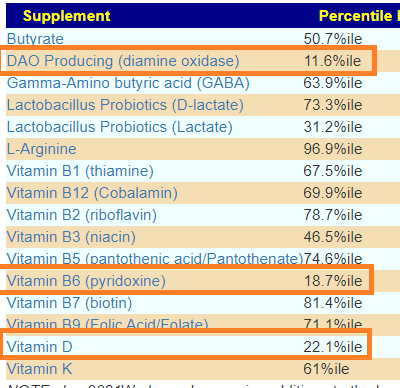
While core supplements has largely been replaced by KEGG, it is still available. There was only one supplement computed that strongly suggests supplementation, DAO. There is no studies on PubMed for CFS and DAO, however DAO does reduce histamine levels — it is a possible experiment to try. I know several people with ME/CFS that have histamine issues, in some cases, severe hay fever. There is some literature in this direction:

The second lowest is Vitamin B6

The third lowest is Vitamin D, a well establish lab result for CFS. Generally “low level” supplementation does not work because the ME/CFS microbiome does a poor job absorbing it. A collection of PubMed Studies, and my prior blog posts

An important observation

All of the above suggestions came solely from the microbiome of the person (no diagnosis information at all!!!). The suggestions agree with significant subsets of ME/CFS patients. Using the microbiome, we appear to be able to be uber-specific to the person. We are not working off “general treatment suggestions” for ME/CFS. The suggestions in this post may not apply to a different ME/CFS patient — they have a different microbiome! Likely similar, but different!

Philosophy

The concept is to supplement what is not being produced by reduced bacteria creating a more normal environment. The hope is that a more normal environment will trigger feedback loops in the microbiome that will increase the reduced (or excessive) bacteria. The microbiome is a city – with a city, reducing the crime rate can often be the result of eliminating causes like: poverty, education, job opportunities, etc.

National Library of Medicine Comparison

In general, the bacteria identified for Chronic Fatigue Syndrome in Studies is not suitable for strong pattern matching. Chronic Fatigue Syndrome has a spectrum with many subsets. This variety is reflected in the studies.

I went to the Component Analysis / Medical Conditions page and then clicked under the Count Column, i.e. by the 📚 for Chronic Fatigue. I then Clicked on Direction to put all of the flagged items (💥) at the top. I then put checked the checkbox besides them (family, genus, species). On this page the 💥 is NOT outside of the Kaltoft-Moltrup Normal Range, but above 75%ile or below 25%ile. The Change Your Microbiome / Medical Condition (PubMed) Outliers applies the 💥 with the K-M ranges (in this sample, there were actually zero outliers!!!)

Only 5 matches.

Why this change? The studies reported averages were above or below for Chronic Fatigue Sydrome compared to controls. The studies did not report extreme values (which is the K-M goal).

Using Hand-picked Bacteria

Above we have the Hand-Picked Suggestions (which uses only the above).

First, we see that two of my favorites (as a person who has dealt with ME/CFS personally) is at the top of the list: Slippery Elm and Triphala. All of the probiotics suggested are non-lactic acid producers: Bifidobacterium. We do have a disagreement with CORE suggestions on Vitamin B6 (CORE says levels may be low, above says avoid). Given that the avoid list is full of B-Vitamins, I would tend to avoid.

Other ways of Getting Suggestions

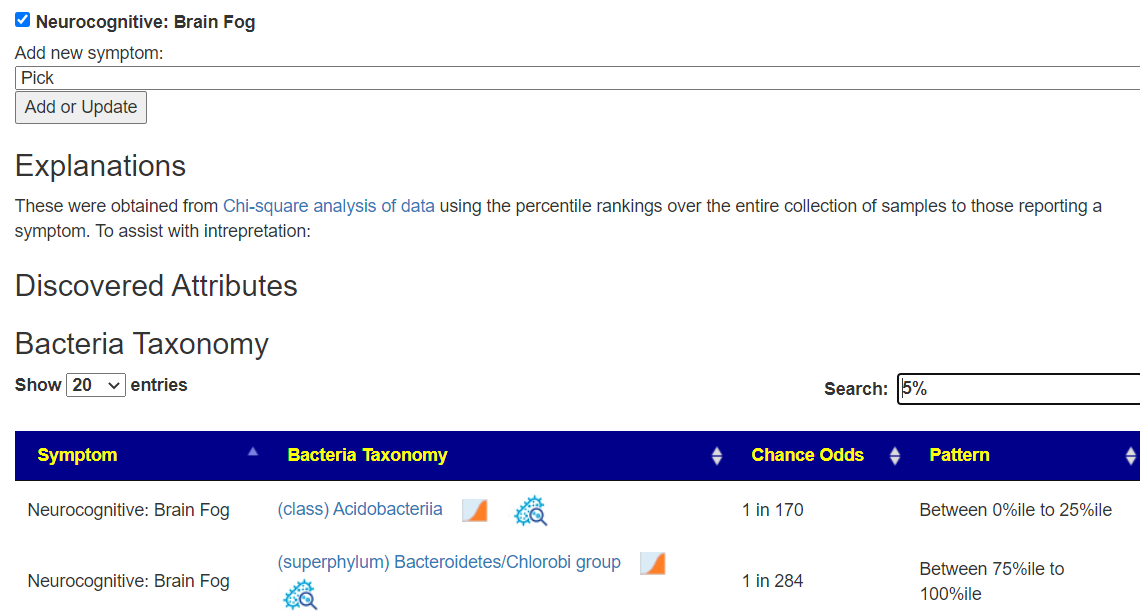
Since ME/CFS often have cognitive challenges, I have a canned computation ( Changing Your Microbiome / For Chronic Fatigue Syndrome./ Brain Fogged ). The suggestions are below.

Above I did the path that I felt was best focused a person for Chronic Fatigue Syndrome. The scopes here is less bacteria and also flags high Lactobacillus. We could add Lactobacillus to the hand picked bacteria (exercise for the reader), but I am inclined not too because lactobacillus will dominate suggestions because there are so many studies for it, the other bacteria will fade off the suggestions.

Bacteria NameAnalysis
  Dorea longicatenaToo Low
  LactobacillusToo High
  Odoribacter splanchnicusToo Low

There are some others options on the site:

Dr. Jason Hawrelak Guidance

His results are based on general health and not ME/CFS. With this sample, we see these bacteria being selected. There is nothing in common with our first analysis, and only lactobacillus with our one above.

Bacteria NameAnalysis
  AkkermansiaToo Low
  BifidobacteriumToo Low
  BlautiaToo Low
  Faecalibacterium prausnitziiToo High
  LactobacillusToo High
  RoseburiaToo Low


I would not run with these suggestions — they are simply not focused on ME/CFS.

Symptom Prediction – Citizen Science

The bacteria pattern found with some 1700 prior samples appears to match. This implies that many symptoms are microbiome bacteria caused — something that may be modified. Many of the prediction agrees with what we know. One item is new, Carbohydrate intolerance which is hinted at by our Phytase (Enzyme) recommendation from KEGG.

It also lines up with the iron recommendation and suggests the mechanism for iron being low:

Antibiotics?

The physician being worked with is not dogmatically opposed to using antibiotics. So I did antibiotics only suggestions with the results shown below. Remember this is off label use of these antibiotics.

From the original handpicked selection
From Canned ME/CFS suggestions
Using Dr. Jason Hawrelak’s Significant Bacteria

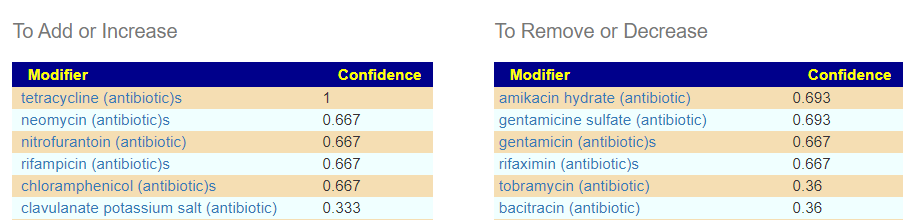
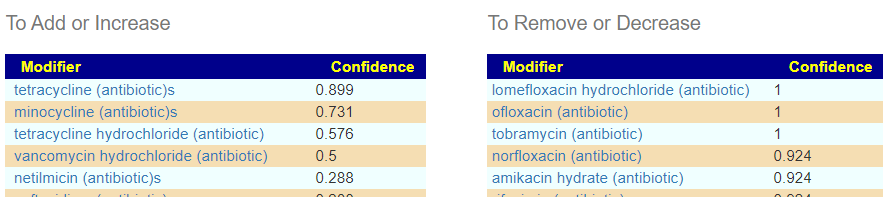
We have everyone agreeing!!! The Tetracycline family (which includes minocycline and doxycycline). My personal preference in minocycline. Not only do we have agreement between methods — we have agreement with protocols reporting success (to various extents) with ME/CFS. [Success or failure is likely connected to each patience’s microbiome]. This approach fell out of favor during the crackdown on “inappropriate use of antibiotics to prevent antibiotic resistance”, and appears to be considered again in 2021.

In this case, “prescribing antibiotics to address a microbiome dysfunction” (which is exactly what we are doing), would likely fly with most medical review boards 🙂

Bottom Line

We have come up with some very specific suggestions based on the person’s microbiome and ME/CFS as a condition. We have also looked at some less specific approaches. These approaches would often be the “stock-in-trade path” that many medical professional will walk. IMHO, they are “ok” but not as “good” or “awesome” as a really focused approach.

Remember, all suggestions should be discussed with a medical professional before doing. The Microbiome Prescription site goal is to model a variety of diseases and compute theoretical candidates for treatment. In some cases, like this post, we find that many candidates have been tested with positive results. Other candidates have not been and thus are potential ones (with logic and studies inferring their benefit).

CFS/ME Research and the microbiome

A reader forwarded a new study from March, 2021. Unfortunately, ME/CFS seems to be in an infinite loop of similar hypotheses that keep repeating with a preliminary investigation and recommendations that are not followed up. I have seen this pattern over the decades that I have followed CFS/ME research.

Potential role of microbiome in Chronic Fatigue Syndrome/Myalgic Encephalomyelits (CFS/ME)

The present research explored the composition of the intestinal and oral microbiota in CFS/ME patients as compared to healthy controls. The fecal metabolomic profile of a subgroup of CFS/ME patients was also compared with the one of healthy controls. The fecal and salivary bacterial composition in CFS/ME patients was investigated by Illumina sequencing of 16S rRNA gene amplicons. The metabolomic analysis was performed by an UHPLC-MS. The fecal microbiota of CFS/ME patients showed a reduction of Lachnospiraceae, particularly Anaerostipes, and an increased abundance of genera Bacteroides and Phascolarctobacterium compared to the non-CFS/ME groups. The oral microbiota of CFS/ME patients showed an increase of Rothia dentocariosa. The fecal metabolomic profile of CFS/ME patients revealed high levels of glutamic acid and argininosuccinic acid, together with a decrease of alpha-tocopherol. Our results reveal microbial signatures of dysbiosis in the intestinal microbiota of CFS/ME patients. Further studies are needed to better understand if the microbial composition changes are cause or consequence of the onset of CFS/ME and if they are related to any of the several secondary symptoms.

Abstract

This is not a new finding. Similar have been reported — dating back to 1998. For prior studies see these links:

Going thru the article and the methodology, I was disappointed on the use of ancient data-analysis (Principal Component Analysis, Canonical correspondence analysis) instead of Random Forest. Moving over to the good news.

The Microbiome of the ME/CFS mouth is a factor!

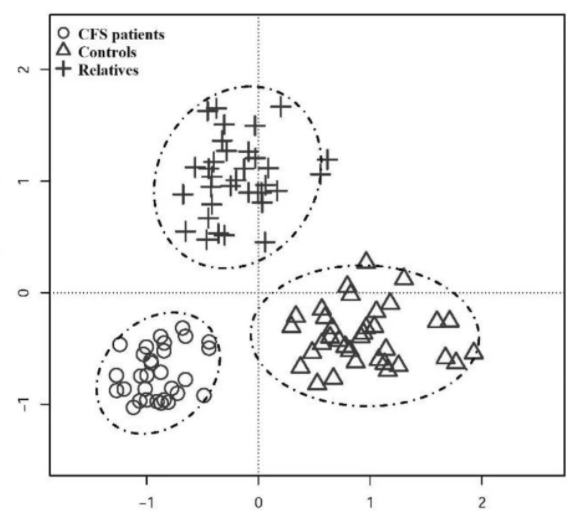
The study illustrated a clear pattern between controls, patients and the patients’ relatives


This suggests that there is a pre-disposition via the salivary microbiome for ME/CFS. The salivary microbiome is formed by kisses, and just being in the same living space (this was demonstrated in a recent study where the microbiome of family pets were transferred to the children [2021] [2021])

It is nice to see this clearly demonstrated. This has been reported prior Chronic fatigue syndrome patients have alterations in their oral microbiome composition and function. [Sep 2018]

In prior posts, over the last 7 years, I have flagged this issue:

What are the changes in the mouth bacteria (with links to what modifies these bacteria)

Bottom Line

The authors asked “if they are related to any of the several secondary symptoms“, the answer is yes. For several years we have demonstrated that on Microbiome Prescription with citizen science.

https://microbiomeprescription.com/Library/CitizenScience?pvalue=0.01&symptomIds=289

Similarly, “if the microbial composition changes are cause or consequence of the onset of CFS/ME” can be answered as: Some transitory event (i.e. infection, stress, vaccination) causes a change of the microbiome composition. This altered composition takes on a life of its own and cascade into ME/CFS.

My own experience, and some others, are that by altering the microbiome composition back towards normal, ME/CFS improves or disappears.

The unfortunate aspect is that it cannot be handled in ‘one drug solves it’ or a pro-forma cookbook by medical professionals. Every individual has a different microbiome shift with items suggested for one ME/CFS person being contraindicated for a different ME/CFS person based on their 16s determined microbiome and using the artificial intelligence used for suggestions on Microbiome Prescription.

My expectations are that they will be no traction towards treating ME/CFS by conventional researchers. The reason is simple — the ground rules for studies and processes will send them into cascading challenges which required “stepping outside” of establish processes to get traction. This has been described as the “Dogma of Conformity”.

A review of a new CFS/ME Hypothesis

A reader asked for my thoughts on “Pathophysiology of skeletal muscle disturbances in Myalgic Encephalomyelitis/Chronic Fatigue Syndrome (ME/CFS)” 21 Apr 2021. With over 20 years of reading many many hypothesis of ME/CFS, I have learnt to look for earlier indicators that it will be unlikely.

First, “skeletal muscle disturbances” applies to a subset of ME/CFS only. The second item is simple – is this a new hypothesis or an old one-recycled? What I found was:

What is the new hypothesis?

The author’s earlier title was “A Unifying Hypothesis of the Pathophysiology of Myalgic Encephalomyelitis/Chronic Fatigue Syndrome (ME/CFS): Recognitions from the finding of autoantibodies against ß2-adrenergic receptors” [2020] There is no reference to acylcarnitine in the document – this is a red flag for an under-researched paper. You want to cite and discuss prior papers on the same topic.

“sympathetic overactivity in the presence of vascular dysregulation by ß2AdR dysfunction causes predominance of vasoconstrictor influences in brain and skeletal muscles,”

The conclusion is below and amounts (IMHO) to a bunch of hand-waving. The key factor is that the hypothesis is really not testable (hence authors get credit for a publication, suffers of ME/CFS gets nothing).

Considering all the potential predisposing factors we think that in the presence of a high sympathetic tone dysfunction of the ß2AdR could play an essential role (conditio sine qua non) in the etiology of ME/CFS although secondary and rather complex mechanisms have to get involved and to interact, particularly in the chronification of the disease (Figs. 4 and 5). Dysfunction of the ß2AdR by autoantibodies, mutations and desensitization by chronic stress would favor vascular dysfunction and cause insufficient stimulation of the Na+/K+-ATPase at least as a risk factor together with other precipitating factors. There may be numbers of different, still unknown predispositions.

According to our hypothesis dysfunctions of the ß2AdR or post-receptor mechanisms, of the NHE1, the Na+/K+ATPase, the NCX, the RAAS and the KKS could be causally involved in ME/CFS and should therefore be further investigated. This concept offers potential novel strategies for the treatment of this debilitating disease.

The only use of the word “treatment” is in the last sentence.

Going to the earlier study by the same author, I read “Metabolic changes in ME/CFS are also in line with a concept of hypoxia and ischemia.” — that echoes the old hypercoagulation hypothesis from Dave Berg [1999, 2000]. The key difference is that Berg’s hypothesis was testable (via the ISAC Panel) and a variety of treatments (depending on the results). For myself, it worked and I went into full remission. This was confirmed in a trial but then a series of poorly done studies faded away. I recall one study that tested using baby-aspirin on ME/CFS patients and reported no results, thus dismissing the coagulation hypothesis.

A major factor in Berg’s hypothesis fading was the complexity of multiple treatment plans was more than most ME/CFS physicians wanted to deal with (give me one magic bullet please!) , patients referred to hematologists were tossed back because low grade chronic coagulation was not of interest to them.

How well studied is ß2-adrenergic receptors?

I checked PubMed and found there is only 16 results. Several deal with asthma, and thus I would expect an association to asthma to be in the ME/CFS literature – which I was unable to find

Bottom Line

I would drop this concept into the circular filing cabinet. It lacks any direct test results on ME/CFS patients to support it, offers no treatments. It is full of speculation and “reasoning”, i.e. “Therefore, QTc shortening can be explained only by ß2AdR dysfunction in the presence of intact ß1-adrenergic receptors and a high sympathetic tone.” The use of the phrase “can be explained only” instead of ” could be explained” signals spin-doctoring and salesmanship to me, not careful science.